Why Bronte’s emerald pistachio is the rarest—and most expensive—on the market
By Santiago Carneri • Updated: 07 Aug 2025 • 15:19 • 2 minutes read
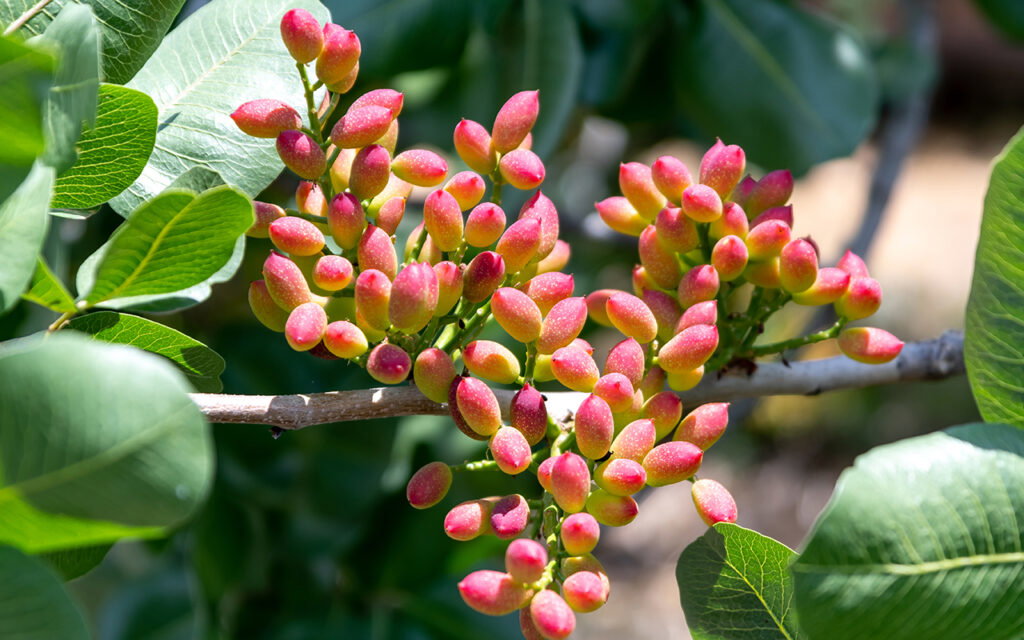
A pistacchio farm in Bronte, Sicily. Credit: Francescadsc / www.shutterstock.com
Tucked into the western slopes of Mount Etna, the village of Bronte is home to fewer than 20,000 people—but it has become world-famous for producing what many consider the finest pistachio on the planet.
This is the Pistacchio Verde di Bronte DOP, a uniquely sweet, emerald-green nut harvested by hand only every two years, in odd-numbered harvest seasons. According to Italy’s national statistics agency ISTAT, Bronte produces around 3,400 tonnes per cycle—a drop in the ocean compared to the over one million tonnes harvested globally. But what Bronte offers is rarity and flavour, not volume.
What makes this pistachio special? Its slow, wild growth directly from volcanic stone, without irrigation. The trees are pruned in even years to store energy, and left to nature the rest of the time. The result: a small but intensely aromatic nut, grown from the ancient Pistacia vera variety grafted onto local wild terebinth bushes.
Rich in monounsaturated fats
“The shell has hints of aubergine, and the inside a vibrant emerald green—never yellow, unlike foreign varieties,” said to El País Enrico Cimbali, head of the consortium that protects the DOP label. Rich in monounsaturated fats, the nut’s sweet taste and long finish make it highly sought after in haute patisserie and savoury dishes alike.
Harvesting, however, is anything but industrial. The rocky terrain makes machines useless, so every nut is gathered by hand in the September heat, often taking a full day to clear a single tree. “It grows out of the stone—people don’t believe us until they see it,” says Melani Minissale of local producer A Ricchigia. “When I tell Greek or Spanish producers we don’t use machines, they think I misunderstood their question.”
Between €55 and €60 per kilo
Bronte’s pistachio sells for between €55 and €60 per kilo, but even that doesn’t fully reflect the labour involved: up to 10,000 workers are employed each harvest year.
The nuts are used in countless ways. Laura Lupo, who runs A Ricchigia’s lab, recommends a simple pesto: 250g of peeled pistachios crushed dry in a mortar with salt and pepper, then drizzled slowly with olive oil to create a chunky, fragrant paste.
In Bronte’s pastry shops, visitors can sample pistachio-filled arancini, tarts, cannoli, biscotti, and gelato made with 100% local nuts—topped, of course, with an extra sprinkle of pistachio.
Stay tuned with Euro Weekly News for the latest news about Europe and Italy.
Follow Euro Weekly News on Google News
Get breaking news from Spain, travel updates, and expat stories directly on your Google News feed.
Follow on Google NewsSign up for personalised news
Subscribe to our Euro Weekly News alerts to get the latest stories into your inbox!
By signing up, you will create a Euro Weekly News account if you don't already have one. Review our Privacy Policy for more information about our privacy practices.



Santiago Carneri
Santiago is a freelance journalist, writer, photographer, and documentary producer with over a decade of experience reporting from Paraguay and Brazil. His work has appeared in The New York Times, The Guardian, Vice News, BBC, Associated Press, France Press, Der Spiegel, Deutsche Welle, El País, and more. Now based in Dénia—his self-described secret paradise—Santi contributes to Euro Weekly News, bringing a global perspective to both local and international stories. Outside of journalism, he enjoys boxing and cultivating his home garden.
Comments