Completely different form of life discovered by researchers in Scotland
By Adam Woodward • Published: 24 Jan 2026 • 10:39 • 2 minutes read
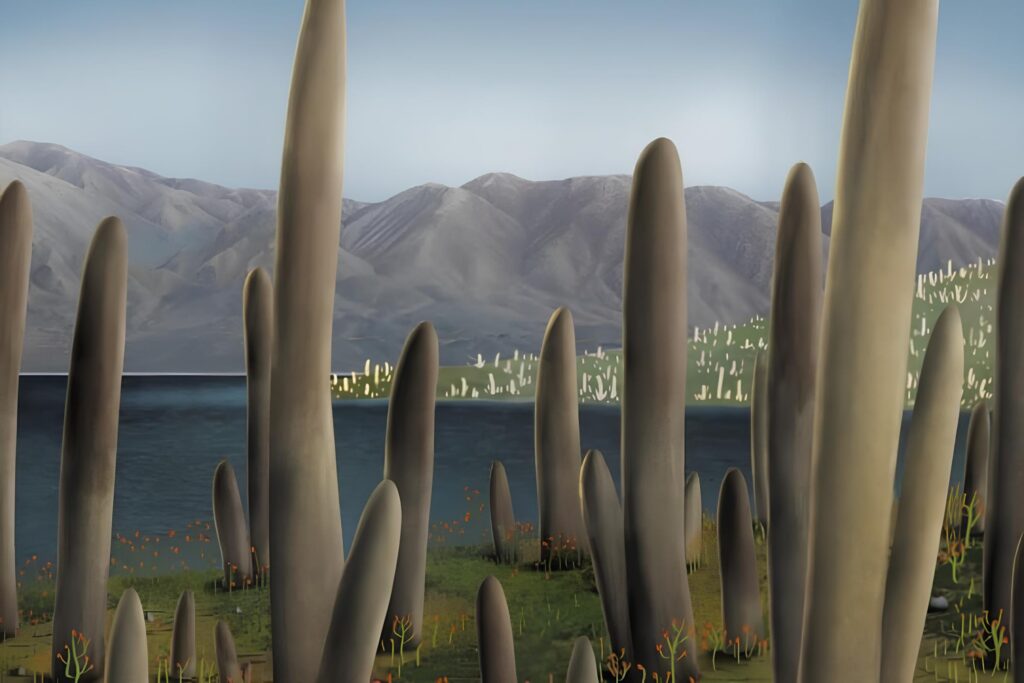
Prototaxites existed 360 million years ago. Credit: Wowscimuseum Instagram
In a breakthrough discovery that rewrites the history of evolution, scientists in Edinburgh have confirmed that Prototaxites, an 8-metre-tall organism that dominated Earth 400 million years ago, was not a fungus, plant, or animal, but a member of a completely extinct and previously unknown category of life.
For over 165 years, this prehistoric giant has baffled the scientific community. Towering over the landscape during the Silurian and Devonian periods, it existed long before trees as we know them. While long dismissed as a massive ancient mushroom, a groundbreaking study published in Science Advances by experts from the National Museums Scotland reveals that this creature was a biological “Plan B” that eventually vanished from the Earth.
A colossus in a miniature world
During the Devonian period, Earth’s terrestrial life was in its infancy. Most plants were small, carpet-like organisms hugging the ground. In this low-slung world, Prototaxites stood as a solitary titan. These organisms formed branchless, trunk-like cylinders up to one metre wide, resembling massive pillars rising from the ancient supercontinent of Gondwana.
Since their discovery in 1843, scientists have struggled to categorise them. They have been variously described as algae, rotting wood, and most recently, giant mushrooms. However, this new research has finally debunked the fungal theory through high-tech forensic analysis.
Neither fungus nor plant: A unique biology
The breakthrough came from analysing exceptionally preserved fossils of Prototaxites taiti from the Rhynie chert in Aberdeenshire, Scotland. This sedimentary deposit is world-renowned for “freezing” Devonian life in exquisite detail.
Using advanced microscopy, researchers discovered that Prototaxites lacks the essential building structure of fungal cells. As well, its internal anatomy, a complex web of interlaced tubes, does not match any known fungal or plant species.
“It belongs to a completely extinct evolutionary branch of life,” explains Sandy Hetherington, co-lead author of the study. Unlike plants that photosynthesise or fungi that decompose matter in a specific way, Prototaxites appears to have used a unique biological structure to reach such massive heights.
An evolutionary “dead end”
The study suggests that these giants possessed internal “medullary spots” to transport water and gases, a sophisticated system that allowed them to grow 180 per cent taller than any other life form of their time. Despite their dominance, they left no living descendants, representing a biological experiment that failed to survive the changing Earth 360 million years ago.
As a discovery, it serves as a humbling reminder of the diversity of life’s history. As we look back at the Devonian period, Prototaxites stands not as a relative of the mushroom, but as a silent monument to a lost branch of evolution.
3I/Atlas is back in focus as the interstellar object nears Earth
Prehistoric puke: 66-million-year-old fossilised vomit discovered
Sign up for personalised news
Subscribe to our Euro Weekly News alerts to get the latest stories into your inbox!
By signing up, you will create a Euro Weekly News account if you don't already have one. Review our Privacy Policy for more information about our privacy practices.





Adam Woodward
Adam is a writer who has lived in Spain for over 25 years. With a background in English teaching and a passion for music, food, and the arts, he brings a rich personal perspective to his work at Euro Weekly News. As a father of three with deep roots in Spanish life, Adam writes engaging stories that explore culture, lifestyle, and the everyday experiences that shape communities across Spain.
Comments