Spain fails to submit budget plan to EU for second year running
By Molly Grace • Published: 01 Mar 2026 • 22:09 • 3 minutes read
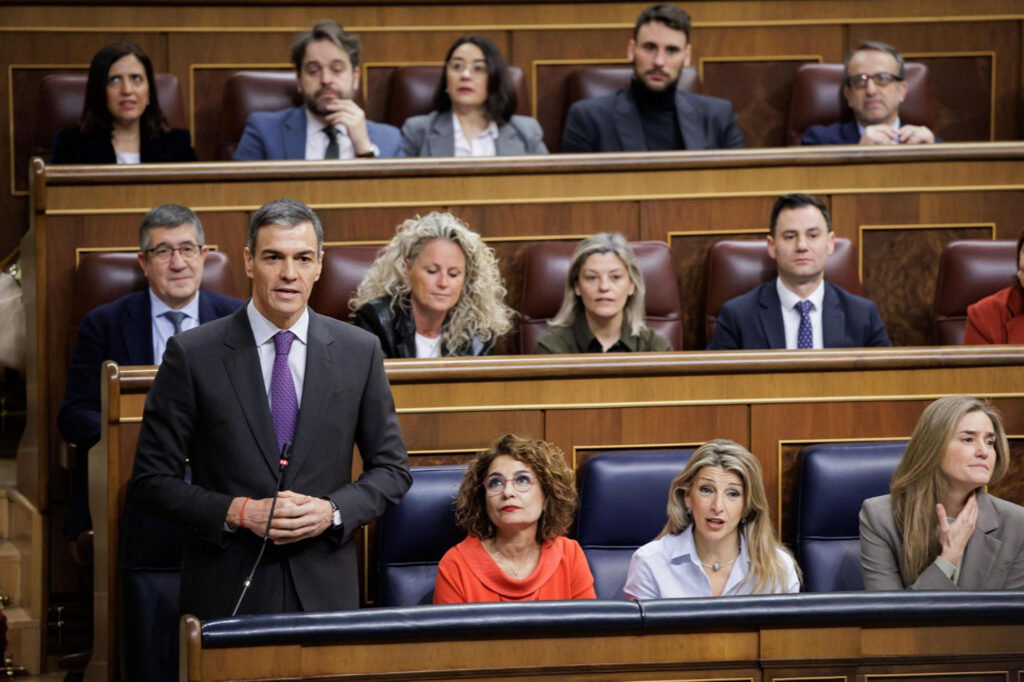
The Spanish government has signaled that it ultimately intends to present a budget to the national parliament. Photo credit: Pool congreso
Spain has emerged as the only country in the eurozone that has failed to submit its national draft budget plan to the European Union for two consecutive years, a lapse that underscores ongoing political deadlock in Madrid and raises concerns among fiscal watchdogs and Brussels officials.
Under European rules, all euro area Member States must submit draft budgetary plans (DBPs) to the European Commission each autumn. These plans outline projected public revenue and expenditure for the coming year, providing the basis for EU fiscal oversight and coordination under the Stability and Growth Pact.
However, Spain did not send its budgetary plan for 2025, and by the government’s own timeline it has likewise missed the customary deadline for the 2026 submission, leaving the country as the sole eurozone Member State without either document formally transmitted to Brussels.
Political Paralysis Behind Missing Plans
The failure to deliver draft budgetary plans stems principally from Spain’s ongoing absence of a new national budget. The Spanish government has operated for years under extensions of the last budget approved in 2023. According to sources within the Spanish Ministry of Finance, the government decided in 2025 to delay sending the draft submission to Brussels until a full national budget exists, a step that has yet to occur due to fractious relations in the Spanish Parliament.
Domestic political instability has made it difficult for Prime Minister Pedro Sánchez’s government to find sufficient support to approve fresh annual budgets for 2024, 2025 and now potentially 2026. In debates in Madrid’s Congreso de los Diputados (Congress of Deputies), top officials have acknowledged the difficulty of passing new public accounts with no stable majority, signalling that the government may continue operating under budget extensions well into 2026.
Because a draft national budget is a precursor to the DBP, the absence of national accounts effectively stopped Spain from fulfilling the EU requirement to send budget plans to Brussels.
EU Framework and Its Importance
Under the EU fiscal governance framework, draft budgetary plans must be submitted by mid-October. These are then reviewed by the European Commission, which assesses compliance with recommended expenditure ceilings and other fiscal benchmarks. Other eurozone countries submitted their plans for 2026 on schedule, enabling Brussels to issue opinions and guide national fiscal policy across the bloc.
For its part, the European Commission’s autumn fiscal package confirmed that most eurozone countries have submitted DBPs and begun compliance assessments for 2026. However, Spain and Belgium were noted as exceptions, with Spain’s missing submission linked directly to a lack of a draft budget in the national parliament.
This omission means Spain’s fiscal stance cannot be assessed in the same manner as its peers, hindering Brussels’ ability to monitor Spanish public finances within the broader eurozone fiscal rules.
Fiscal Watchdog Sounding the Alarm
The Spanish Autoridad Independiente de Responsabilidad Fiscal (AIReF), the country’s independent fiscal institution, has repeatedly highlighted risks associated with the absence of both a national budget and the accompanying EU budgetary plans. In its reports, AIReF notes that the failure to present these plans makes meaningful fiscal supervision “particularly difficult.” It flagged that the government has not submitted the draft general state budget for 2024 or 2025, and has likewise failed to transmit the 2025 budgetary plan to EU institutions.
AIReF’s analysis also underscores that other key ingredients of a functioning fiscal process, such as establishing fiscal targets and setting non-financial expenditure limits, have not occurred in the ordinary timeline, contributing to systemic uncertainty in Spain’s budgetary strategy.
left without regular fiscal documents, AIReF warned that EU fiscal monitoring mechanisms are effectively “blind” to Spain’s budgetary path, reducing transparency and complicating compliance oversight.
Domestic and International Impacts
From a domestic perspective, the repeated budgetary delays have generated criticism across the Spanish political spectrum. Opposition parties argue that an extended reliance on outdated 2023 accounts undermines democratic accountability and hampers fiscal planning for public services, investment and social programs.
Internationally, Spain’s unusual position as the lone eurozone country missing two consecutive DBPs has drawn attention from analysts and policymakers who emphasise the significance of transparent fiscal planning within the monetary union. The Commission’s fiscal package explicitly noted Spain’s absence from the list of compliant draft plans, contrasting it with the bulk of other Member States who have met both procedural and timing expectations.
Looking to the Future
The Spanish government has signalled that it ultimately intends to present a budget to the national parliament and, by extension, to EU authorities. However, with political negotiations ongoing and parliamentary majorities still unsettled, there is no firm date for when Spain might rectify its absence of a national budget and fulfil its European reporting obligations.
Until then, Spain will remain an outlier in the eurozone’s fiscal governance framework, highlighting both domestic political challenges and broader questions about fiscal coordination in Europe.
Follow Euro Weekly News on Google News
Get breaking news from Spain, travel updates, and expat stories directly on your Google News feed.
Follow on Google NewsSign up for personalised news
Subscribe to our Euro Weekly News alerts to get the latest stories into your inbox!
By signing up, you will create a Euro Weekly News account if you don't already have one. Review our Privacy Policy for more information about our privacy practices.




Molly Grace
Molly is a British journalist and author who has lived in Spain for over 25 years. With a background in animal welfare, equestrian science, and veterinary nursing, she brings curiosity, humour, and a sharp investigative eye to her work. At Euro Weekly News, Molly explores the intersections of nature, culture, and community - drawing on her deep local knowledge and passion for stories that reflect life in Spain from the ground up.
Comments
Mark
02 March 2026 • 15:57What a long article, expressing the fact that Spain’s failure to elect a government with a clear majority has meant that it has not heen able to bring together the various factions on which the Socialists depend to agree a budget!
And what exactly does “non-financial expenditure limits” mean? I’ve never heard of any expenditure, budgeted or otherwise that does not involve finance!
Comments are closed.