17 million journeys and a €200 fine: What the Easter road rules mean for drivers in Spain
By Dora Urbancsek • Updated: 26 Mar 2026 • 14:29 • 3 minutes read
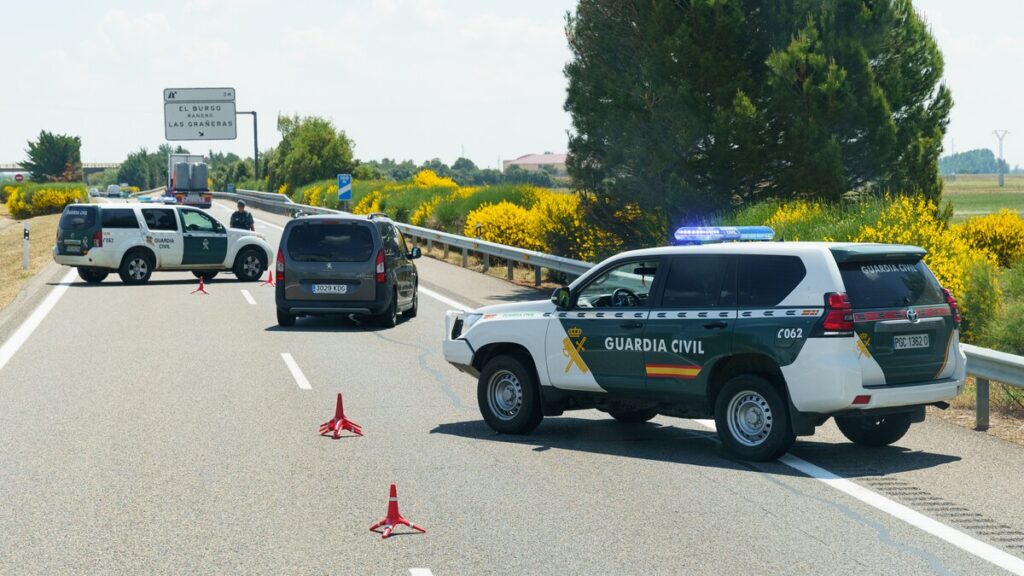
Guardia Civil officers stress the importance of creating an emergency corridor so patrol cars and ambulances can reach accidents quickly during Easter travel Credit: Shutterstock/SkazovD
More than 17 million long-distance journeys are expected across Spain as the DGT Semana Santa operation officially triggers this Friday, March 27, 2026. With congestion predicted to hit record levels on the A-6, A-1, and Mediterranean routes, the Guardia Civil has confirmed a strict crackdown on drivers who fail to form an emergency corridor (pasillo de emergencia) during traffic halts.
For a full overview of Easter traffic in Spain and where delays will hit hardest, see our article on Spain’s DGT road crackdown.
The immediate consequence of failing to clear this central path is a €200 fine, as authorities prioritize the “golden hour” for emergency response during the holiday rush. Travellers are also being reminded of the new 2026 mandate for the geolocated V-16 beacon, which has officially replaced warning triangles and must be used to signal any roadside incident to the DGT 3.0 tracking system.
When Easter traffic turns dangerous
Easter week consistently ranks among the most congested periods on Spanish roads, with long-distance journeys, holiday traffic, and unpredictable weather all increasing the risk of accidents. In this context, even small delays can have serious consequences.
The Guardia Civil is reinforcing awareness around a simple but often misunderstood action: how drivers should react when emergency vehicles approach or when traffic comes to a halt after an accident. According to recent guidance, forming a “pasillo de emergencia” or emergency corridor allows ambulances, police, and fire services to pass quickly through traffic. This is not just good practice, it is a legal obligation under Spain’s traffic regulations.
The gesture that can save lives
When traffic slows or stops on multi-lane roads, drivers must move their vehicles to create a clear path for emergency services.
The rule is straightforward:
- On two-lane roads: vehicles on the left move left, those on the right move right
- On three-lane roads: left lane moves left, middle and right lanes move right
This creates a central corridor where emergency vehicles can pass without obstruction. Authorities stress that many drivers still react incorrectly, stopping randomly or blocking the centre, which can delay life-saving interventions.
Why every minute counts after an accident
Emergency responders often refer to the “golden hour”, the critical period immediately after a serious accident when rapid medical attention significantly improves survival chances. Delays caused by blocked traffic can reduce those chances. Even a few minutes can be decisive in preventing fatalities or long-term injuries. The Guardia Civil emphasises that what may seem like a minor gesture from individual drivers can collectively determine whether emergency teams arrive in time.
How to make safe Semana Santa travel plans?
For motorists planning journeys over Semana Santa, this guidance becomes especially relevant. Increased congestion means:
- Higher likelihood of accidents
- Slower traffic flow
- Greater dependence on efficient emergency response
Drivers are being urged to stay alert, avoid panic reactions when hearing sirens, and follow the correct positioning rules instinctively. Failing to give way to emergency vehicles is considered a serious traffic offence in Spain and can result in penalties, but more importantly, it can put lives at risk.
What drivers often get wrong in these moments
Authorities highlight several frequent errors that worsen emergency situations:
- Sudden braking without awareness of surrounding traffic
- Blocking the central lane instead of clearing it
- Changing lanes unpredictably
- Ignoring sirens until the last moment
These behaviours not only delay emergency services but can also create secondary accidents.
A simple rule that could save lives this holiday
With Easter travel already underway, awareness campaigns are expected to intensify across Spain, particularly on major motorways and high-traffic routes.
The message is simple and direct: safe driving is not only about avoiding accidents, but also about knowing how to respond when they happen. As millions take to the roads this Semana Santa, authorities are reminding drivers that sometimes the smallest action, done correctly and at the right time, can save a life.
Sign up for personalised news
Subscribe to our Euro Weekly News alerts to get the latest stories into your inbox!
By signing up, you will create a Euro Weekly News account if you don't already have one. Review our Privacy Policy for more information about our privacy practices.




Dora Urbancsek
Dora Urbancsek is an SEO writer with over eight years of experience producing high-quality, search-optimised journalism and digital content. Based in Spain for more than five years, she covers a wide range of topics concerning Spain and Europe, including current affairs, community stories, culture, and lifestyle. Dora is known for accurate, well-researched reporting that keeps readers informed and engaged.
Comments
Philip
27 March 2026 • 12:47Personally, I feel greater safety and convenience for emergency services would be made by everyone moving left. This leaves the hard shoulder area and exits available and far less dangerous than speeding between two lines of traffic.
Rather easier for people to remember; oh, do I move left or right?
Obviously planned with as much forethought by the same group who banned triangles and introduced flashing lights.
I presume offenders will be dealt with on the spot by a speeding guardia in preference to continuing to the emergency. That would be better for revenue collection which often seems the primary object of so many of these stunning safety diktats.
Comments are closed.