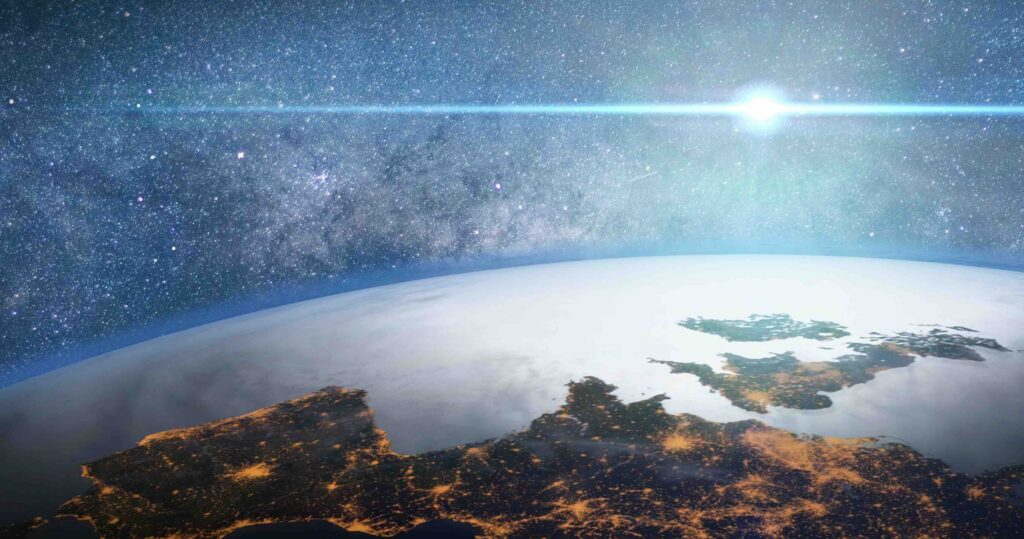
The idea that Spain could be one of the last places on Earth where life might persist in 250 million years sounds dramatic. But scientists are not saying Spain would be safe or comfortable. They are describing it as less extreme than other parts of the planet.
A study from the University of Bristol, published in Nature Geoscience, suggests that when a future supercontinent forms, most land could become too hot and dry for mammals. Some parts of southern Europe, including Spain, appear in regions where conditions might still fall within the limits that some mammals can tolerate.
That does not mean those areas would be hospitable. It only means they may avoid the worst conditions expected elsewhere.
What “survivable” means here
In this research, “survivable” is a relative term.
Scientists are identifying places where temperature and humidity might stay just low enough for some forms of mammalian life to exist. Even in these regions, conditions would likely be harsh, with high heat and limited water.
Large parts of the future supercontinent could become far more extreme, with combinations of heat and humidity that make survival very difficult for complex life.
How a supercontinent forms
Earth’s continents move slowly over time because of tectonic activity. Over millions of years, oceans can open and close, and continents drift before coming together again.
Scientists think that in about 250 million years, this process could produce a new supercontinent often called Pangea Ultima. In that scenario, the Atlantic Ocean would close and today’s continents would merge into one large landmass.
The main impact would not just be geography, but how that arrangement affects climate.
Why Spain shows up in a less extreme region
Two main factors explain this.
First is latitude. As continents move, Spain is expected to sit further north than it does today. Regions closer to the poles are generally cooler than those near the equator, especially under very warm global conditions.
Second is proximity to the ocean. Coastal areas tend to have less extreme temperatures than inland regions, where heat can build more easily.
Because of this, the Iberian Peninsula appears in a part of the model where conditions are less severe than in large interior regions.
Why much of the planet becomes hostile
The study points to several long term processes working together.
Volcanic activity associated with continental movement would release large amounts of carbon dioxide. At the same time, the Sun is expected to become gradually brighter over geological timescales. A single large landmass would also change how heat is distributed.
Together, these factors would push global temperatures higher. Inland areas could regularly exceed 40°C, with some regions going beyond 50°C. Rainfall would be limited across large areas.
Why this does not mean Spain is “safe”
These projections are based on models looking hundreds of millions of years ahead.
There are different possible outcomes for how continents might come together, including alternatives such as Aurica or Amasia. Each would produce different climate patterns.
That means Spain appearing in a less extreme region is one possible scenario, not a certainty.
What this means in practice
The value of this research is not in predicting where life will survive in the distant future. It is in understanding how changes in geography, atmospheric conditions and solar energy affect climate.
The same principles are used to study climate today, just over much shorter timescales.
The idea of Spain as a future refuge is a simplified way of describing a much more complex point. In this model, it is simply one of the places where conditions may be less severe than elsewhere, not a place that would remain stable or comfortable.


Tara Russell
Tara is a writer and editorial team member at Euro Weekly News, specialising in news reporting and feature writing. Born and raised in Spain, she holds a B.A. in Applied Languages and Translation Studies. With a strong background in linguistics, communication, and cross-cultural storytelling, Tara previously worked as a language teacher before transitioning to journalism and media.
Comments