Be ahead of the rush: Spanish government about to offer big grants for renovating homes
By Adam Woodward • Published: 16 Apr 2026 • 19:09 • 3 minutes read
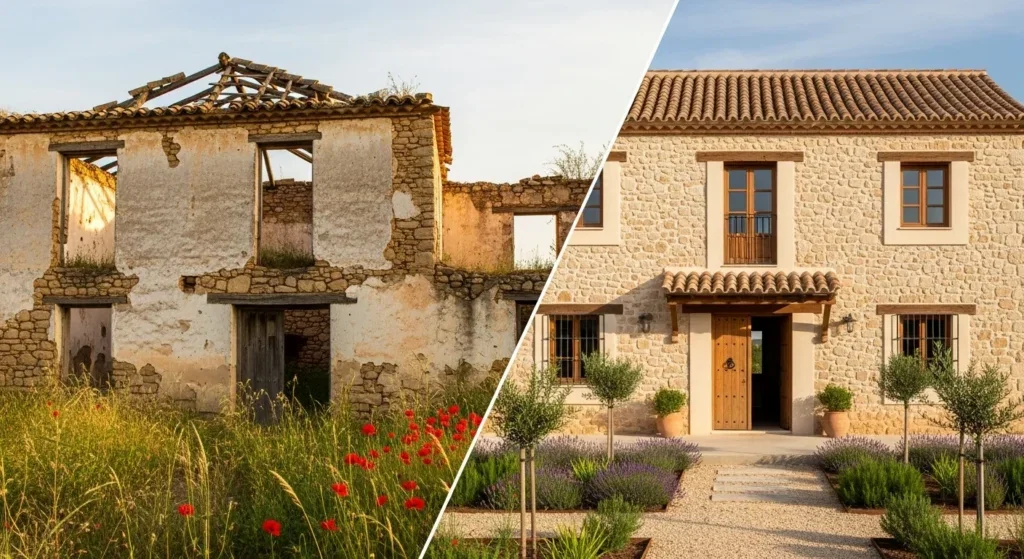
Before and after a little love. Credit: afincamundorural.com
Often our Spanish hosts in Spain are surprised at expats’ penchant for house renovations, whether it is for us to dwell in as a beautiful piece of genuine Spain, or to turn a tidy profit on a house flip and sell it on at a higher price than we paid. Rural Spain is full of cut-price homes, just ripe for the buying, and all they really need is a little love. There are others that a pro-builder would advise not touching with a barge pole, but all this balances on our finances and get-up-and-go.
However, the weighing up of whether it is financially worth it is about to change as the Spanish government is going to introduce new grants (available to foreigners too) that could cut the cost of rehabilitating a property and add a lot to its resale value.
Spain’s new state housing plan is due to deliver major renovation incentives for owners of second-hand properties. Housing Minister Isabel Rodríguez has announced that the Council of Ministers will approve the Plan Estatal de Vivienda 2026-2030 on Tuesday, April 21. This framework triples funding from earlier versions and directs resources into rehabilitation of existing stock across the country.
Renovation grants reach up to €50,000 per dwelling
Purchasers of homes in need of a little love will be able to access a whole stack of subsidies for energy efficiency, structural repairs and accessibility improvements. Energy works qualify for payments reaching €20,500, based on consumption reductions achieved, dwelling size and total project expenses. Structural interventions attract up to €8,000, which would go a long way to repairing that dodgy roof, while accessibility features (ramps, non-slip showers, and the like) draw a maximum of €13,000. Historic buildings or protected sites add another €30,000 in support.
Buyers who combine these categories recover massive portions of renovation costs on older apartments or village houses. Many expats often go after properties from earlier decades that need insulation upgrades, rewiring, window replacements or modern heating systems. Completed works lower ongoing energy bills and improve resale potential massively in competitive markets.
Rural properties gain extra advantages under the scheme.
Smaller towns feature prominently in the approved measures. Young purchasers aged 35 or under buying or constructing a first home in villages with below 10,000 residents, or in zones up to 20,000 facing population decline, will receive aid of up to €15,000. Vacant homes renovated and then let as affordable housing for at least five years qualify for a massive €35,000.
Owners who transfer management to regional authorities for seven years obtain compensation together with initial renovation funding of €12,000 and a further €18,000 when the property returns. These options suit investors who acquire rundown assets, complete improvements and either sell at a profit or arrange rental income.
Flipping older homes requires attention to rental conditions
Property investors say that certain incentives tie support leaning towards long-term affordable letting rather than immediate resale. Lines aimed at public housing promotion offer €85,000 for protected units in small towns and villages, with permanent safeguards against selling at a quick profit.
Budget allocation directs 30 per cent of resources to rehabilitation within a potential total of €7 billion. The government plans to fund 60 per cent while autonomous regions will cover the remaining 40 per cent.
Buyers should prepare for regional application processes.
Those already with an old home in need of doing up, or those eyeing old properties to buy, should watch out for publication of full details once ministers give the final approval. Submissions will route through autonomous community housing offices where criteria and deadlines differ slightly by location. Legal residents holding valid TIE cards qualify for rehabilitation assistance without any nationality barriers.
Advice from local professionals experienced in grant procedures will help clarify project eligibility before any purchase contract. Energy upgrades will often combine with separate national or regional schemes already in operation.
This plan arrives at a time when many expats or potential expats are looking more inland at more rural locations where older properties present lower purchase prices but call for targeted investment in modernisation.
Follow Euro Weekly News on Google News
Get breaking news from Spain, travel updates, and expat stories directly on your Google News feed.
Follow on Google NewsSign up for personalised news
Subscribe to our Euro Weekly News alerts to get the latest stories into your inbox!
By signing up, you will create a Euro Weekly News account if you don't already have one. Review our Privacy Policy for more information about our privacy practices.




Adam Woodward
Adam is a writer who has lived in Spain for over 25 years. With a background in English teaching and a passion for music, food, and the arts, he brings a rich personal perspective to his work at Euro Weekly News. As a father of three with deep roots in Spanish life, Adam writes engaging stories that explore culture, lifestyle, and the everyday experiences that shape communities across Spain.
Comments
Farrar
17 April 2026 • 20:38What about the 60 day rule. Health unsure. We sold our beautiful old house beautiful of these ridiculously rule. Loosing money after 20years renovation paid for by ourselves. Lots of others in this position after supporting local workers and businesses. Wanting to spend uk winters there in our retirement. So so sad !
LAU
18 April 2026 • 10:06I would have to read all the conditions and the small writing. It sounds too good to be true.
Michael long
18 April 2026 • 11:43You’ll never see the money
Mark
20 April 2026 • 20:13Would love to see a proper photo instead of this AI BS :-/
Comments are closed.