Where Orcas and fishermen meet: The levantá on Spain’s Costa de la Luz
By Molly Grace • Published: 01 May 2026 • 22:16 • 4 minutes read
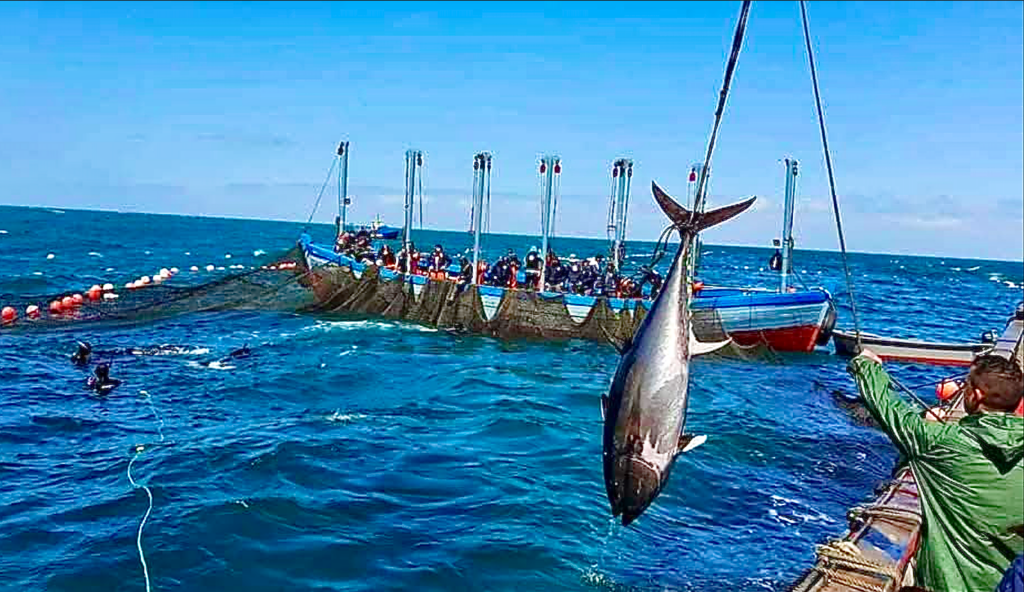
The tradition is believed to be around 3,000 years old. Photo credit: Ayuntamiento de Conil
Along the Costa de la Luz in southern Spain, costal villages are beginning to celebrate the first “Levantás” of the year, the moment when the almadraba nets are raised from the sea and Atlantic bluefin tuna are brought to the surface in one of the oldest fishing traditions still practised today. The almadraba is a fixed system of offshore nets designed to intercept tuna during their seasonal migration, and the Levantá is the final stage of this process when the catch is lifted from the water.
The tradition is believed to be around 3,000 years old, with origins traced back to the Phoenicians and later refinement under Roman and Andalucían coastal societies. It remains active in a small number of locations along the Cádiz coastline, where the migration of tuna through the Strait of Gibraltar continues to make the system viable each spring. Beyond its economic role, it has also become part of the cultural identity of the coastal communities, where the fishing calendar still shapes daily life and seasonal activity.
The almadraba system and the Levantá
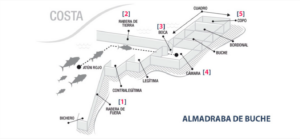
The almadraba operates using a fixed network of anchored nets arranged like an underwater maze. As Atlantic bluefin tuna follow their natural migration route, they are gradually guided through a sequence of chambers, each section narrowing their path until they reach a final enclosure known as the copo. This structure allows fishermen to control the movement of the fish without chasing or stressing them across open water.
Within this system, specialist divers known as ranas, literally “frogs” in Spanish, a local term used for the underwater fishermen, play a crucial role. These divers enter the net chambers alongside the tuna to monitor what has been caught before the Levantá begins. If other marine species are trapped unintentionally, the ranas open sections of the net to release them back into the sea. They also assess the tuna themselves, ensuring that only fish of the appropriate size are retained. Pregnant females and undersized individuals are released, helping maintain the long-term sustainability of the stock.
Once the final enclosure is confirmed, the Levantá begins, the coordinated lifting of the net structure that brings the selected catch to the surface. Boats surround the enclosure while crews raise the system in stages, controlling tension and movement to keep the structure stable. The process requires precise coordination, as the weight of the nets increases significantly during lifting, and timing depends on sea conditions as well as the behaviour of the fish.
The Levantá is the most intensive moment of the fishing season. Modern regulations govern quotas and sustainability, but the method itself remains unchanged, preserving a continuity that is rare in contemporary European fisheries.
A 3,000-year tradition along the Cádiz coast
The almadraba originates with the Phoenicians, who developed early systems for exploiting tuna migration routes using fixed nets more than 3,000 years ago. The Romans later refined the technique, and it was preserved through Andalucían coastal societies in the Gulf of Cádiz, where knowledge of tides, currents and fish behaviour was passed down through generations of fishermen.
Its continuity is unusual. Tuna are not pursued but intercepted as they follow predictable routes between the Atlantic Ocean and the Mediterranean Sea. This reliance on migration makes the system entirely dependent on seasonal timing rather than industrial scheduling, and explains why the fishing season is so limited each year.
The Strait of Gibraltar is central to this process. Each spring, Atlantic bluefin tuna enter the Mediterranean through this corridor to reproduce, forming the first phase of the almadraba season. Later in the year, after spawning, the tuna leave the Mediterranean and return to the Atlantic, creating a second opportunity for capture as they pass back through the same route. The almadraba is positioned to take advantage of both movements, reflecting a deep understanding of the species’ lifecycle.
Orcas and the Strait of Gibraltar ecosystem
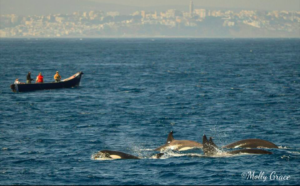
The Strait is also home to a resident population of orcas (Orcinus orca) that share the same tuna migration routes. These predators follow seasonal movements closely linked to large fish schools, creating overlap between natural hunting patterns and fishing activity.
Fishermen have long worked alongside these orca who push tuna into shallower waters as part of their hunting behaviour, sometimes bringing them closer to almadraba installations. In other cases, once tuna are concentrated near or within the nets during the Levantá, orcas may attempt to intercept fish during capture. These encounters are seen every year and are well known among local crews, who recognise them as part of the broader marine environment rather than a controlled interaction.
These dynamics reflect a shared ecosystem where predator, prey and traditional fishing coexist within the same maritime corridor, rather than coordinated behaviour with human activity.
A living maritime heritage on the Costa de la Luz
Today, the almadraba remains a defining feature of coastal life in the region. It provides seasonal employment and supports a specialised fishing industry, while also attracting visitors along the Costa de la Luz who come to witness a method that has survived with minimal change since antiquity. In many towns, the arrival of the tuna season is still treated as a significant moment in the local calendar. The Levantá is the most visible moment of this tradition, where ancient technique, natural migration and coordinated labour converge at sea.
It represents continuity between Phoenician maritime practices and modern regulated fishing, still governed by the same seasonal rhythms. In a global fishing industry dominated by industrial fleets, the almadraba remains distinct. Its survival reflects both cultural persistence and ecological dependence, maintaining a direct link between contemporary coastal life and one of the oldest known fishing systems in the world.
Sign up for personalised news
Subscribe to our Euro Weekly News alerts to get the latest stories into your inbox!
By signing up, you will create a Euro Weekly News account if you don't already have one. Review our Privacy Policy for more information about our privacy practices.





Molly Grace
Molly is a British journalist and author who has lived in Spain for over 25 years. With a background in animal welfare, equestrian science, and veterinary nursing, she brings curiosity, humour, and a sharp investigative eye to her work. At Euro Weekly News, Molly explores the intersections of nature, culture, and community - drawing on her deep local knowledge and passion for stories that reflect life in Spain from the ground up.
Comments