Yuri Milner and Jensen Huang just named a physics prize after Vera Rubin — Here’s why that matters
By Guest Writer • Published: 03 May 2026 • 19:09 • 4 minutes read
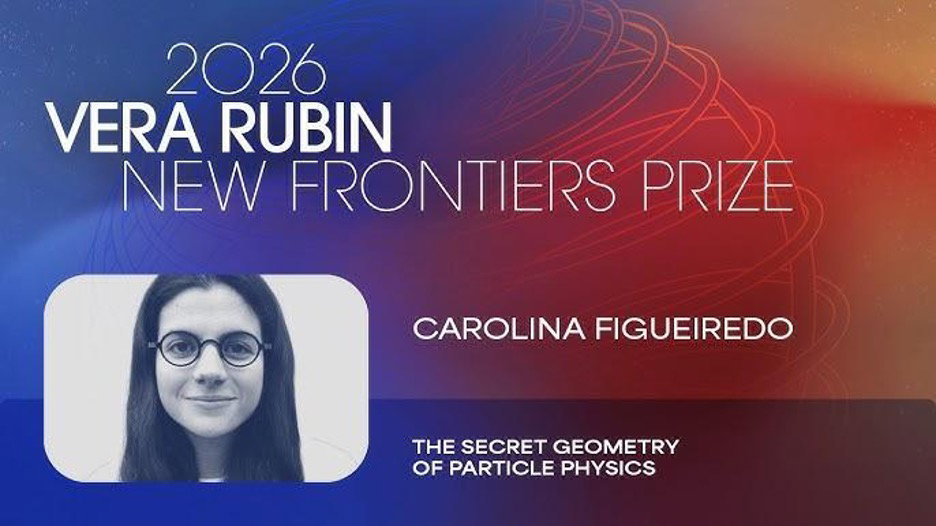
Image: Vera Ruben New Frontiers
Two of the most recognisable names in technology stood onstage together at the twelfth Breakthrough Prize ceremony in Santa Monica last weekend to announce a new prize in physics. One of them had recently named his company’s most powerful AI chip platform after an astronomer who died in 2016. The other co-founded the prize now carrying her name forward.
Jensen Huang, the founder and CEO of NVIDIA, and Yuri Milner announced the inaugural Vera Rubin New Frontiers Prize, awarded to women physicists within two years of completing their PhDs who have already made significant contributions to science. The first recipient was Carolina Figueiredo, a physicist at Princeton University. The prize carries $50,000 this year and expands to three annual awards from 2027.
Who was Vera Rubin
Most people in the room probably recognised the name Vera Rubin through NVIDIA’s branding. The Rubin GPU architecture powers the company’s latest generation of AI infrastructure hardware. But the astronomer herself is worth understanding on her own terms, because what happened to her career is precisely what this prize exists to address.
Rubin spent decades at the Carnegie Institution studying the rotation curves of spiral galaxies — specifically, how fast stars at different distances from a galaxy’s center travel in their orbits. What she found consistently violated expectations. Stars at the outer edges of galaxies travel at nearly the same velocity as those near the center, which shouldn’t be physically possible given the visible mass. Newtonian gravity predicts they should be moving slower, or flying off entirely. They don’t.
The only explanation that works is that galaxies contain far more mass than is visible — mass that doesn’t emit or interact with light and therefore can’t be detected directly. This is what physicists call dark matter. The European Space Agency estimates it makes up roughly 27% of the universe’s total mass-energy content. Rubin’s meticulous observations, compiled over years with her collaborator Kent Ford, provided some of the most systematic and convincing evidence that dark matter exists.
She was nominated for the Nobel Prize in Physics multiple times. She never received it. She died in December 2016. The Nobel committee does not award prizes posthumously.
A prize built for the overlooked
NVIDIA named its chip platform after Rubin because her contributions to understanding the universe are foundational. Now her name is also on a prize designed to do something her own career couldn’t fully benefit from: find women physicists before institutional structures have had the chance to overlook them.
Figueiredo’s winning work involves scattering amplitudes, the mathematical objects that describe what happens when fundamental particles collide. She discovered that three quantum field theories — two describing nuclear particles called gluons and pions, and a third describing particles in a theoretical model with no physical analog in the real world — all forbid exactly the same set of particle collisions. The three theories have no obvious relationship and were not developed with any connection to each other. That they share this hidden constraint was a genuine surprise to the physicists who encountered the result.
Figueiredo, accepting the inaugural prize, described physics as now capable of “meaningfully addressing the deepest of questions, such as the very origins of space and time.” That kind of statement, at the very beginning of a career, is exactly what the prize is designed to amplify.
The field of scattering amplitudes has grown considerably over the past two decades. Physicists have found that the mathematical structure of particle interactions is far more elegant than the original Feynman diagram framework suggested — that there are hidden symmetries and organising principles that only become visible when you look at the geometry of the calculations rather than the mechanics. Figueiredo’s discovery belongs to this tradition. Finding that three disconnected theories share a forbidden set of outcomes is the kind of result that forces physicists to ask why — and the answer to that question may reveal something about the deep structure of quantum field theory that nobody currently understands.
The pipeline logic
Recognising a physicist within two years of their PhD is a specific argument about timing. Acknowledgment at the start of a career — when researchers are making foundational choices about questions to pursue, institutions to join, and whether the field wants them — changes trajectories in ways that recognition twenty years later cannot. The Maryam Mirzakhani New Frontiers Prize applies the same principle to early-career women mathematicians. The Vera Rubin prize extends it to physics.
Milner’s broader approach to scientific recognition follows similar thinking. The Breakthrough Initiatives fund research into questions like the search for extraterrestrial intelligence, where the expected return timeline is measured in decades at minimum. The Eureka Manifesto, Milner’s book on humanity’s scientific mission, frames all of this as a civilizational obligation rather than an optional investment.
What the pairing says
Huang’s NVIDIA has a more direct relationship with physics research than most technology companies. GPU infrastructure powers modern particle physics simulations, cosmological modeling, quantum field theory calculations, and the large-scale data analysis that precision experiments require. That Huang was standing next to Milner to announce a prize named after an astronomer whose discoveries the physics community is still working to fully account for is not exactly coincidental. It’s what happens when the people building the tools of scientific computation also start publicly acknowledging the scientists who make those tools worth building.
The inaugural Vera Rubin New Frontiers Prize went to a physicist who found unexpected connections between theories that had no business being connected. That’s a fitting start for a prize named after someone who kept finding things that weren’t supposed to be there.
Sign up for personalised news
Subscribe to our Euro Weekly News alerts to get the latest stories into your inbox!
By signing up, you will create a Euro Weekly News account if you don't already have one. Review our Privacy Policy for more information about our privacy practices.





Guest Writer
Comments