Scientists have made a surprising new discovery about 3I/ATLAS and it could change the story completely
By Farah Mokrani • Published: 19 Jun 2026 • 0:48 • 3 minutes read
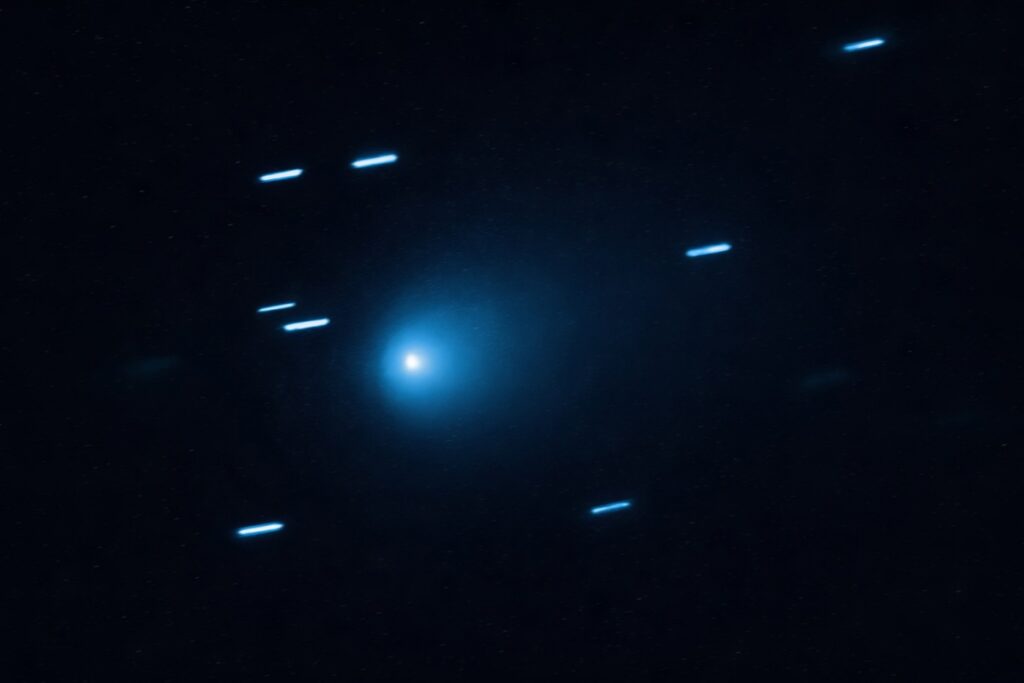
Scientists believe interstellar comet 3I/ATLAS could be older than the Sun itself. Credit : Adobe Stock
Astronomers thought 3I/ATLAS was already one of the most interesting objects ever seen passing through our solar system. Now researchers believe it may be something even more extraordinary. A new analysis suggests the interstellar comet could be around seven billion years old, making it potentially far older than the Sun itself.
When 3I/ATLAS first grabbed headlines, the excitement was easy to understand. An object from outside the solar system doesn’t come along every day.
In fact, confirmed interstellar visitors remain incredibly rare. That’s why telescopes around the world quickly turned their attention towards the comet after it was detected last year.
But what is attracting attention now isn’t where the object came from. It’s how old it might be.
According to researchers at the University of Oxford, 3I/ATLAS may have formed roughly seven billion years ago. If that estimate turns out to be correct, the comet would be around 2.4 billion years older than the Sun.
That number has made astronomers sit up and pay attention. Not because it breaks any laws of physics. Plenty of stars in our galaxy are older than the Sun.
The reason scientists find it so fascinating is that they may have briefly had the opportunity to study material that formed around one of those ancient stars.
For a few months, that object was passing through our cosmic neighbourhood. Now it is already heading away again.
Why researchers think it could be so old
The age estimate comes from work carried out by researchers at Oxford, who analysed the comet’s trajectory through the galaxy. Rather than focusing on the comet itself, they looked at where it appears to have originated.
Their calculations point towards a region of the Milky Way known as the thick disc.
Most people have never heard of it, yet it contains some of the galaxy’s older stellar populations.
Our Sun belongs to what astronomers call the thin disc, a flatter region where younger stars are more common.
The thick disc is different. Its stars tend to be much older and follow different paths around the centre of the galaxy.
By tracing the likely origin of 3I/ATLAS, researchers concluded that the comet probably formed around one of those ancient stars. That doesn’t mean the seven billion year estimate is settled science.
Astronomers will continue studying the data and debating the details.
What it does mean is that 3I/ATLAS may represent something researchers have never had access to before. A sample of material from a much earlier period in the Milky Way’s history.
A frozen record of a different era of the galaxy
Comets are often described as time capsules. Unlike planets, which change dramatically over billions of years, comets can preserve ancient material in remarkably good condition.
That is one reason scientists become so excited whenever a new comet appears. The excitement grows considerably when that comet comes from another star system.
Early observations suggest that 3I/ATLAS contains significant amounts of water ice and volatile compounds. Researchers are particularly interested in whether its chemical composition differs from that of objects formed in our own solar system.
If it did form around an older star, there is a good chance its ingredients developed under very different conditions. That could provide valuable clues about what planetary systems looked like billions of years before the Sun and Earth existed.
For astronomers, the object is interesting not because of its size or appearance, but because of the information it may be carrying. Every measurement collected during its brief visit could help answer questions about how the Milky Way evolved over time.
The discovery may be a glimpse of what is coming next
There is another reason why the scientific community is paying close attention : 3I/ATLAS may be only the beginning.
For years, astronomers suspected that interstellar objects were passing through the solar system far more often than anyone realised.
The problem wasn’t their existence. The problem was finding them.
That situation is changing quickly. New observatories are becoming capable of scanning larger areas of the sky with greater sensitivity than ever before.
Many researchers expect discoveries of interstellar visitors to become increasingly common during the coming years.
Instead of analysing one object every few years, astronomers may eventually be able to compare multiple visitors from different parts of the galaxy.
That would transform a scientific curiosity into an entirely new field of research.
As for 3I/ATLAS, its visit is already over. The comet has passed through the inner solar system and is continuing its journey through interstellar space and it won’t be coming back.
Yet long after it disappears from view, scientists will still be studying the data it left behind, because if the latest estimates are correct, this wasn’t simply another visitor from beyond the solar system.
It may have been one of the oldest objects humanity has ever observed up close, a traveller that had already existed for billions of years before our own star was born.
Follow Euro Weekly News on Google News
Get breaking news from Spain, travel updates, and expat stories directly on your Google News feed.
Follow on Google NewsSign up for personalised news
Subscribe to our Euro Weekly News alerts to get the latest stories into your inbox!
By signing up, you will create a Euro Weekly News account if you don't already have one. Review our Privacy Policy for more information about our privacy practices.





Farah Mokrani
Farah is a journalist and content writer with over a decade of experience in both digital and print media. Originally from Tunisia and now based in Spain, she has covered current affairs, investigative reports, and long-form features for a range of international publications. At Euro Weekly News, Farah brings a global perspective to her reporting, contributing news and analysis informed by her editorial background and passion for clear, accurate storytelling.
Comments