Spanish passport holders can still do this in Europe in 2026 – Britons lost it after Brexit
By Farah Mokrani • Published: 24 Jun 2026 • 14:42 • 5 minutes read
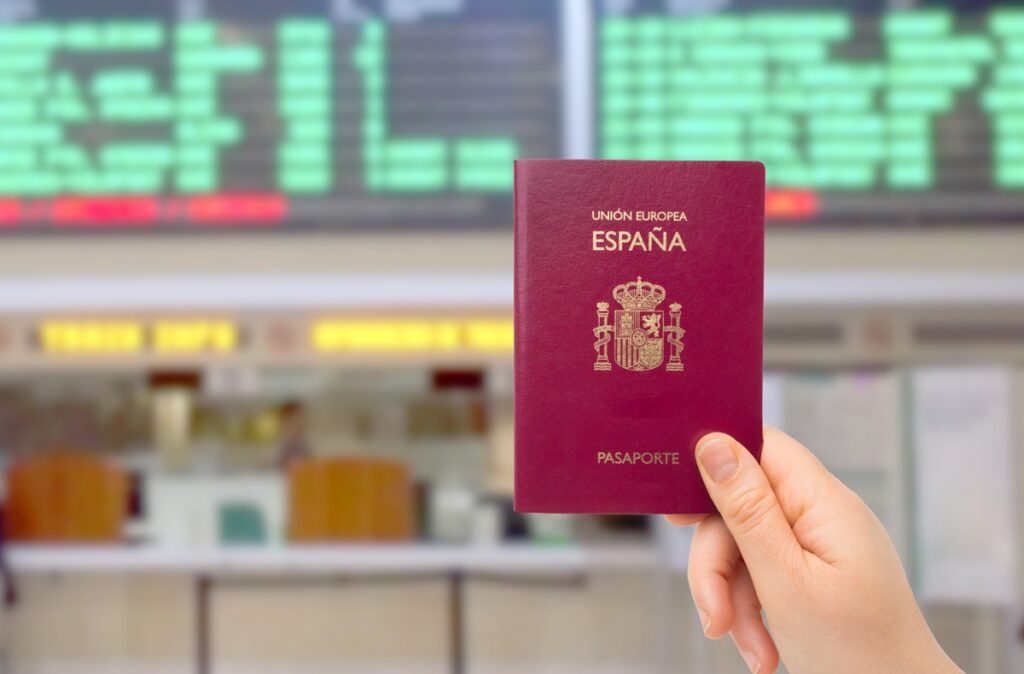
A Spanish passport pictured at an airport as 2026 rankings highlight Spain’s travel edge over the UK after Brexit. Credit : cunaplus, Shutterstock
If you only look at the raw passport rankings, the gap between Spain and the UK in 2026 does not look dramatic. In the latest Henley Passport Index, Spain sits among the world’s strongest passports with access to 185 destinations without a visa in advance, while the United Kingdom follows closely behind on 183. On paper, that is a difference of just two destinations.
But that tiny gap hides a much bigger story. Because for Spanish passport holders, the real advantage in 2026 is not simply about ticking off a couple more countries on a map. It is about what comes with being an EU citizen. And that is exactly where Brexit changed the picture for Britons.
The result is that a Spanish passport today offers something a British one no longer can: not just easy holidays abroad, but the right to move, live, work and settle freely across much of Europe without visas, permits or immigration formalities. For Britons, that freedom disappeared with Brexit.
Spain still travels near the top of the world’s passport rankings
The latest 2026 passport tables once again place Europe among the global mobility heavyweights. Henley’s April update keeps Singapore in first place, while Spain remains in the top tier alongside a cluster of European countries including France, Germany, Italy and Switzerland.
The UK is still very strong by global standards. British passport holders can travel visa-free, or without getting a visa before departure, to 184 destinations according to Henley. That is hardly a weak travel document. In fact, millions of passport holders around the world would gladly swap for that level of access.
But rankings only tell part of the story. A passport index measures short-term travel freedom. It tells you where you can go for a trip without applying for a visa in advance. What it does not fully capture is the difference between being allowed to visit somewhere and being free to build a life there and that is where Spain pulls away.
What Spanish passport holders can do that Britons can no longer do
A Spanish passport does not just open borders for tourism. It also comes with EU citizenship rights, and that changes everything.
A Spaniard can move to France, Germany, Italy, the Netherlands or Ireland and, broadly speaking, live there without applying for a work visa first. They can take a job, register as a resident, study, retire, open a business or relocate with far less bureaucracy than a non-EU national. They also keep access to freedom of movement across the EU and the wider European Economic Area, subject to local registration rules once they stay long term.
A British passport holder no longer has that automatic right.
That is the real post-Brexit divide. Before the UK left the EU, Britons had the same broad freedom of movement rights as Spaniards do now. A British citizen could move to Spain, find work, settle in France or retire to Portugal under the same European framework. That framework is gone.
In 2026, a Briton can still go to Spain for a holiday without a visa. But wanting to stay, work, study for an extended period or move permanently is a completely different matter. It now means dealing with the immigration rules of the destination country rather than relying on EU free movement.
For British holidaymakers, Brexit did not shut the door to Europe. For British citizens who wanted Europe as a place to live or work, it absolutely changed the lock.
Brexit did not destroy the British passport – it changed what ‘travel freedom’ really means
One of the easiest mistakes to make with passport rankings is assuming that a passport’s ‘power’ is just about how many flags you can collect without a visa sticker. That makes for a neat league table, but it misses how people actually use mobility.
For many British readers, the biggest post-Brexit change has not been a sudden inability to travel. It has been the slow pile-up of extra friction.
British travellers are no longer treated like EU citizens at European borders. They can face separate queues, passport stamping and tighter checks on how long they have stayed in the Schengen area. The familiar 90 days in any 180-day period rule now matters in a way it never used to. For second-home owners, remote workers, long-stay visitors and people who split their year between countries, that change has been particularly significant.
There are also practical irritations that have become part of post-Brexit travel: stricter passport validity rules for entry into some European countries, the end of the old assumption that moving around the EU would be largely frictionless, and a growing list of admin-heavy situations that did not exist when the UK was still inside the bloc.
Spanish passport holders simply do not deal with Europe in the same way. They are not third-country travellers when they move around the EU. Britons are.
And that distinction matters more than whether one passport ranks fourth and the other sixth.
The British passport is still strong – just not in the same way
None of this means the British passport has become weak. It hasn’t.
The UK still sits comfortably in the global top tier. British passport holders continue to enjoy excellent access worldwide, and in many day-to-day travel situations the difference between Spain and the UK is barely noticeable. A holiday in Thailand, a city break in New York or a trip to much of Latin America is not suddenly impossible because of Brexit.
But the old version of British mobility was bigger than tourism. It included the right to treat Europe not as a foreign destination, but as an extension of home territory for work, life and family plans. That is what has changed.
Spain, by contrast, still offers both layers of mobility at once. There is the passport strength itself, which remains among the world’s best, and then there is the added value of EU citizenship. That combination is what makes the Spanish passport especially powerful in 2026.
It is why two countries can sit near each other in the rankings while offering very different real-world freedoms.
So who really has the better deal in 2026?
If the question is purely about short trips, the answer is that both Spanish and British passport holders remain in a very privileged club. The gap is narrow and both passports open a large part of the world.
But if the question is broader – who has more freedom to use Europe as a place to live, work, settle and move around with minimal red tape – then Spain wins by a distance.
That is the quiet truth behind the 2026 passport rankings. Brexit did not make the British passport collapse. It made it narrower.
Spanish passport holders still enjoy what Britons once had: a powerful passport backed by the right to move freely across the European project. British travellers can still board the plane. What they lost was the ability to land in much of Europe and treat it as a place they could simply get on with living in.
And in 2026, that matters far more than two extra visa-free destinations.
Follow Euro Weekly News on Google News
Get breaking news from Spain, travel updates, and expat stories directly on your Google News feed.
Follow on Google NewsSign up for personalised news
Subscribe to our Euro Weekly News alerts to get the latest stories into your inbox!
By signing up, you will create a Euro Weekly News account if you don't already have one. Review our Privacy Policy for more information about our privacy practices.



Farah Mokrani
Farah is a journalist and content writer with over a decade of experience in both digital and print media. Originally from Tunisia and now based in Spain, she has covered current affairs, investigative reports, and long-form features for a range of international publications. At Euro Weekly News, Farah brings a global perspective to her reporting, contributing news and analysis informed by her editorial background and passion for clear, accurate storytelling.
Comments