Local author had always dismissed Benidorm – until its hidden history inspired him to write a book
By Lottie Verrier • Updated: 28 Jul 2026 • 12:53 • 3 minutes read
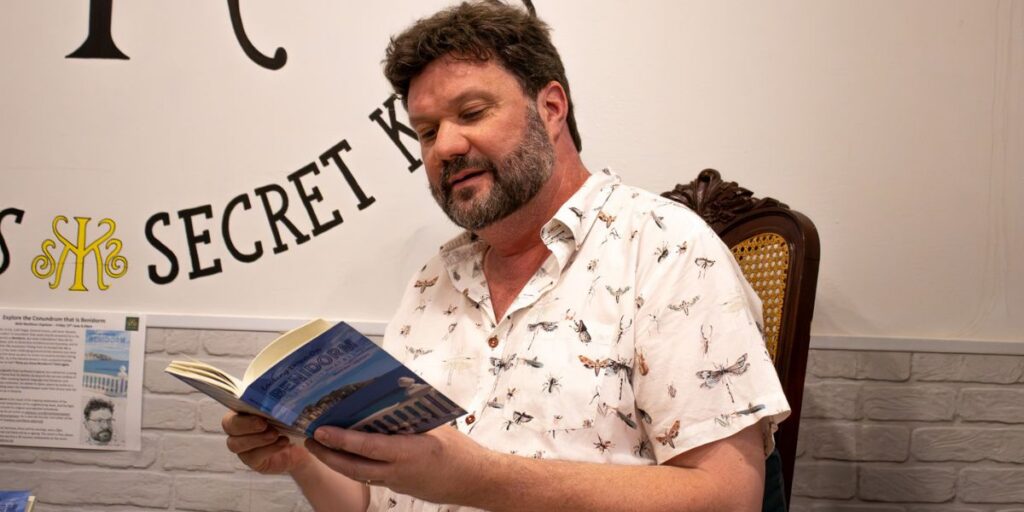
From sceptic to storyteller: The man who thought he'd hate Benidorm... then wrote a book celebrating its history Credit: EWN
For decades, Benidorm has been one of Europe’s most talked-about holiday resorts. To some, it is Britain’s favourite sunshine escape. To others, it is little more than a skyline of concrete towers, karaoke bars and cheap package holidays.
But for one Costa Blanca resident, moving to the area’s doorstep completely changed that perception, inspiring him to write an entire book about the town he once dismissed.
Matthew Clapham, a translator and writer originally from northwest England who now lives close to Benidorm, admits he spent years driving past the resort without ever wanting to stop. Like many people, he saw it as a place defined by stereotypes rather than substance.
Now, after years researching its history and living alongside it, he has written Looking Down on Benidorm, a book that argues one of Spain’s most misunderstood cities deserves a second look.
A different side of Benidorm
Clapham never expected Benidorm to become the subject of a book. After studying Spanish language and literature, teaching English across three continents and eventually settling in Spain as a translator, his creative ambitions lay elsewhere.
Life, however, had other plans.
Moving to the Marina Baixa region meant Benidorm quickly became part of everyday life. Rather than visiting for holidays or nightlife, he found himself travelling there for routine appointments, government offices, shopping and healthcare.
Those ordinary experiences slowly dismantled the image he had built up over years.
Instead of endless stag parties and nightlife, he discovered a functioning Spanish city that serves as the administrative and commercial heart of the surrounding region, used daily by thousands of local residents.
That prompted a question which eventually became the foundation of his book: how had such a small fishing village become one of Europe’s most famous holiday destinations?
Digging beneath the skyline
Researching the town’s past uncovered far more than Clapham expected.
His exploration stretches back centuries, touching on medieval legends surrounding El Cid and Roland before tracing Benidorm’s dramatic transformation during the second half of the twentieth century.
He examines how the once-impoverished fishing community reinvented itself as mass tourism emerged, becoming one of Spain’s biggest success stories almost overnight.
Rather than simply retelling familiar tales, Clapham also looks at the myths that have grown around Benidorm itself, including the famous story of former mayor Pedro Zaragoza riding his Vespa to Madrid to persuade General Franco to allow bikinis on the town’s beaches.
His research suggests the real story is rather more complex, focusing instead on Zaragoza’s marketing vision and ambitious urban planning, which helped place Benidorm firmly on Europe’s tourism map.
Rethinking a misunderstood city
Perhaps the book’s most surprising argument is that Benidorm’s controversial skyline may actually offer lessons for the future.
While many destinations across Spain struggle with housing shortages, urban sprawl and the environmental pressures created by tourism, Clapham argues Benidorm’s high-rise model concentrated development into a relatively small footprint, preserving surrounding natural landscapes while accommodating millions of visitors.
Its compact layout, walkability and dense infrastructure are increasingly attracting attention from urban planners studying more sustainable forms of tourism.
The same skyscrapers that have long attracted criticism are now being viewed by some experts as an example of efficient land use.
Clapham believes that perspective deserves wider attention.
Rather than portraying Benidorm as either paradise or punchline, he presents it as a place full of contradictions that reflects changing attitudes towards travel, architecture, British tourism and modern Spain.
A love letter born from surprise
The author says writing the book ultimately became less about defending Benidorm and more about challenging assumptions.
He hopes readers who think they already know the resort may discover there is much more beneath its famous skyline, from its rich history to its cultural significance and unexpected role in shaping modern tourism.
For Clapham, the biggest surprise was not simply discovering Benidorm’s past, but realising how easily first impressions can obscure a far richer story.
Looking Down on Benidorm is published by Ybernia Books and Clapham – who continues to work as a translator while writing about Spanish language and culture – says the project reflects years of exploring the hidden history of the town on his doorstep.
It proves that perhaps we should reserve judgement… after all, the man who once looked down on Benidorm, then wrote a book celebrating it!
Follow Euro Weekly News on Google News
Get breaking news from Spain, travel updates, and expat stories directly on your Google News feed.
Follow on Google NewsSign up for personalised news
Subscribe to our Euro Weekly News alerts to get the latest stories into your inbox!
By signing up, you will create a Euro Weekly News account if you don't already have one. Review our Privacy Policy for more information about our privacy practices.



Lottie Verrier
Lottie Verrier is a journalist and digital media specialist based in Mallorca. After a decade in London media, including a role as Deputy Editor for the MailOnline’s eCommerce division, she now combines her editorial expertise with a passion for the island to create engaging content that celebrates the best of life in Spain. Instagram @lottieinmallorca
Comments