Italy calls for Spain to be suspended from Schengen after Ceuta migrant crossings. UPDATED
By Lottie Verrier • Updated: 31 Jul 2026 • 19:50 • 3 minutes read
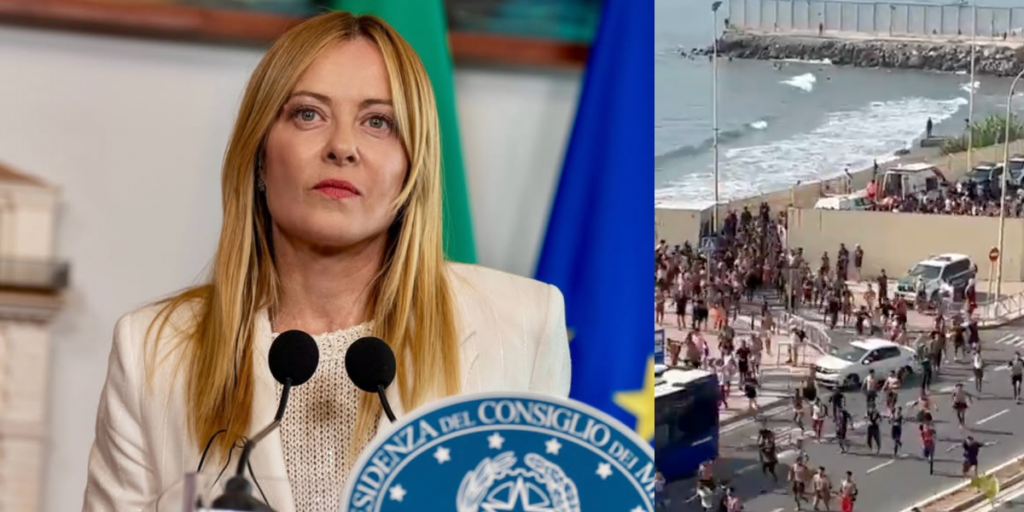
Italy's Prime Minister Giorgia Meloni threatens to suspend Schengen arrangements with Spain following mass migrant crossings Credit: Facebook/GiorgiaMeloni and X/AUGCGuardiaCivil
Update – 31 July 2026, late afternoon
Italy’s Interior Ministry has now formally ordered the temporary reintroduction of border controls on air and sea routes with Spain. The decision, announced just after 6pm, follows a meeting of the Committee for Immigration Analysis and Border Security chaired by Interior Minister Matteo Piantedosi. Travellers arriving in Italy from Spain by plane or ferry will be required to show a valid national identity card or passport. Flights and ferry services continue to operate, but passengers should allow extra time for identity checks on arrival. Italy has also agreed with France to strengthen controls along their shared land border.
Il Governo ha deciso di sospendere temporaneamente il regime di libera circolazione previsto da Schengen nei collegamenti marittimi e aerei con la Spagna, reintroducendo i controlli di frontiera.
Si tratta di una misura straordinaria, adottata per tutelare la sicurezza nazionale… pic.twitter.com/bpszoG8soX
— Giorgia Meloni (@GiorgiaMeloni) July 31, 2026
Translated from Italian
“The Government has decided to temporarily suspend the free movement regime provided for by Schengen in maritime and air connections with Spain, reintroducing border controls.
This is an extraordinary measure, adopted to safeguard national security and prevent possible repercussions for our Nation. The measure will be kept in force only for the time necessary, with particular attention to limiting any impact on summer tourist flows.
In parallel, Italy is ready to support every European initiative to assist Spanish institutions as needed to restore full control of the Union’s external borders and to address the ongoing situation with determination.
Defending borders means defending the safety of citizens, combating irregular immigration, and striking at the criminal networks that traffic human beings.
Italy’s prime minister Giorgia Meloni threatened to suspend Schengen arrangements with Spain after the mass crossings into Ceuta, raising an obvious question for anyone planning to fly between the two countries. There are no new travel checks in place and Spain cannot simply be expelled from the passport free zone, but Italy could seek to restore temporary controls if it believes there is a serious security threat.”
Follow Euro Weekly News on Google News
Get breaking news from Spain, travel updates, and expat stories directly on your Google News feed.
Follow on Google NewsSign up for personalised news
Subscribe to our Euro Weekly News alerts to get the latest stories into your inbox!
By signing up, you will create a Euro Weekly News account if you don't already have one. Review our Privacy Policy for more information about our privacy practices.




Lottie Verrier
Lottie Verrier is a journalist and digital media specialist based in Mallorca. After a decade in London media, including a role as Deputy Editor for the MailOnline’s eCommerce division, she now combines her editorial expertise with a passion for the island to create engaging content that celebrates the best of life in Spain. Instagram @lottieinmallorca
Comments
Son tan lotion
31 July 2026 • 13:56Good on Italy. Countries need to leave the EU.
Hard Faced
31 July 2026 • 17:07Maybe the Italians should look to themselves and their own actions when illegal migrants that arrived on their tiny island of Lampedusa were then transported to the Italian/EU mainland instead of being returned. This started as a trickle and grew in numbers and was the start of the ever growing number of migrants seen today.
CCW60
01 August 2026 • 15:06RIGHT!
CCW60
01 August 2026 • 15:07RIGHT! Illegal invasions aren’t good for any country and Italy already has it’s share of housecleaning to do.
Molly ringworm
01 August 2026 • 19:19Italy can’t do a dam thing and they know that. This was a planned invasion, paid for by America and arranged by Morocco to make Spain look bad.
Charles Thomas
02 August 2026 • 14:41They think this was a “spontaneous invasion”; anyone with half a brain can see it was well planned and orchestrated. Trump did say he would “Punish Spain” and then this happened. Yeah, call me a “conspiracy theorist”; better than believing their narrative.
Comments are closed.