Mallorca’s eclipse may end with a rare green flash few ever see
By Harry Dennis • Published: 01 Aug 2026 • 17:39 • 3 minutes read
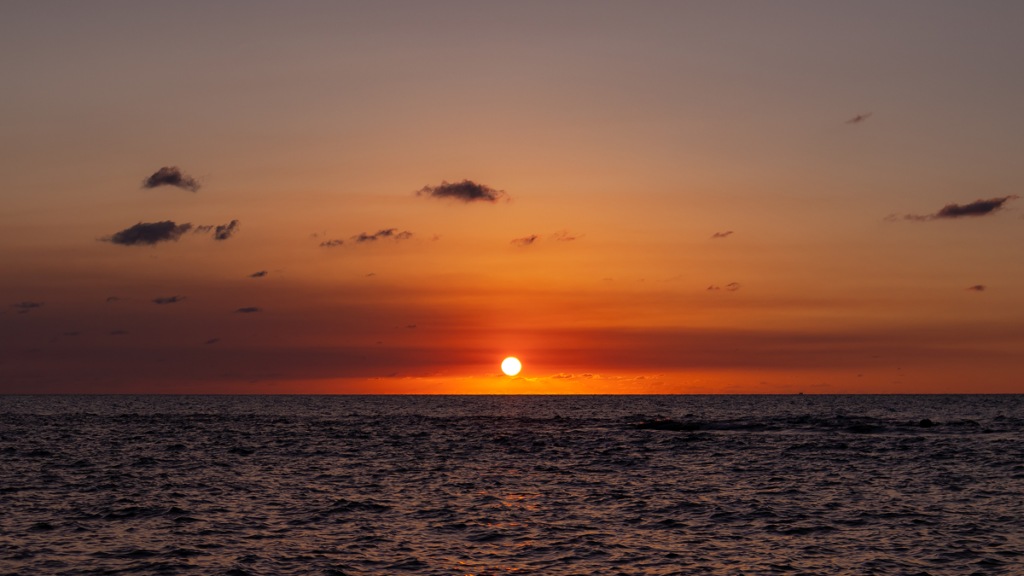
A brief green flash could cover the upper edge of the setting Sun. Credit: Omar Amjed / Shutterstock
Once daylight returns after roughly 90 seconds of totality, the show may still reveal an emerald encore. Mallorca’s low sunset could produce a flash so brief and elusive that Jules Verne even sent a heroine around Scotland to find it.
Mallorca’s glimpse at the anomaly would arrive at sunset
The partial eclipse will begin in Palma at 7.38pm on Wednesday August 12, according to Spain’s National Geographic Institute (IGN). The Sun will then disappear completely at around 8.30pm, depending on the observer’s location, with totality lasting approximately a minute and a half across Mallorca.
Maximum eclipse in Palma comes at about 8.32pm, when the Sun will be only two degrees above the horizon. Sunset follows at around 8.49pm to 8.50pm. That final interval could produce an unexpected anomaly. As the Moon begins uncovering the Sun, the remaining crescent will continue sinking towards the Mediterranean and at the final instant of sunset, a tiny part of its upper edge may turn vivid green.
Amando Carbonell Santos, president of the Mallorca Astronomical Observatory, told El País that the unusually low eclipse creates the possibility of two spectacles within minutes of each other. It is, however, still only a possibility. Unlike the eclipse, the green flash cannot be 100% forecasted. Low clouds, haze or dust over the horizon could ruin the moment completely.
The green ‘ray’ is smaller and faster than its name suggests
As stunning as it would still be to capture this, potentially, once-in-a-lifetime event, the phenomenon isn’t actually a huge green beam shooting across the sky. It generally appears as a tiny emerald segment, spot or flicker along the upper edge of the setting Sun, sometimes lasting only a second or two. It happens because the atmosphere bends and separates sunlight much like a prism. When the Sun is almost below the horizon, its different colours are refracted by slightly different amounts.
Red, orange and yellow disappear first. Blue and violet light are more readily scattered through the atmosphere, potentially leaving green as the last visible colour. A clean atmosphere and a distant, unobstructed horizon make the effect easier to catch, which is why it is most closely associated with sunsets over the sea. Carbonell was lucky enough to capture one in a photograph from the Banyalbufar viewpoint in May, according to El País.
Jules Verne turned this sunset phenomenon into a test of love
The flash was already known when Jules Verne published The Green Ray in 1882, but his novel helped transform a piece of atmospheric optics into a romantic legend. Its heroine, Helena Campbell, refuses an arranged marriage until she has witnessed the green ray. Her pursuit takes her around the Scottish coast, following a belief that anyone who sees it will understand their own feelings and never again be mistaken in matters of the heart. When the long-awaited sunset finally arrives, Helena misses the phenomenon because she is looking into the eyes of the man she loves instead. She finds the answer she wanted, even if she fails rather badly at the astronomical part of the journey.
It’s a considerable expedition for something that can disappear faster than a phone camera opens, although I imagine back then they didn’t have to worry about uploading it to their Instagram story two seconds later.
If the horizons are clear, you could be in luck
An expensive boat trip or remote cliff is not essential, however desirable it is for the ‘gram. The Balearic Government says the eclipse can be watched from home or holiday accommodation if there is a completely clear view towards the western horizon.
Nine official observation areas have also been designated in Mallorca, including Platja de Palma and Platja de Santa Ponça. These locations were selected for accessibility, capacity and emergency cover rather than because they necessarily provide the island’s finest view. With traffic controls affecting the Serra de Tramuntana and other sensitive areas, spectators should avoid setting off for an unofficial viewpoint without checking if roads may be closed or diverted.
Certified eclipse glasses must be worn whenever any part of the Sun is visible. They may be removed only during complete totality and must go back on before the first direct sunlight reappears. Cameras, binoculars and telescopes also require a suitable solar filter fitted over the front of the optics. Ordinary sunglasses are not enough.
If residents and visitors watch carefully, and the atmosphere cooperates, the result could be a stunning view of an emerald crescent as the sun meets the sea during its final moments.
Follow Euro Weekly News on Google News
Get breaking news from Spain, travel updates, and expat stories directly on your Google News feed.
Follow on Google NewsSign up for personalised news
Subscribe to our Euro Weekly News alerts to get the latest stories into your inbox!
By signing up, you will create a Euro Weekly News account if you don't already have one. Review our Privacy Policy for more information about our privacy practices.


Harry Dennis
Born in the UK and raised on the Cádiz coast, Harry brings his background in design, music, and photography to his writing for Euro Weekly News, sharing stories that celebrate culture and lifestyle across Spain and beyond.
Comments