Student’s home-built satellite will fly three times higher than a jumbo jet during Spain’s solar eclipse
By Lucy Ramnought • Published: 06 Aug 2026 • 9:20 • 2 minutes read
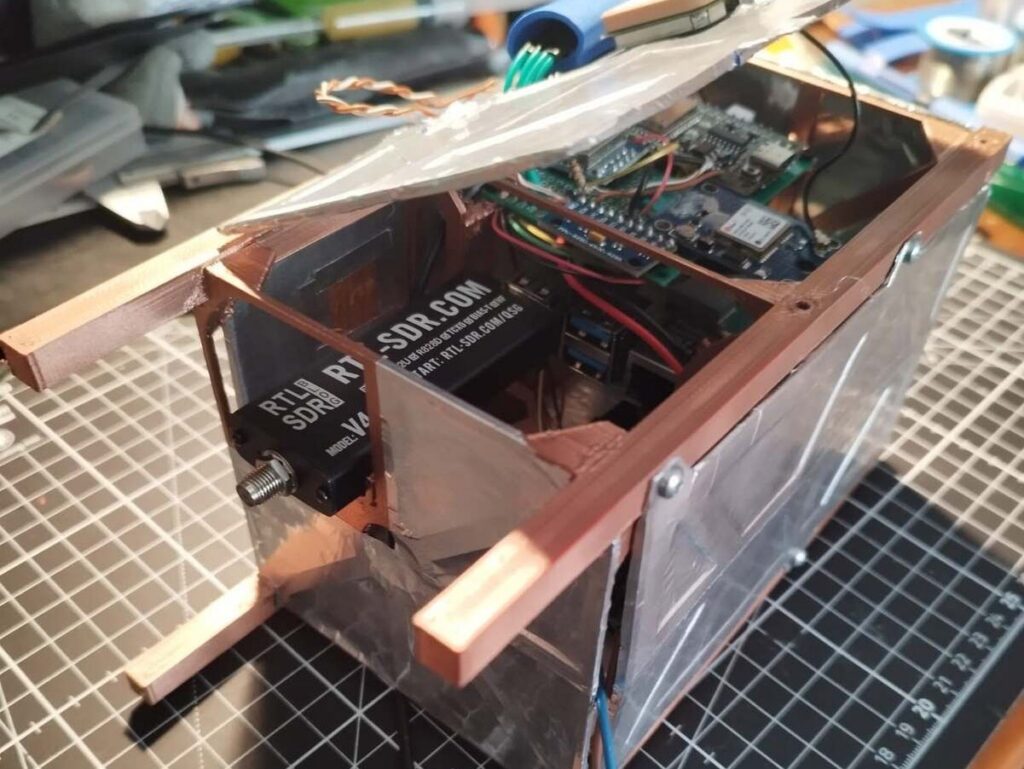
The creation to study the eclipse Credit:Javier Aragón Garcia/FB
A 21-year-old from Alhaurin el Grande has spent time most students devote to exams building something that will soar into the stratosphere next week, with a little help from his dad.
Malaga engineering student prepares for launch day
Javier Aragon, an Aerospace Engineering student at Universidad Rey Juan Carlos, has designed, built and tested a stratospheric satellite in his home town of Alhaurin el Grande, working with the S-ART university consortium and the AstroHita Astronomical Foundation. Built to the CubeSat 2U standard, the craft will record weather data and use a spectrometer to examine how the eclipse alters radio waves reaching Earth from the sun. According to Aragon, it is the first satellite ever designed and built in the town.
Launch will take place at the La Hita astronomical complex in Toledo, scheduled for around 7.30pm on August 12, roughly an hour before the eclipse itself.
Why the eclipse offers a rare scientific window
Eclipses give scientists a rare chance to study solar flares up close. According to Aragon, the event allows him to observe type III solar emissions, powerful pulses that can disrupt telecommunications on Earth when strong enough. As the moon’s shadow passes over, it temporarily switches off the ionosphere, the atmospheric layer that normally reflects solar radiation like a mirror, making these emissions easier to detect. Timing works in his favour as August 2026 also marks a peak in solar activity, which Aragon hopes will mean richer data.
What the satellite will do once airborne
A latex weather balloon filled with helium will carry the craft skyward at a controlled five metres per second, eventually reaching an altitude of around 30 kilometres, roughly three times higher than a commercial aircraft cruises. A 3D-printed polymer chassis, engineered to withstand vacuum conditions and temperatures as low as minus 60 degrees, houses two internal circuit boards: one managing a radio telescope, the other handling flight data and ground communication. Onboard cameras will also capture the eclipse from the stratosphere, timed to coincide with sunset for what Aragon hopes will be striking footage. The equipment will record a 2 MHz band centred on 20 MHz, the exact frequency range where type III bursts occur. Data from this range should help improve forecasting of solar storms, which can affect satellites and critical electronic infrastructure.
A family and team effort with bigger ambitions
Fifteen young engineers and physicists collaborated on the mission, with Aragon responsible for mechanical design, hardware fabrication and electronics assembly. He has credited his father specifically for helping troubleshoot avionics problems during the build. Lasting around two and a half hours, the flight will end when the balloon bursts and a parachute deploys, allowing a mobile recovery team to track the craft via radio beacon. In simulations, recovery has required travelling up to 100 kilometres from the launch site, depending on weather conditions.
Local town gets behind its young engineer
Support has poured in on social media following news of the launch. Well-wishers have called him “a star” and told him he’s “unique”, with one commenter, believed to be a family member, writing that “you’ll achieve everything you set out to do, this is only the beginning.” It’s a warm local reaction, and a fitting one, for a young engineer who, backed by his team and his family, has managed to put something remarkable together ahead of a once-in-a-lifetime astronomical event.
Follow Euro Weekly News on Google News
Get breaking news from Spain, travel updates, and expat stories directly on your Google News feed.
Follow on Google NewsSign up for personalised news
Subscribe to our Euro Weekly News alerts to get the latest stories into your inbox!
By signing up, you will create a Euro Weekly News account if you don't already have one. Review our Privacy Policy for more information about our privacy practices.



Lucy Ramnought
Lucy Ramnought is a local news writer and mother of 4 from the UK who has lived in the Costa Del Sol for just over 4 years. With a background in content writing and social media for various companies, and with vast experience in PA and project management, Lucy is committed to producing accurate, engaging and reliable stories to her work at Euro Weekly News.
Comments