Huelva fire leaps 3.5km in 15 minutes: 681 out of their homes as firebreaks fail
By Harry Dennis • Published: 11 Aug 2026 • 10:39 • 3 minutes read
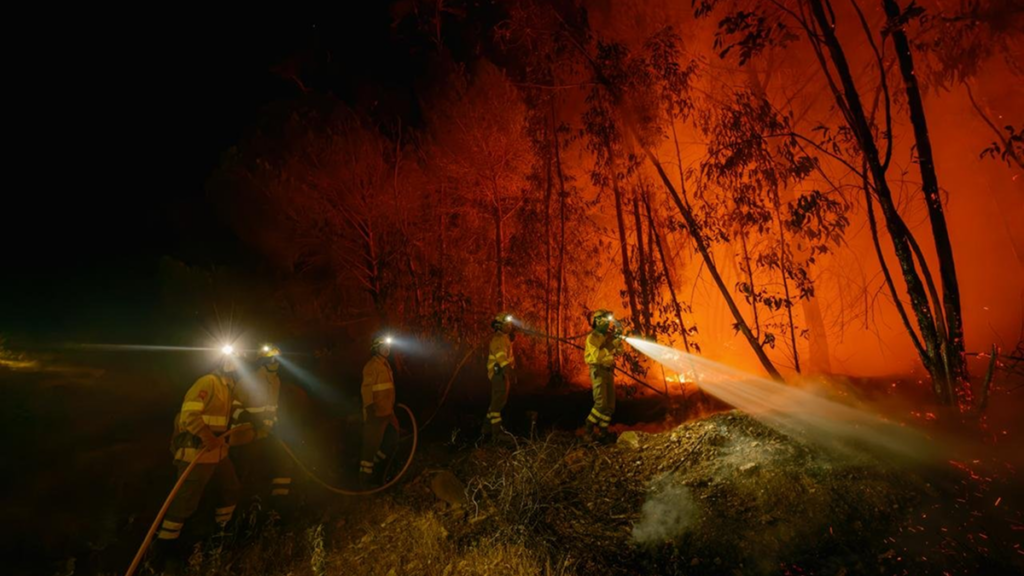
Military Emergency Unit crews working on the Niebla wildfire in Huelva. Credit: Plan_INFOCA / X
A burning ember travelled 3.5 kilometres in a quarter of an hour, a distance the fire would normally need most of a working day to cover. That single jump explains why crews in Huelva have spent five days defending villages rather than attacking the flames.
The jump that took 15 minutes instead of 10 hours
Antonio Sanz, the Junta de Andalucía minister who directs the Plan Infoca firefighting service, said a secondary fire carried the blaze 3.5 kilometres in roughly a quarter of an hour on Monday August 10. In ordinary conditions, he said, the flames would have taken between eight and 10 hours to travel the same distance.
Sanz described the day as “frankly hard, difficult and dangerous”, and said the most important outcome was that the fire had not deteriorated further. The last official assessment of the night placed it level with where it had stood that morning.
Why water dropped from the aircraft is not reaching the flames
The fire, declared on Thursday August 6 in the Raboconejo area of Niebla, has been generating weather of its own. Sanz said the convective activity began earlier on Monday than on previous days, between 9.30am and 10am, throwing out secondary fires in directions unrelated to the prevailing wind. The resulting smoke column has at times prevented water dropped by aircraft from reaching the base of the flames. Firebreaks have also been jumped, and ground crews have had to be withdrawn from sectors where new fires threatened to cut off their escape.
“When secondary fires can isolate our professionals, we have to order them to withdraw,” Sanz said. “No extinguishing manoeuvre can come above the life and safety of the crews.”
The Junta has described the fire as beyond the capacity of the service to extinguish, a phrase Sanz has stressed refers to the behaviour of the blaze rather than any shortage of resources. More than 600 personnel, 26 aircraft and 14 bulldozers have been committed to it.
681 people are out of their homes, and 89 slept in halls and hotels
The evacuation total stood at 681 on Monday night: 500 in Huelva province and 181 in Sevilla.
The preventive orders cover parts of Niebla, Villarrasa, Berrocal, Zalamea la Real, Paterna del Campo and La Palma del Condado, along with the hamlets of Las Delgadas and Montesorromero. In Sevilla province they cover El Madroño and its hamlets of El Álamo, Juan Antón, Juan Gallego and Villargordo.
Most of those affected are staying with relatives or in second homes. Some 89 people spent Monday night in council accommodation: 32 in the theatre at Zalamea la Real, five at a hotel in Valverde del Camino and 52 from El Madroño at a centre opened in El Castillo de las Guardas.
Sanz repeated that staying away from an evacuated property is an obligation rather than a recommendation.
Berrocal has now burned three times in 50 years
Crews kept the flames out of Berrocal itself on Monday, helped by heavy machinery and controlled burning carried out over the preceding nights. The fire has not crossed into Sevilla province, unlike the disaster of 2004. For Berrocal though, this is the third major fire in half a century. Ecologistas en Acción and the Plataforma Fuegos Nunca Más said ash, burning eucalyptus bark and leaves were falling on the village’s streets and rooftops while the fire front was still around 10 kilometres away.
The 2004 fire, which started at Minas de Riotinto, burned more than 34,000 hectares across 14 municipalities in Huelva and Sevilla and killed two people. Close to 8,000 hectares of that were in Berrocal. The village has lost more than half its population in 50 years. The two campaign groups said each fire takes more of the cork, beekeeping and livestock that support what is left of it.
Eleven roads closed across Huelva and Sevilla
Eleven roads were listed as affected on Monday night. In Huelva they are the A-493, HU-3106, HU-4103, HU-5104, HU-6104, HU-6106 and HU-6108; in Sevilla, the SE-538, SE-5400, SE-6400 and SE-6402. Emergency services are asking people to avoid travelling through the area and not to attempt to reach the evacuated villages.
The disruption has reached the summer calendar too. Valverde del Camino has put back the start of its August feria by 48 hours, and in La Palma del Condado the brotherhood running the Nuestra Señora del Valle festivities suspended its daily rocket volleys after firefighters objected publicly to fireworks being set off beside an active fire.
The operation is still waiting for its first clear opportunity in five days to attack the fire rather than defend against it. “When it opens, we will make the most of it,” Sanz said.
Follow Euro Weekly News on Google News
Get breaking news from Spain, travel updates, and expat stories directly on your Google News feed.
Follow on Google NewsSign up for personalised news
Subscribe to our Euro Weekly News alerts to get the latest stories into your inbox!
By signing up, you will create a Euro Weekly News account if you don't already have one. Review our Privacy Policy for more information about our privacy practices.



Harry Dennis
Born in the UK and raised on the Cádiz coast, Harry brings his background in design, music, and photography to his writing for Euro Weekly News, sharing stories that celebrate culture and lifestyle across Spain and beyond.
Comments