NASA jet to chase solar eclipse across Spain as historic day finally arrives
By Lottie Verrier • Published: 12 Aug 2026 • 9:15 • 2 minutes read
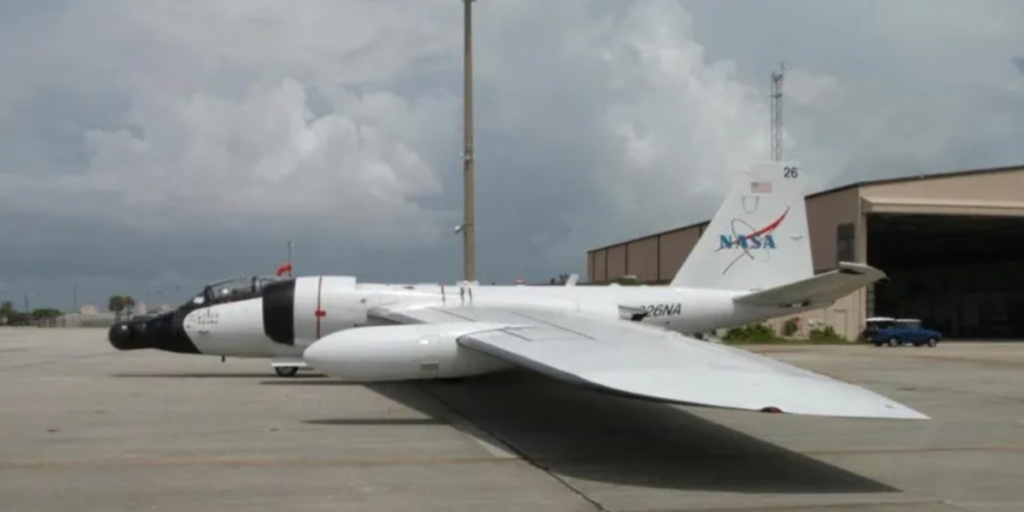
One of NASA's WB-57 high-altitude aircrafts will carry cameras up to 50,000 feet to capture images Credit: NASA
As millions across Spain prepare to look skywards for today’s spectacular total solar eclipse, NASA scientists will be getting an extraordinary view of their own, chasing the Moon’s shadow from high above the clouds.
The US space agency is deploying a high-altitude WB-57 research jet as part of a major scientific operation surrounding the August 12 eclipse, which will sweep across Greenland and Iceland before crossing Spain and reaching the Balearic Islands close to sunset.
Chasing the eclipse at 740km/h
NASA’s aircraft will climb to more than 15 kilometres, or around 50,000 feet, carrying four specialised cameras designed to capture detailed images of the Sun’s corona, the normally hidden outer atmosphere revealed during totality.
Rather than simply watching the eclipse pass overhead, the jet will travel along its path at approximately 740km/h, effectively chasing the Moon’s shadow.
That will stretch its view of the corona to almost three minutes, compared with a maximum of around two minutes and 18 seconds from the ground. Flying above clouds will also reduce the risk of weather spoiling the observations.
The cameras are expected to record at least 20 images every second using visible and infrared wavelengths. Scientists hope the resulting images will reveal more about solar prominences, the mysterious heating of the corona and its relationship with the solar wind.
NASA scientist Amir Caspi said every eclipse presents a different opportunity because the Sun is constantly changing, meaning researchers could capture phenomena they have never previously observed.
Scientific balloons over Spain
The aircraft is only one part of NASA-backed research taking place today.
Three teams in Spain are also set to launch six scientific balloons fitted with 360-degree cameras, allowing researchers to photograph the eclipse’s vast shadow from above.
The balloons will carry instruments measuring atmospheric ozone, giving scientists an opportunity to investigate what happens when sunlight suddenly disappears during totality. Previous experiments during the April 2024 eclipse detected a fall in ozone levels.
Meanwhile, teams in Iceland are launching dozens more balloons to investigate changes in the lowest part of Earth’s atmosphere.
Spain takes centre stage
Today’s eclipse has placed Spain at the heart of a major international astronomical event, with the path of totality cutting across a large swathe of the country before ending towards sunset in the Mediterranean and Balearic Islands.
For spectators on the ground, the spectacle will last just minutes. For NASA, those precious minutes could provide a rare window into the workings of the Sun and its influence on Earth, satellites and astronauts in space.
The day is finally here
After months of anticipation, eclipse day has finally arrived, with millions of people across Spain expected to stop and look skywards as the Moon passes directly between the Earth and Sun.
But amid the excitement, authorities are urging people to put safety first. Anyone watching the eclipse should use certified eclipse glasses that meet the ISO 12312-2 safety standard and never look directly at the Sun through ordinary sunglasses, cameras, binoculars or telescopes without the correct solar filters.
From NASA scientists to your neighbours next door, one thing is certain: the countdown is officially on to witness this once-in-a-lifetime phenomenon.
Follow Euro Weekly News on Google News
Get breaking news from Spain, travel updates, and expat stories directly on your Google News feed.
Follow on Google NewsSign up for personalised news
Subscribe to our Euro Weekly News alerts to get the latest stories into your inbox!
By signing up, you will create a Euro Weekly News account if you don't already have one. Review our Privacy Policy for more information about our privacy practices.




Lottie Verrier
Lottie Verrier is a journalist and digital media specialist based in Mallorca. After a decade in London media, including a role as Deputy Editor for the MailOnline’s eCommerce division, she now combines her editorial expertise with a passion for the island to create engaging content that celebrates the best of life in Spain. Instagram @lottieinmallorca
Comments