Solar eclipse warning: Six pairs of glasses withdrawn in Spain over eye injury fears
By Adam Woodward • Updated: 10 Aug 2026 • 14:15 • 4 minutes read
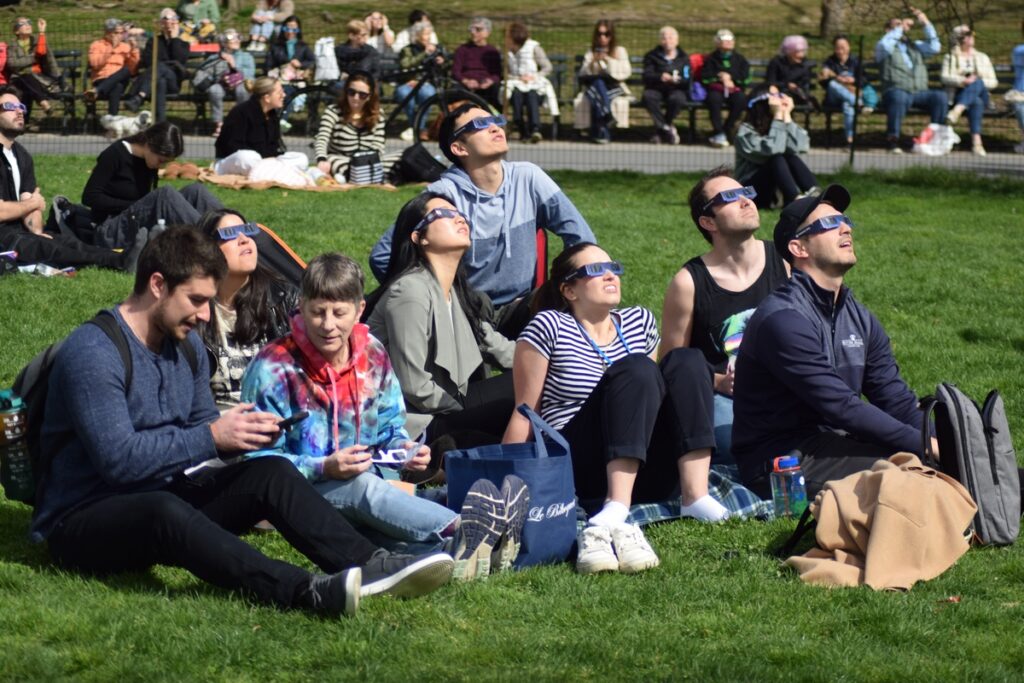
Group gathers to watch the eclipse. Credit: Xackery Irving - Shutterstock
Just because a pair of cardboard eclipse glasses carries a CE mark does it automatically mean you should trust them with your family’s eyesight?
That is the warning facing people across Spain with just two days to go before the total solar eclipse on Wednesday, August 12, after consumer authorities ordered six models of eclipse glasses to be withdrawn from the market over concerns about eye safety.
FACUA-Consumidores en Accion, the independent Spanish consumer agency, says the affected glasses were detected by consumer protection authorities in Madrid, Castilla y Leon, Galicia, La Rioja and Aragon.
Six models from the brands Lionstar, ECP Eye Care Proffesional, Pelispan, Homanaje, Orro and even renowned retailer Opticalia have been affected. The problem identified by the authorities relates to the filters being too dark, making it difficult for the wearer to locate the Sun. That might sound like a relatively minor problem, but it can create a dangerous reaction.
Ordenan la retirada de seis modelos de gafas para el eclipse solar por riesgo de lesiones oculares.
Se trata de productos de las marcas Lionstar, ECP Eye Care Proffesional, Pelispan, Homanaje, Orro y Opticalia.https://t.co/Xs2rKtmQWJ
— Rubén Sánchez (@RubenSanchezTW) August 10, 2026
Six eclipse glasses models withdrawn in Spain
Anyone who puts on eclipse glasses and cannot see where the Sun is may instinctively move them, tilt them or take them off briefly to find the correct position. Doing that while facing the Sun can leave the eyes directly exposed to visible, ultraviolet and infrared radiation. FACUA says this can result in a chemical or thermal injury to the cells of the retina.
Here are the six products identified in the consumer alerts:
| Brand | Model / identification | Alert date | Authority | Action |
|---|---|---|---|---|
| Lionstar | LSP1 | 5 August 2026 | Comunidad de Madrid | Withdrawal, immobilisation and sales ban |
| ECP Eye Care Proffesional | Model not stated in the FACUA information | 3 August 2026 | Castilla y Leon | Withdrawal and sales ban |
| Pelispan | Model not stated in the FACUA information | 29 July 2026 | Galicia | Withdrawal from the market |
| Homanaje | QW-50Z1 | 29 July 2026 | Galicia | Withdrawal from the market |
| Orro | O37-R, lot 2603-01, manufactured March 2026 | 30 July 2026 | La Rioja | Withdrawal and sales ban |
| Opticalia | Model not stated in the FACUA information | 31 July 2026 | Aragon | Immobilisation and withdrawal |
FACUA has also warned that similar problems could potentially affect other eclipse glasses that have been sold or handed out in recent months.
Does a CE mark mean eclipse glasses are safe?
A CE symbol printed on the glasses is not, by itself, a guarantee that the product is safe for looking directly at the Sun. Proper solar viewing filters are covered by the international ISO 12312-2 standard, which specifically applies to products intended for direct observation of the Sun, including solar eclipse glasses.
Specialist eclipse safety guidance also warns consumers not to assume that simply printing an ISO reference on a product makes it compliant. Properly tested products should have been assessed by an appropriately accredited laboratory, with the manufacturer and supply chain identifiable. That makes traceability particularly important this week.
Consumers should check the glasses carefully for the relevant ISO 12312-2 reference, CE marking and clear manufacturer identification. Any glasses with scratches, holes, tears or other damage should be thrown away. Buying from an established optical outlet, recognised supplier or another trustworthy source is a much safer approach than relying on an anonymous online listing or an unidentifiable pair of cardboard glasses.
Solar eclipse could damage your eyes in seconds
Ophthalmologist Estefania Cobos Martin, a retina specialist at Hospital Universitario de Bellvitge in Barcelona, has warned that looking at the Sun without proper protection can cause serious retinal burns within seconds.
One reason eclipse viewing can catch people out is that the Sun appears less uncomfortable as the sky becomes darker. Reduced ambient light can make people feel that looking towards the Sun is easier. Pupils can also dilate slightly, while the retina continues to receive dangerous visible and invisible radiation.
Retinal damage can be particularly deceptive because it does not necessarily hurt. The retina does not have the pain receptors found elsewhere in the body, meaning a person can suffer serious damage without feeling anything at the moment it happens. Symptoms can appear hours later or during the following 24 to 48 hours.
Possible warning signs include blurred vision, a fixed dark spot in the centre of the field of vision, distorted images, changes in colour perception and unusual sensitivity to light. Anyone developing those symptoms after solar viewing should seek medical attention as soon as possible.
Ordinary sunglasses are not enough
Ordinary sunglasses should never be used to look directly at the Sun, regardless of how dark they appear. ISO makes a clear distinction between ordinary sunglasses and specialist filters designed for direct solar observation. ISO 12312-2 applies to the latter, not normal sunglasses.
Cameras, binoculars and telescopes also need special solar filters. Putting eclipse glasses on your face and then looking through an unfiltered optical device is not safe because the concentrated sunlight can damage the filter and the eyes.
Children should be supervised particularly closely during the eclipse so they do not remove their protection while facing the Sun. Anyone outside the narrow path of totality must keep proper solar protection in place throughout the eclipse.
Spain’s Instituto Geografico Nacional says the August 12 eclipse will be visible as total across much of the northern half of the country, while southern areas will see a partial eclipse. The total phase will occur close to sunset, making a clear western horizon especially important.
Science fiction or terrifying prophecy?
John Wyndham’s The Day of the Triffids was published in 1951 and opens with one of science fiction’s most memorable warnings.
In the story, people around the world gather outside to watch an extraordinary meteor shower, described as a spectacular once-in-a-lifetime display. Anyone who watches is then confronted by a terrifying consequence: the following morning, most of the world’s population has been blinded.
Wyndham’s story is, of course, science fiction, and there is no suggestion that Wednesday’s solar eclipse could cause anything remotely like that. Yet the opening still feels uncomfortably relevant as millions of people prepare to look towards the sky. This time, the danger is real but much simpler to avoid.
Take care of your eyes, check your eclipse glasses carefully and make sure your family knows not to look directly at the Sun without proper protection on Wednesday evening.
Follow Euro Weekly News on Google News
Get breaking news from Spain, travel updates, and expat stories directly on your Google News feed.
Follow on Google NewsSign up for personalised news
Subscribe to our Euro Weekly News alerts to get the latest stories into your inbox!
By signing up, you will create a Euro Weekly News account if you don't already have one. Review our Privacy Policy for more information about our privacy practices.
Adam Woodward
Adam is a writer who has lived in Spain for over 25 years. With a background in English teaching and a passion for music, food, and the arts, he brings a rich personal perspective to his work at Euro Weekly News. As a father of three with deep roots in Spanish life, Adam writes engaging stories that explore culture, lifestyle, and the everyday experiences that shape communities across Spain.
Comments