Spain’s hospitals keep eye clinics reinforced until Saturday over eclipse retina fears
By Harry Dennis • Published: 12 Aug 2026 • 10:02 • 3 minutes read
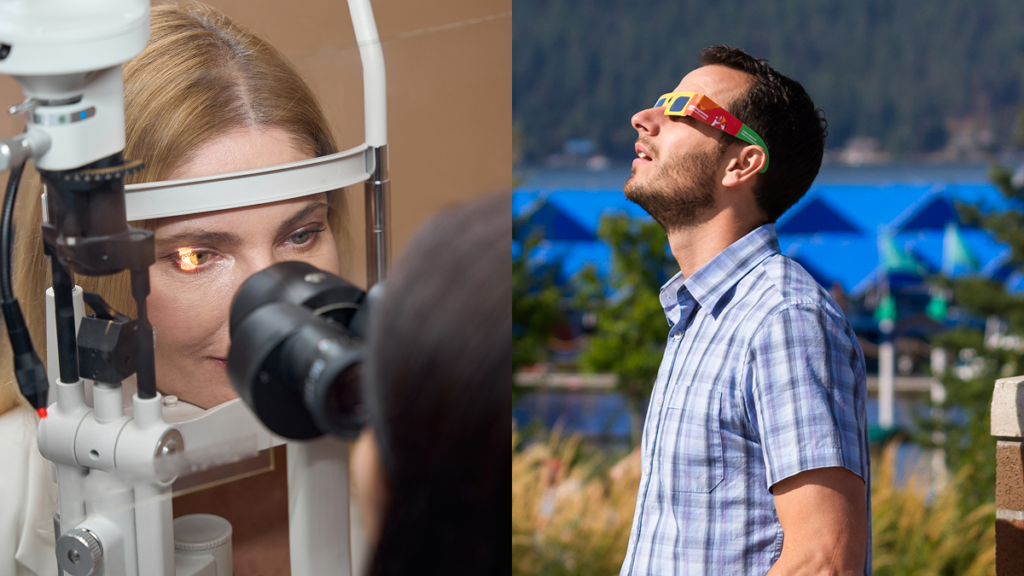
Eye specialists on standby for tonight's eclipse. Credit: Nature’s Charm / Yakobchuk Viacheslav / Shutterstock
Clinic slots were held open days ago in anticipation for patients who haven’t been injured yet. Five Spanish regions have rostered ophthalmologists through tonight’s eclipse and into the weekend, and the Balearic Islands alone are adding up to 160 staff, just in case.
Extra eye consultants on the night shift at three Basque hospitals
Osakidetza, the Basque health service, has put ophthalmology specialists physically inside its emergency departments for the evening and overnight shifts of Wednesday August 12 and Thursday August 13. The Cruces, Txagorritxu and Donostia university hospitals each get one additional on-call consultant on top of the usual cover. Osakidetza described the measures as preventive, taken ahead of a foreseeable rise in consultations caused by unsafe viewing of the eclipse.
The partial phase begins across Spain at about 7.30pm peninsular time. Totality crosses the north from Galicia to the Balearic Islands between roughly 8.27pm and 8.33pm, and the whole event ends close to sunset at around 9.20pm.
Clinic slots held open until Saturday August 15
The same three hospitals will adapt their morning ophthalmology work on Thursday August 13, Friday August 14 and Saturday August 15, because that is when patients are expected to notice something is wrong. Smaller Basque hospitals that have ophthalmology departments but no emergency rota, including Mendaro, Zumarraga, Bidasoa and Alto Deba in Gipuzkoa and Basurto, Galdakao, San Eloy and Urduliz in Bizkaia, have been told to expect more emergency department activity across the same three days.
Specific slots have been held open in specialists’ diaries so anyone arriving with symptoms can be seen urgently rather than queued behind routine appointments.
Up to 160 extra staff across Mallorca, Menorca, Ibiza and Formentera
The Balearic government is adding up to 160 health workers for the eclipse, split across primary care, hospitals and the SAMU061 emergency service. Forty of those go to primary care, made up of 18 doctors, 18 nurses and four drivers, with 26 in Mallorca, six in Menorca, six in Ibiza and two in Formentera. Roughly 70 more work in hospitals, and the remainder cover SAMU061 and its coordination centre.
At least one ophthalmologist will be on call, and the islands’ ophthalmology cover is reinforced from Wednesday through to Saturday. The Balearic protocol notes that 30 seconds without protection is enough to cause irreversible injury.
Cataluña, Aragón and the Comunidad Valenciana have their own plans
Cataluña’s health department has a contingency plan covering Lleida, Camp de Tarragona and Terres de l’Ebre, the regions inside the path of totality. Emergency cover is reinforced overnight on Wednesday, with maximum morning cover on the two days that follow. Ophthalmology emergencies will have a resident doctor present and a consultant on call.
In Aragón, the regional health service has activated the alert phase of its plan for incidents involving multiple casualties, with reinforcements at the Miguel Servet hospital in Zaragoza, Alcañiz, Ernest Lluch in Calatayud and Obispo Polanco in Teruel. Every official observation point also has a Red Cross resource coordinated through the 061 emergency number.
The Comunidad Valenciana has deployed 22 ambulances and reinforced 15 primary care centres. Regional health chief Marciano Gómez said any emergency in the observation zones could be made worse by crowds blocking access to the area.
What the ophthalmologists will be looking for
Alejandro Verdú, an ophthalmologist at the Hospital de la Santa Creu i Sant Pau in Barcelona, said damage to the retina shows up several hours after exposure, usually as blurred vision, difficulty reading, lines that appear bent, a fixed spot in the centre of the visual field and altered colour perception. Most cases are mild and clear up within weeks, he said, but longer exposure damages the photoreceptors and the retinal pigment epithelium permanently. Total blindness is not a realistic outcome because the injury is confined to the central retina, though partial loss of central vision can be permanent, therefore no chances should be taken.
He considers children the group most at risk, precisely because nothing hurts and they may lift their glasses out of curiosity. The Ministry of Health only regards eclipse glasses carrying the CE mark and the ISO 12312-2 standard as safe, and six models have already been withdrawn from sale in Spain.
What to watch for on Thursday morning
Health authorities say symptoms can appear anywhere between six and 48 hours after exposure, which is why the reinforced cover runs to Saturday rather than ending with the eclipse.
Anyone who wakes up with blurred central vision, a dark or grey patch in the middle of what they are looking at, or sudden difficulty reading should go to an emergency department rather than wait for it to pass.
Follow Euro Weekly News on Google News
Get breaking news from Spain, travel updates, and expat stories directly on your Google News feed.
Follow on Google NewsSign up for personalised news
Subscribe to our Euro Weekly News alerts to get the latest stories into your inbox!
By signing up, you will create a Euro Weekly News account if you don't already have one. Review our Privacy Policy for more information about our privacy practices.



Harry Dennis
Born in the UK and raised on the Cádiz coast, Harry brings his background in design, music, and photography to his writing for Euro Weekly News, sharing stories that celebrate culture and lifestyle across Spain and beyond.
Comments