The world’s first ‘space-age’ bone that saved a Madrid patient’s leg from amputation
By Harry Dennis • Published: 15 Aug 2026 • 14:34 • 3 minutes read
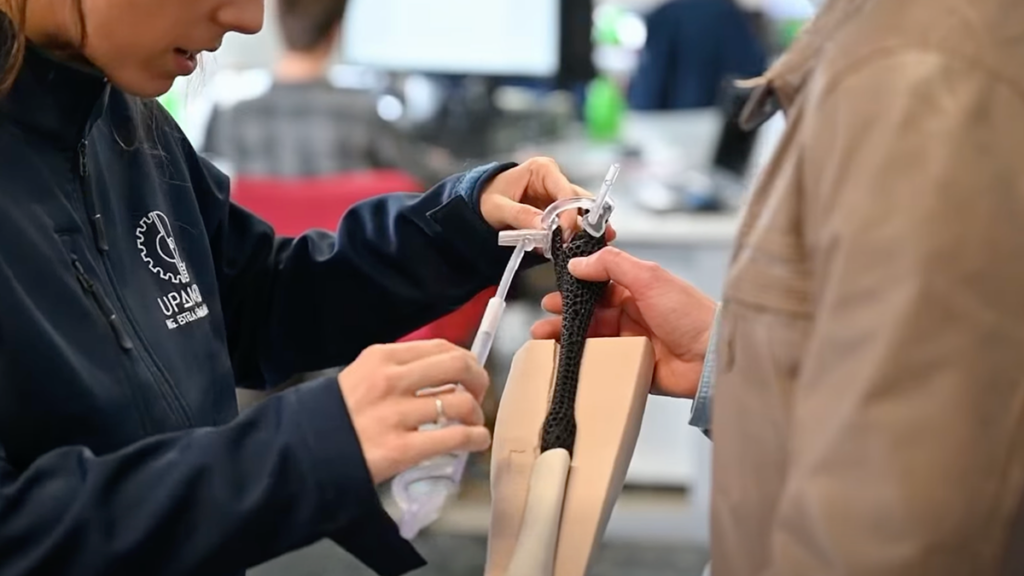
300 grams, 500 kilos: the 3D-printed bone that saved a Madrid patient's leg from amputation. Credit: Comunidad de Madrid / Facebook.
Surgeons in Madrid seemed to be left with only one option: amputate. But instead, they built the patient a new bone from scratch, using a lattice structure borrowed from spacecraft engineering that the human body now can’t tell apart from its own.
A tibia riddled with cancer left no room for a normal implant
Pierre, a 38-year-old patient at Hospital Gregorio Marañón in Madrid, developed a high-grade sarcoma in his tibia, the shin bone. A previous infection and a severe loss of bone density meant it could no longer support any of the off-the-shelf implants doctors would normally use. Amputation looked like the only option left, one that would have cost him the use of his leg for good.
Instead of settling for that, surgeons at the hospital’s Advanced Planning and 3D Manufacturing Unit (UPAM3D) reached for a piece of engineering more familiar to the aerospace industry than an operating theatre, according to a statement from the hospital.
Engineers borrowed rocket science to rebuild his leg
The technology at the centre of the implant is called a metamaterial, a lattice of millimetre-scale titanium rods engineered to behave like something entirely different from the metal it’s made of. It is the same principle used to keep satellites and aircraft light enough to fly while strong enough to survive extreme stress. Now, doctors used that space-grade engineering on a human bone for the first time anywhere in the world. They began with scans of Pierre’s healthy leg and built a digital twin of it, then simulated the real forces a tibia absorbs while walking, climbing stairs or stumbling. That data allowed the team to calculate, point by point, how the implant’s internal lattice needed to be shaped so weight travelled only through areas the bone could actually bear, and exactly where the fixing screws should go.
How the implant can weigh 300 grams and hold 500 kilos
Standard metal prostheses can weigh several kilograms and cost tens of thousands of euros. Built using the same lightweight logic engineers use to keep spacecraft airborne, Pierre’s implant weighs just 300 grams and can bear more than 500 kilos. The 3D printing itself cost around €3,000, according to the hospital.
Because the structure is hollow, surgeons packed it with spongy bone graft taken from the hospital’s own bone and tissue bank. The graft locked into the metal lattice, helping real bone grow into the implant rather than simply sitting beside it. Rubén Pérez, the oncological surgeon who led the case, said the design lets the human body “take it as its own” without registering it as a foreign object, avoiding the kind of mechanical rejection that heavier standard implants can cause.
Nearly a year on, he is walking without crutches
Almost a year after the operation, Pierre has had no infection or complications. He has kept the alignment and movement in his knee, something a conventional implant could not have guaranteed, and can now walk in many situations without crutches, according to Redacción Médica. The implant has already been tested more severely than planned. EFE reported that Pierre later suffered a bad fall that fractured bones in his other leg, and the printed tibia held.
A wrist and a sternum are already in development
Surgeons at the Gregorio Marañón have since carried out a second, similar operation for another patient, and are developing two further personalised implants: one for a wrist and one for a sternum.
Pérez said the ambition is for implants like these, that use engineering once confined to spacecraft design, to become available to any patient in the future through Spain’s public health system, starting with sarcoma cases. The hospital treats around 600 sarcoma patients a year as one of Spain’s national reference centres for the disease.
Follow Euro Weekly News on Google News
Get breaking news from Spain, travel updates, and expat stories directly on your Google News feed.
Follow on Google NewsSign up for personalised news
Subscribe to our Euro Weekly News alerts to get the latest stories into your inbox!
By signing up, you will create a Euro Weekly News account if you don't already have one. Review our Privacy Policy for more information about our privacy practices.



Harry Dennis
Born in the UK and raised on the Cádiz coast, Harry brings his background in design, music, and photography to his writing for Euro Weekly News, sharing stories that celebrate culture and lifestyle across Spain and beyond.
Comments