Why an anchovy shortage 8,000km away could cost Spain’s fish-lovers more
By Harry Dennis • Updated: 17 Aug 2026 • 12:41 • 3 minutes read
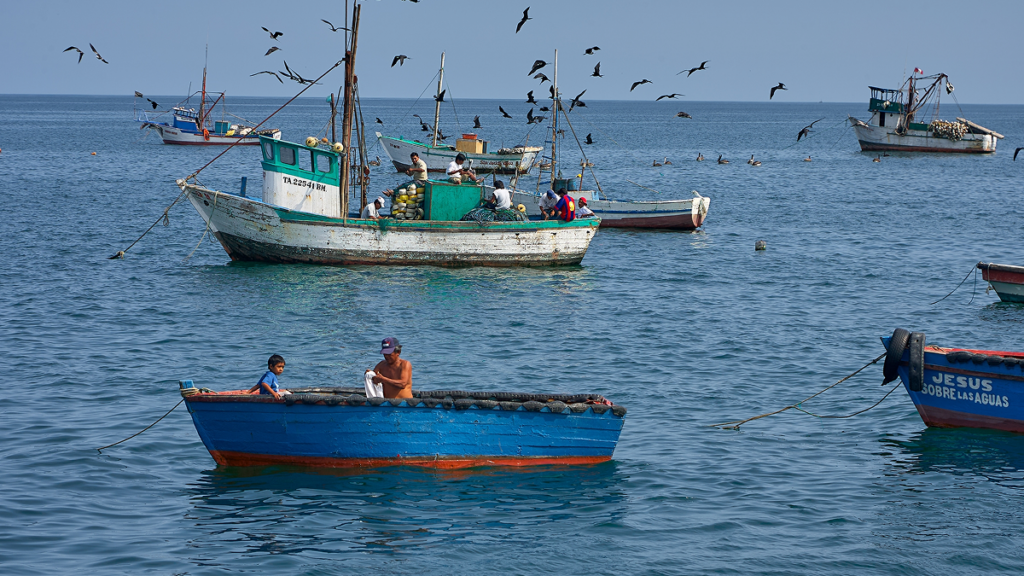
Fishing boats off the coast of Peru, where a shrinking anchovy catch is being felt worldwide. Credit: Beto Santillan / Shutterstock
The shortage of one particular small fish thousands of kilometres away is rippling through fish counters. Peru’s anchovy catch has collapsed under El Niño, sending the cost of farmed fish feed to record highs, and dorada, lubina and salmon raised on that feed could be the next to feel it.
Peru’s fleet has landed barely a quarter of its quota
Peru’s Production Ministry suspended anchovy fishing in the country’s main North-Central zone in May, then extended the ban into June as a coastal El Niño warmed the water and filled nets with juvenile fish instead of mature anchovy. By early June, boats had landed just 471,111 tonnes of the 1.9 million tonnes allowed for the season, only 24.6 per cent of the quota, according to official figures reported by SeafoodSource. More than half of that catch was juveniles, which is exactly what the suspension was meant to prevent.
This year’s quota was already the lowest in a decade, 36 per cent below the three million tonnes allowed in 2025. The fishery has been hit before as well: the entire first season of 2023 was cancelled outright, wiping out more than 1.4 billion dollars (1.2 billion euros) in fishmeal and fish oil export sales.
Why one small fish supplies a fifth of the world’s aquaculture feed
Most of Peru’s anchovy catch is too small to eat directly. Instead it is ground into fishmeal and pressed for fish oil, the two main ingredients in feed for farmed fish, prawns, pigs and chickens. Peru alone supplies about a fifth of the world’s fishmeal, according to the United Nations Food and Agriculture Organisation.
IFFO, the marine ingredients trade body, said global fishmeal production fell 21 per cent in April compared with a year earlier, with the year-to-date total down 26 per cent. Fish oil output dropped too, down 19 per cent in April and 14 per cent so far this year. Roughly two-thirds of the farmed fish sold worldwide, including salmon, is raised on feed containing fishmeal, according to food economist Mike von Massow of the University of Guelph. He said the ingredient is difficult to replace because swapping in cheaper plant proteins such as soy changes the fish’s nutritional profile, lowering the omega-3 levels that make salmon and similar fish popular in the first place.
Fishmeal prices have already hit record highs this year
A tonne of Peruvian fishmeal cost 2,389 dollars (2,069 euros) at the end of May, up 13 per cent on a month earlier. Prices for top-grade Peruvian fishmeal climbed even higher in April, reaching what traders described as a historical high. Feed already makes up 40 to 50 per cent of a fish farm’s running costs, so when the price of its main ingredient jumps this fast, that cost has to go somewhere, and it’s either into thinner margins for producers or higher prices further down the chain.
Spain’s dorada, lubina and salmon share the same feed market
Lubina, or sea bass, is Spain’s most valuable farmed fish, with 27,376 tonnes harvested in 2024 worth 123.7 million euros, according to industry body APROMAR. Dorada, or sea bream, followed with 10,765 tonnes worth 72 million euros. Spain is also one of Europe’s biggest markets for imported Norwegian salmon. All three of these depend on feed made largely from the same global pool of fishmeal and fish oil that Peru’s crisis has squeezed, meaning Spanish producers face the same cost pressure as farms in Norway, Greece or Turkey. Add to this that fish is already getting more expensive at Spanish counters. Consumption fell 2.7 per cent and prices rose 3.5 per cent over the past year, according to the Ministry of Agriculture, Fisheries and Food, with dorada among the hardest hit as consumption of sea bream dropped 23.5 per cent. A separate study by consumer group OCU found pre-packaged, filleted fish in supermarkets already costs up to 30 per cent more than the same fish bought whole from a fishmonger.
Whether Peru’s shortage adds directly to that trend depends on how quickly its anchovy fleet recovers. Peruvian authorities have said the ban could be lifted fully, partially or gradually, but have not set a date, leaving fish farmers, and the shoppers who buy from them, waiting to see how long the squeeze lasts.
Follow Euro Weekly News on Google News
Get breaking news from Spain, travel updates, and expat stories directly on your Google News feed.
Follow on Google NewsSign up for personalised news
Subscribe to our Euro Weekly News alerts to get the latest stories into your inbox!
By signing up, you will create a Euro Weekly News account if you don't already have one. Review our Privacy Policy for more information about our privacy practices.





Harry Dennis
Born in the UK and raised on the Cádiz coast, Harry brings his background in design, music, and photography to his writing for Euro Weekly News, sharing stories that celebrate culture and lifestyle across Spain and beyond.
Comments