Plug-in solar panels go legal in Britain – the balcony kit already common in Spain could save £110 a year
By Harry Dennis • Published: 27 Aug 2026 • 13:11 • 3 minutes read
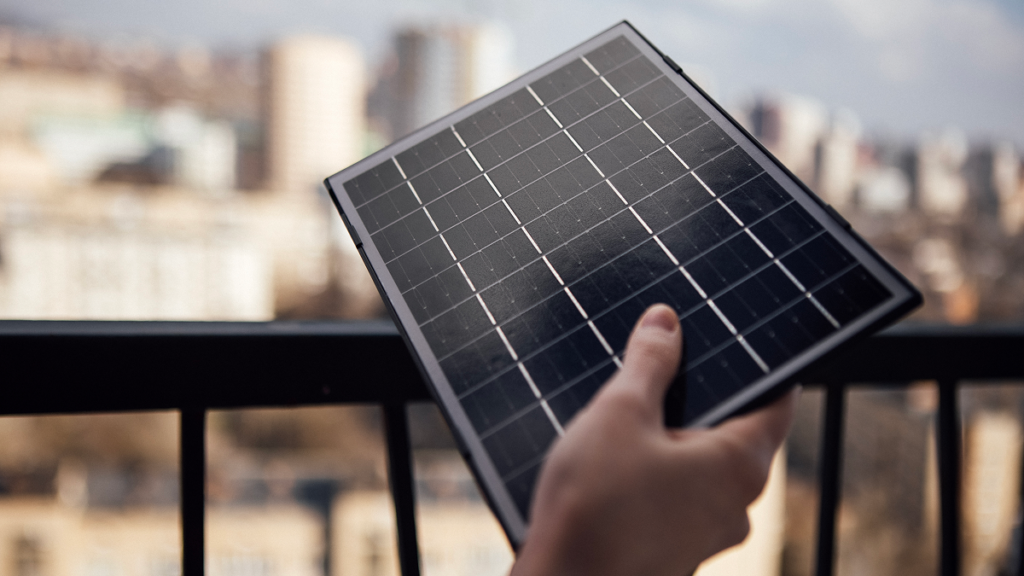
Initial investment in panels could require an upfront cost that pushes back savings. Credit: Dasha Petrenko / Shutterstock.
Many people living in Spain have probably spotted the small panels clipped to a balcony rail and plugged straight into a wall socket. Well, from today, the same kit becomes legal to buy and use across Great Britain for the first time, with the government promising typical households savings of up to £110 (€128) a year.
How the panels work and what they can power
Each plug-in kit generates up to 800W, roughly a fifth of an average household’s daily electricity use, according to the Department for Energy Security and Net Zero (DESNZ). The panel connects directly to an ordinary outdoor socket rather than being wired into the property’s main fuse board, so no electrician or installer is required.
Because the systems have no battery, the power they generate has to be used as it is made rather than stored for later. DESNZ says a typical kit could run a fridge, a television, a Wi-Fi router, a laptop, a phone charger and a games console at the same time during daylight hours.
A £400-plus cost behind the £110 headline figure
The government’s £110 figure is the maximum average annual saving, based on a household using most of the power the panel produces. Independent estimates put the more typical saving at £70 (€82) to £110 a year, against an upfront cost of £400 (€467) to £600 (€700) for a kit, meaning households should treat it as more of an investment for future savings after a payback period of four to six years, rathen than an instant cut on bills.
Buyers will also need to register the system with their local electricity network operator through a simple online form before switching it on, a step DESNZ says takes only a few minutes.
Independent testing, but one clear warning on extension leads
Ministers say the kits have passed independent safety testing to a UK specification stricter than Germany’s, where about 500,000 plug-in units were installed last year alone. Energy Secretary Miatta Fahnbulleh called plug-in solar “a simple, affordable way for households to take control of their energy bills and start saving straight away.”
Electrical Safety First has one clear warning: do not run the panel through an extension lead. Luke Osborne, the charity’s expert, told ITV News that extension leads risk overloading and overheating, and warned that not every domestic socket or junction box is built to handle power flowing in both directions safely.
Renters were the real gap in the market
Before now, solar panels in Britain effectively meant a full roof installation, out of reach for many renters and flat-dwellers with no roof of their own. Plug-in kits are designed to close that gap, sitting on a balcony rail, a garden fence or a patio instead.
It doesn’t remove every existing hurdle though. DESNZ is still advising buyers to check for landlord permission, freeholder consent, planning permission or listed building consent before fitting one, depending on the property. Retailers including Amazon, Argos, Currys, Wickes, B&Q and Screwfix have committed to stocking the kits, due in stores and online within the coming weeks.
Spain got there first, but Britain has a clearer rulebook
The small panels have been a familiar sight on balconies across Spain for several years, often bought by residents who cannot install a full rooftop system. Yet Spain has never introduced a dedicated legal framework for them in the way Britain has just done.
Spain’s main self-consumption law was written before plug-in kits took off and does not set out a simplified process for small kits under 800W. Suppliers often tell buyers no registration is needed below that threshold, but legal specialists say the formal requirements, including certification and regional registration, technically still apply. For anyone weighing up a kit for a UK property against one for a Spanish balcony, although Spain offers the clearest advantage in potential hours under the sun, Britain’s new rules are, for now, the more clear-cut of the two.
Follow Euro Weekly News on Google News
Get breaking news from Spain, travel updates, and expat stories directly on your Google News feed.
Follow on Google NewsSign up for personalised news
Subscribe to our Euro Weekly News alerts to get the latest stories into your inbox!
By signing up, you will create a Euro Weekly News account if you don't already have one. Review our Privacy Policy for more information about our privacy practices.




Harry Dennis
Born in the UK and raised on the Cádiz coast, Harry brings his background in design, music, and photography to his writing for Euro Weekly News, sharing stories that celebrate culture and lifestyle across Spain and beyond.
Comments