Spanish skippers circle Ceuta as firefighters call Monday protest and locals shut out hard-line outsiders
By Adam Woodward • Updated: 30 Aug 2026 • 19:12 • 3 minutes read
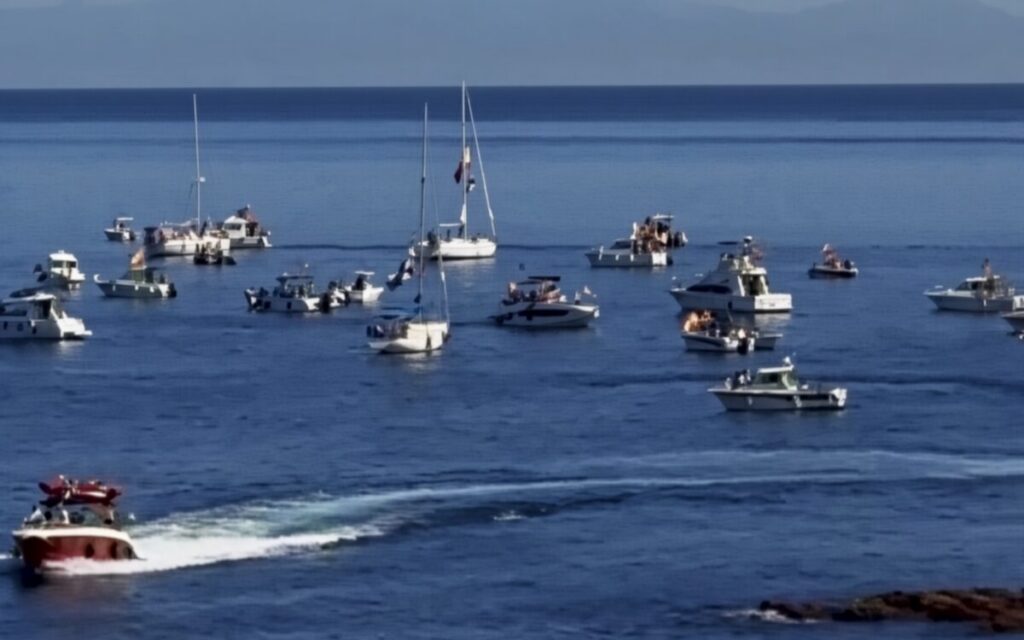
Ceuta "fragata" to support the city. Credit: vital X video
More than 100 private boats from the Costa del Sol, Cadiz and Ceuta itself spent Sunday morning wrapping the autonomous city in Spanish flags, foghorns and a simple message shouted across the water: “Ceuta is not alone”. Skippers called the civilian flotilla the “Armada of Solidarity”, a tongue-in-cheek nod to the Navy, not an official military operation. Crews left the marina from about 10.30am and worked their way past San Amaro, San Antonio, El Chorrillo, the Ribera and the Foso before looping back.
Crowds packed the Baluarte, the Cristo bridge, Valdeaguas and the city’s two central beaches. Motorbikes joined walkers. Bathers already on the Ribera waved Spanish and Ceuta flags as the boats idled offshore. One woman on the shore said she could not speak at first because she had been crying. Neighbours later described a lump-in-the-throat morning after a month of strain: “It has been an emotional morning, and it is appreciated in the middle of so much chaos.” Shouts of “Viva Espana” and “Ceuta is not alone” carried from deck to pavement.
Una flotilla ciudadana inmensa llega a Ceuta para mostrar apoyo pic.twitter.com/GWmjMF7np4
— Constitución Española de 1978 (@_constitucion78) August 30, 2026
Most of the visiting boats had crossed the Strait of Gibraltar on Saturday from ports such as Tarifa, Algeciras, Marbella, Benalmadena, Sotogrande and Puerto Sherry. Organisers had talked of 45 to 60 boats and about 120 people; local counts on Sunday put the fleet, once Ceuta’s own boats joined in, at well over 100. Marina de Ceuta offered free berths. Promoters, including businessman and former MP Marcos de Quinto, described the crossing as a civic, peaceful show of backing for residents after tens of thousands of people entered the city from Morocco on 30 and 31 July.
What call the boats were answering
Ceuta’s ordinary population is a little over 80,000. Estimates of how many people remain after the late-July mass crossing still clash: Madrid talks of roughly 5,000; local officials and aid tallies put the figure much higher, sometimes above 10,000. Many of those still in the city have been sleeping on beaches such as Benitez and El Trampolin. Clashes in recent days have included stone-throwing at military vehicles in Benzu, tents pulled down or set on fire, Red Cross food drops interrupted, and journalists surrounded or shoved while filming. Twelve people were arrested after one attack on soldiers; eleven were later sent back to Morocco.
That is the backdrop to Sunday’s unusual sight: pleasure boats doing a slow circuit while residents insisted they wanted to go back to normality, public services that work, and protests that stay lawful.
Firefighters want solutions, not slogans
Ceuta’s fire service has now called the public onto Plaza de los Reyes at noon on Monday, August 31. Their line is blunt: “Ceuta needs solutions.” Crews are asking national police, local police, health workers, Civil Protection, private security, teachers, prison officers, soldiers, Civil Guard officers, street-cleaning staff and journalists to stand with them. They say front-line services are doing essential work without enough kit, staff or political answers, and that competent authorities must put real resources on the table rather than let the crisis drag on any longer. Their closing line matches a chant already heard on the waterfront: “Ceuta is not for sale, Ceuta will defend itself.”
A separate appeal from the same corps has asked people across Spain to gather at town halls on Wednesday, September 2, at 8pm under the motto “Today for Ceuta, tomorrow for everyone.” That call sits outside Monday’s city-centre rally but points to the same complaint: first responders say they cannot keep covering a city under this kind of pressure with yesterday’s means.
Locals draw a line against hard-line outsiders
Organisers of a planned peaceful weekend march cancelled it after hard-line groups arrived in the city. Their statement could hardly have been clearer. They would not join any outfit that stirs violence, hatred or racism. They pointed to centuries of shared life with Muslim neighbours, common history and a city that belongs to everyone who lives there. Recent arson at camps, racist chants and street fights, they said, were completely rejected.
What happens next
Madrid has asked the EU for Frontex help screening people still in the city and is lining up an emergency cash package reported at €165 million, on top of an earlier recovery plan. Whether that money and extra officers arrive fast enough for firefighters, police and hospital staff is exactly what Monday’s gathering is meant to force into the open. For a city that spent Sunday watching pleasure craft stand in for a navy, the next test is whether government answers match the emotion on the quay.
Follow Euro Weekly News on Google News
Get breaking news from Spain, travel updates, and expat stories directly on your Google News feed.
Follow on Google NewsSign up for personalised news
Subscribe to our Euro Weekly News alerts to get the latest stories into your inbox!
By signing up, you will create a Euro Weekly News account if you don't already have one. Review our Privacy Policy for more information about our privacy practices.



Adam Woodward
Adam is a writer who has lived in Spain for over 25 years. With a background in English teaching and a passion for music, food, and the arts, he brings a rich personal perspective to his work at Euro Weekly News. As a father of three with deep roots in Spanish life, Adam writes engaging stories that explore culture, lifestyle, and the everyday experiences that shape communities across Spain.
Comments