Guardia Civil raises V16 safety concern after two drivers die in Albacete crash
By Molly Grace • Published: 01 Sep 2026 • 17:18 • 3 minutes read
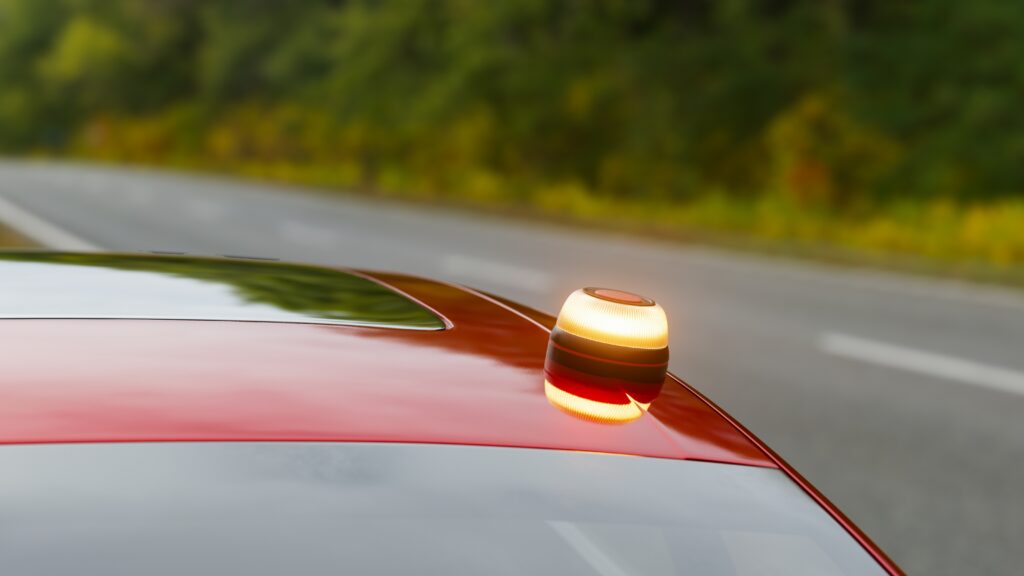
The Guardia Civil officer has questioned whether the outcome could have been different under the previous warning system. Photo credit: AdriaVidal/Shutterstock
Drivers using Spain’s mandatory V16 beacon could face a potentially dangerous visibility problem in certain circumstances, after a Guardia Civil officer has raised concerns that the device may not have been visible to an approaching motorist in time to prevent a fatal crash in Albacete.
The issue centres on a breakdown involving a SsangYong Rodius on the N-322 near the Romica industrial estate, where the vehicle had stopped on the hard shoulder with a V16 beacon deployed. The vehicle’s height may have prevented the warning light from being seen clearly by traffic approaching from behind.
The fatal collision
The crash happened at around 06:50am, when the Rodius stopped after suffering a breakdown. Its driver placed the V16 on the roof of the vehicle. The Rodius stands at more than 1.80 metres tall, and a Guardia Civil traffic officer believes this may have affected how visible the beacon was to approaching motorists.
A Ford Kuga travelling from Barcelona towards Jaén was approaching the stationary vehicle when its driver apparently failed to see it until the last moment. The Kuga then swerved to avoid the Rodius, crossed into the opposite lane and collided head-on with another car. Both drivers, who were reportedly over 60, died in the collision. A woman was also seriously injured.
Driver reportedly tried to reposition the beacon
The circumstances surrounding the V16 have raised further questions because the driver of the Rodius had already recognised a potential visibility problem. According to the account given to officers, the driver realised that the beacon was not sufficiently visible and was attempting to move it when the collision occurred. The Guardia Civil officer subsequently questioned whether the height of the Rodius had prevented the warning light from being seen early enough by the Kuga driver.
The V16 had therefore been deployed, but the warning may still have been difficult for approaching traffic to detect because of the vehicle’s height. Traditional warning triangles could be positioned at a distance behind a stationary vehicle, giving approaching motorists a warning before reaching the vehicle itself. The V16 is positioned directly on the immobilised vehicle, making its visibility dependent on where it can be placed and the line of sight from approaching traffic.
Could the triangles have made a difference?
The officer also raised the possibility that the outcome could have been different under the previous warning system. Traditional warning triangles could be positioned at a distance behind a stationary vehicle, allowing approaching motorists to receive a warning before reaching the vehicle itself.
The V16, by contrast, is positioned directly on the immobilised vehicle. Its location is therefore dependent on the driver’s ability to place it somewhere that remains visible to approaching traffic. The issue becomes more complicated with high-bodied vehicles, where even placing the beacon on the roof may not guarantee that it can be seen clearly from a sufficient distance.
DGT rules on where to place the V16
Spain’s V16 system became compulsory for immobilised vehicles on January 1, this year, replacing the traditional warning triangles. DGT guidance requires the beacon to be placed on the highest possible part of the vehicle, with the roof the preferred position when it can be reached safely. If the roof cannot be accessed, it may be placed in an accessible lateral position while remaining as high and horizontal as possible.
In the Albacete case, the beacon was reportedly placed on the roof of the Rodius, where they are meant to be placed the circumstances have raised the possibility that the position itself may not have provided sufficient visibility from behind. The connected V16 also transmits the location of the immobilised vehicle to the DGT 3.0 platform, providing information that can be distributed through connected traffic services. That additional warning does not, however, change what a driver approaching the stationary vehicle can physically see from the road.
The V16 has not been blamed officially
There is currently no official finding that the V16 caused the Albacete crash. Investigators still have to establish exactly what the Kuga driver could see, when the Rodius became visible and how much time was available to react. The investigation will also determine whether the beacon’s position played a significant role in the collision or whether other factors were involved.
For now, the Guardia Civil officer’s assessment remains a possible explanation rather than a confirmed cause. The case nevertheless raises a specific concern for drivers who may have to stop on a Spanish road: even when a V16 is deployed in accordance with the rules, its position on a high vehicle may not necessarily give approaching traffic enough visual warning to react safely.
Follow Euro Weekly News on Google News
Get breaking news from Spain, travel updates, and expat stories directly on your Google News feed.
Follow on Google NewsSign up for personalised news
Subscribe to our Euro Weekly News alerts to get the latest stories into your inbox!
By signing up, you will create a Euro Weekly News account if you don't already have one. Review our Privacy Policy for more information about our privacy practices.



Molly Grace
Molly is a British journalist and author who has lived in Spain for over 25 years. With a background in animal welfare, equestrian science, and veterinary nursing, she brings curiosity, humour, and a sharp investigative eye to her work. At Euro Weekly News, Molly explores the intersections of nature, culture, and community - drawing on her deep local knowledge and passion for stories that reflect life in Spain from the ground up.
Comments