British families face hard truth as Spain’s pupils fall up to two years behind UK
By Harry Dennis • Published: 08 Sep 2026 • 12:39 • 4 minutes read
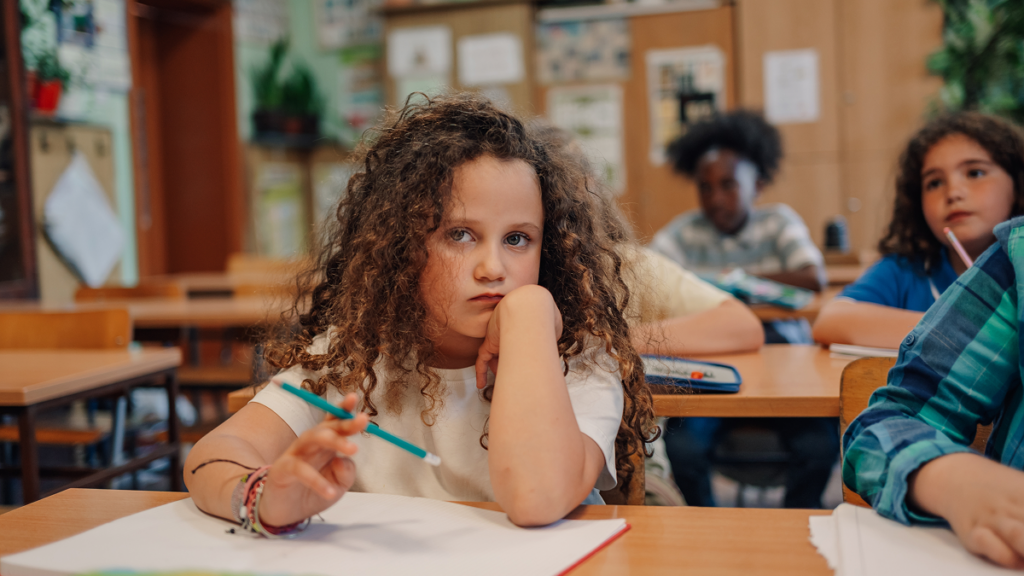
Spain’s latest PISA results reveal a widening education gap with the UK and stark differences between Spanish regions. Credit: Zamrznuti tonovi / Shutterstock
Spanish teenagers have fallen up to two years behind their UK peers after recording their worst-ever PISA results, leaving British parents with an uncomfortable question about where their children should be educated.
The school question British families can no longer afford to ignore
For families considering a move to Spain, questions about jobs, housing and residency can usually be answered with figures. However, one of the biggest doubts of all, and a much harder questions to answer, is how good the education will be for their children.
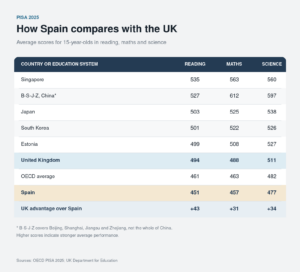
The latest Programme for International Student Assessment (PISA) results provide the clearest official comparison available, and the gap is uncomfortable. Spanish 15-year-olds recorded the country’s lowest scores since testing began in 2000, averaging 457 points in maths, 451 in reading and 477 in science.
UK pupils scored 488 in maths, 494 in reading and 511 in science, placing the country among the world’s ten strongest-performing education systems across all three subjects. That leaves Spanish teenagers 31 points behind their UK peers in maths, 43 behind in reading and 34 behind in science.
The Organisation for Economic Co-operation and Development says a 22-point difference represents slightly more than one year of learning. Using that broad comparison, Spanish pupils are approximately a year and a half behind their UK counterparts in maths and close to two years behind in reading.
Spain’s education gap widens
PISA isn’t just an ordinary school examination. It tests whether 15-year-olds can use their knowledge to interpret information, solve problems and deal with situations they may face outside the classroom. More than 760,000 pupils across 91 countries and economies participated in the 2025 assessment, whose results were published on September 8. Spain’s decline was considerably sharper than the average across developed countries, and since the previous assessment in 2022, it lost 23 points in reading and 16 in maths, while science also fell. The UK’s results, meanwhile, remained stable in reading and maths and improved substantially in science.
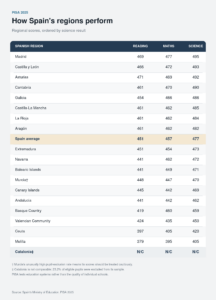
The national totals also conceal enormous differences within Spain itself. Madrid scored 477 in maths and 469 in reading, while Asturias led Spain in reading with 471. Castilla y León also remained above the national average.
Results were much weaker in several areas popular with foreign residents. Andalucía scored 442 in maths and 441 in reading, while the Balearic Islands recorded 449 and 441 respectively.
The Valencian Community fell particularly far, scoring 435 in maths and just 424 in reading, 67 points below the UK. Murcia registered 447 in maths and 448 in reading, although its figures must be treated cautiously because an unusually high proportion of selected pupils was excluded from the assessment.
Cataluña’s regional results cannot be reliably compared at all after 23.2 per cent of its selected pupils were excluded, far beyond the five per cent limit normally accepted by the OECD.
Does this mean Spanish state schools are failing?
The figures deserve attention, but they don’t provide a straight-forward verdict on every Spanish state school. PISA compares entire education systems and includes pupils attending public, state-funded semi-private concertado schools and fully private schools. It doesn’t directly compare an average Spanish state school with an average British state school.
The report also found that much of the apparent advantage enjoyed by private schools in Spain was linked to the more affluent backgrounds of their pupils. Once the socioeconomic circumstances of both pupils and schools were taken into account, the difference narrowed and reversed in favour of public schools.
But exam results don’t capture everything parents value in a childhood. Despite their lower academic scores, 89.5 per cent of Spanish pupils said they felt that they belonged at school, one of the highest proportions recorded anywhere in the assessment. Spanish teenagers also reported greater curiosity, perseverance and willingness to continue when schoolwork became difficult than the OECD average. They were more likely to feel safe and connected to their classmates, while reported exposure to bullying was comparatively low.
That leaves British parents with a more complicated picture than a league table alone can give. The UK has stronger academic performances, but evidence of high levels of belonging and social integration is in Spain.
The decision must be made school by school
For a British child entering Spanish education, the experience will depend heavily on their age, Spanish ability, region and individual school. Parents should ask which language subjects are taught in, particularly in autonomous regions with a co-official language; what support is available for newly arrived pupils; whether the school publishes local assessment results; and how it helps children who may later return to the British education system. Moving an eight-year-old into a Spanish primary school is also a very different decision from transferring a teenager who is approaching GCSE or Spanish Bachillerato age.
The new PISA results don’t mean British families should automatically reject Spain’s state system or assume that an expensive private school guarantees better teaching. But they do, however, make it harder to dismiss concerns about falling standards.
A move to Spain can give a child another language, another culture and a very different way of life. But the latest figures are a reminder that the school decision deserves every bit as much scrutiny as the home, the job and the move itself.
Follow Euro Weekly News on Google News
Get breaking news from Spain, travel updates, and expat stories directly on your Google News feed.
Follow on Google NewsSign up for personalised news
Subscribe to our Euro Weekly News alerts to get the latest stories into your inbox!
By signing up, you will create a Euro Weekly News account if you don't already have one. Review our Privacy Policy for more information about our privacy practices.


Harry Dennis
Born in the UK and raised on the Cádiz coast, Harry brings his background in design, music, and photography to his writing for Euro Weekly News, sharing stories that celebrate culture and lifestyle across Spain and beyond.
Comments