Spain’s record heat breaks with a 10ºC drop, and Alicante gets hail on the first day back at school
By Harry Dennis • Published: 08 Sep 2026 • 10:30 • 2 minutes read
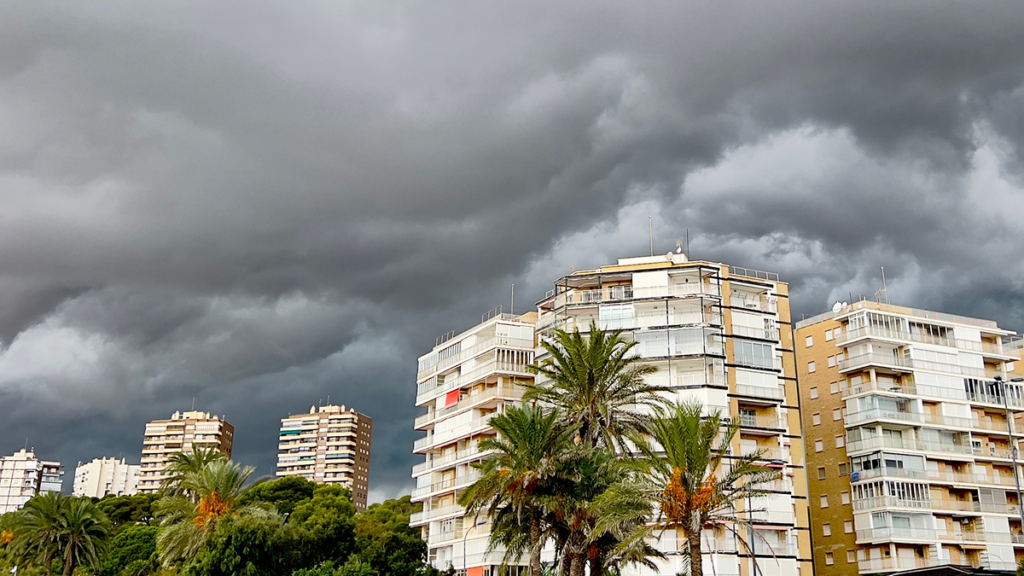
Storms, large hail, torrential rain and strong winds hit Alicante on Wednesday. Credit: marinissim / Shutterstock
Thousands of children in Alicante go back to school on Wednesday, the same afternoon AEMET expects large hail and torrential rain along the coast north of the city. The record-breaking heat of the past week breaks in Spain on exactly the same day.
Maximum temperatures fall 6 to 10ºC in a day
AEMET spokesman Rubén del Campo said Wednesday would bring “an accentuated temperature drop in much of the territory”, with maximum temperatures 6 to 10ºC lower than the day before across wide areas. Inland cities feel it most sharply. Zaragoza is forecast to fall from around 38ºC on Tuesday to about 27ºC on Wednesday, and Madrid from 34ºC to 25ºC.
Burgos, Soria, Bilbao, Pamplona and Logroño will reach only 20 to 22ºC, figures more usual in mid-October than in the second week of September.
Why the Alicante coast is on orange warning from 2pm
The front is not arriving over a cool sea. Mediterranean surface temperatures have run at record levels this year, and polar air moving in above that warm water is what turns a straightforward cool-down into something heavier. AEMET has an orange warning in place for the northern coast of Alicante province from 2pm until midnight on Wednesday, covering storms, large hail, torrential rain and strong winds. Yellow warnings cover the interior and areas further south.
The thresholds behind the warnings reach 60 litres per square metre in 12 hours and 40 litres in a single hour. The timing is also not great, with Wednesday September 9 being the day thousands of pupils across the province return to class, and the warning opens just as the afternoon school run begins.
Galicia and Asturias take the first hit
The front spends Tuesday over the northwest. Del Campo forecast “strong and persistent precipitation in Galicia and Asturias, with accumulations exceeding 40 litres per square metre in less than 12 hours”, with rain also reaching northern and western Castilla y León.
By Wednesday the storms have spread across the north and centre of the country and into the Balearic Islands, some of them carrying hail, with strong northerly winds following behind.
Murcia and southern Andalucía stay above 36ºC
Not everywhere gets the change though. The southeast holds on to the heat through Wednesday, with Murcia and southern Andalucía still expected to pass 36ºC while northern cities sit 15 degrees lower. The Canary Islands keep their calima (a dust haze carried in from the Sahara) rather than any real cooling.
The sharpest contrast arrives overnight. Del Campo said night-time temperatures would drop by around 10ºC across much of the centre and the northern half of the country by Thursday morning, when Teruel and Ávila could fall below 5ºC.
That comes barely a week after El Granado in Huelva reached 45.7ºC, equalling the national September record set at Montoro in 2016 and standing as the highest temperature measured anywhere in Spain this year.
The heat is back by Friday
High pressure builds in again on Thursday and the recovery starts almost immediately. AEMET expects highs of 30 to 35ºC across the east, centre and south by Friday and through the weekend, with Extremadura and western Andalucía approaching 35 to 37ºC.
Nights will be fresher inland in the north, though still tropical along the Mediterranean coast and in the far south.
The break is short, and what matters inside it is the rain rather than the temperature. In an area where AEMET’s own thresholds allow for 40 litres in an hour, a road can go from dry to flooded between the last bell and the drive home.
Follow Euro Weekly News on Google News
Get breaking news from Spain, travel updates, and expat stories directly on your Google News feed.
Follow on Google NewsSign up for personalised news
Subscribe to our Euro Weekly News alerts to get the latest stories into your inbox!
By signing up, you will create a Euro Weekly News account if you don't already have one. Review our Privacy Policy for more information about our privacy practices.




Harry Dennis
Born in the UK and raised on the Cádiz coast, Harry brings his background in design, music, and photography to his writing for Euro Weekly News, sharing stories that celebrate culture and lifestyle across Spain and beyond.
Comments