Flying lost its easy charm: 25 years since 9/11 remade airport security
By Adam Woodward • Updated: 09 Sep 2026 • 23:05 • 4 minutes read
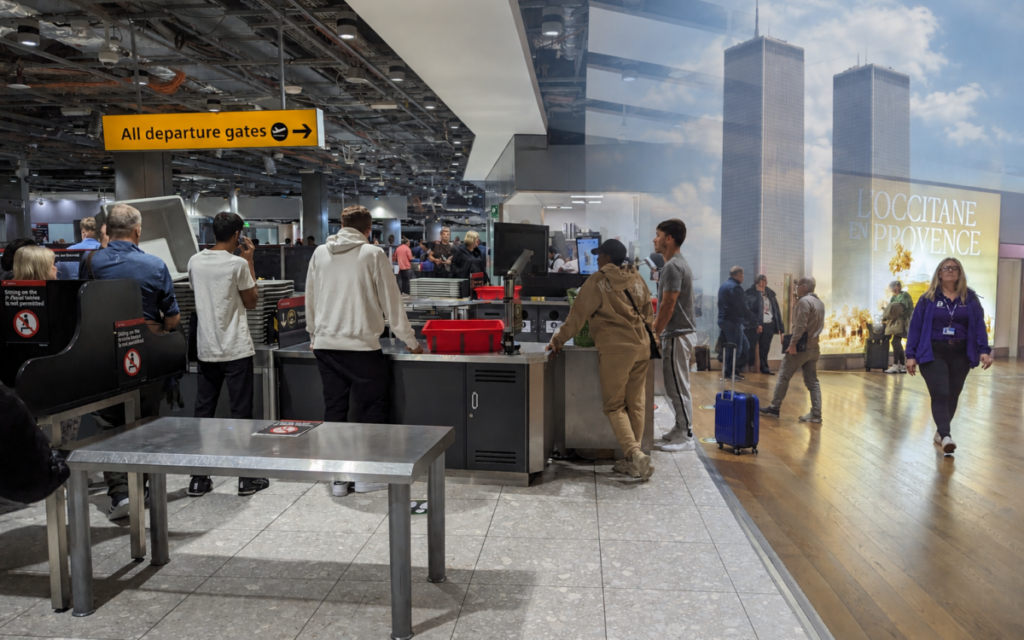
25 years of intensified airport security. Credit: 1000 Words - Shutterstock
Friday marks a quarter of a century since four hijacked airliners turned a clear September morning into the most watched terror attack of the television age, and it changed all of us. Nearly 3,000 people died when two jets tore into New York’s Twin Towers, a third ripped into the Pentagon, and a fourth came down in a field near Shanksville, Pennsylvania, after passengers fought back. World Trade Center Building 7 later fell as well. Families from more than 90 countries lost someone that day.
Live pictures of the towers collapsing went round the world in real time. Many readers of a certain age still remember exactly which kitchen, office or school corridor they were standing in. Days later President George W. Bush told a press conference a seemingly inconsequential and simple line that still shapes policy and lives today: “Either you are with us, or you are with the terrorists.” And no one dared complain about airport security again.
Governments reached for new laws, new wars and a new vocabulary, such as the so-called ‘War on Terror’, and ordinary life changed in quieter ways too. Few of those changes are closer to home for Britons and other Europeans heading to Spain or further, than the business of boarding a plane.
Once, air travel still carried a faint sense of occasion. It was even considered ‘romantic’ once. Even after D.B. Cooper’s 1971 parachute hijack pushed metal-detector arches into terminals, you could often stroll to a gate with a relative, keep your shoes on, and treat a bottle of water as nobody’s business but your own. That world ended on September 11, 2001.
What passengers now go through
Layer upon layer of extra screening followed and rarely has been questioned, first in the United States and then, with local variations, across Europe. A short list of the main changes since that morning runs like this:
- Federal or state screeners replaced many of the private contractors airlines used to hire.
- Photo identification became a hard requirement, not a polite request.
- Only ticketed passengers pass beyond the checkpoint; waving someone off at the gate is a distant memory.
- Reinforced, locked cockpit doors were fitted across commercial fleets by 2003, and cabin access to the flight deck is barred.
- Armed air marshals were put on more routes.
- Every piece of checked baggage is now supposed to be screened for explosives, not a small sample.
- Richard Reid’s failed “shoe bomb” attempt in December 2001 led, from 2006, to footwear coming off at many checkpoints. United States airports dropped that shoes-off rule last year, though habits die hard.
- After British police broke up a 2006 plot to mix liquid explosives on flights out of Heathrow, the 100ml / 3-1-1 liquids rule spread worldwide. Some UK airports now allow larger bottles through new scanners; Spanish checkpoints are still mixed, even as Malaga and other Aena airports roll out 3D cabin-bag machines.
- Full-body scanners, explosive-trace wipes, laptop-out-of-the-bag drills and, later, computed-tomography X-rays joined the queue.
- Watch-list matching, trusted-traveller lanes and, in the European Union, advance passenger data plus the new Entry/Exit biometric system added another paper trail before anyone even reaches the belt.
EU rules on advance passenger information are in the same family of post-attack thinking: know who is flying before the wheels leave the tarmac. A bomb scare at Malaga earlier this year showed how quickly a single message still empties a jet bridge.
Romance drained out of the flying experience. Travellers now factor in an extra hour or two, decant shampoo into tiny bottles, and treat a joke about a bomb as a career-ending mistake at the airport. Security queues became part of the holiday, not an interruption of it.
Front door tight, back door less so?
Passenger halls get the cameras, the trays, falling trousers as the belt comes off and the public argument with security staff. Does cargo get the same? Freight still arrives through service roads, warehouses and “known shipper” schemes that rely as much on paperwork and trusted companies as on a scanner staring at every pallet. United States law eventually required 100 per cent screening of cargo on passenger aircraft after the 2010 printer-cartridge bomb plot from Yemen; all-cargo freighters and some off-airport screening still work to a different rhythm.
Inspectors and congressional reviews have, for years, warned that a shrink-wrapped pallet is harder to read than a cabin bag, and that staff doors and cargo gates do not always face the same scrutiny as the family shuffling through Terminal 3.
Safer? More uncomfortable
Official histories of the era, including the TSA’s own timeline and the record kept at the National September 11 Memorial & Museum, show a system built in panic and then patched, year after year, as each new plot exposed another gap. Flying is statistically safer from hijacking than it was on 10 September 2001. Cockpit doors hold. Box-cutters do not sail through unchallenged. Random people no longer wander airside because they fancied a look at the departure board.
Comfort is another matter. Suspicion became a habit. Fellow passengers are scanned as possible threats. Staff bark instructions because the drill leaves little room for a smile. Children who never knew the old ease grow up thinking a clear plastic bag of toothpaste is simply how holidays begin.
We may be safer in the air than our parents were before that Tuesday morning. We are also more watchful, more impatient, and not quite as easy in our seats as we once were. That, as much as the skyline that never came back, is the long shadow of 11 September 2001.
Follow Euro Weekly News on Google News
Get breaking news from Spain, travel updates, and expat stories directly on your Google News feed.
Follow on Google NewsSign up for personalised news
Subscribe to our Euro Weekly News alerts to get the latest stories into your inbox!
By signing up, you will create a Euro Weekly News account if you don't already have one. Review our Privacy Policy for more information about our privacy practices.



Adam Woodward
Adam is a writer who has lived in Spain for over 25 years. With a background in English teaching and a passion for music, food, and the arts, he brings a rich personal perspective to his work at Euro Weekly News. As a father of three with deep roots in Spanish life, Adam writes engaging stories that explore culture, lifestyle, and the everyday experiences that shape communities across Spain.
Comments