Where wild boars swim with tourists: The island cove that’s going viral
By Lucy Ramnought • Published: 15 Sep 2026 • 14:14 • 3 minutes read
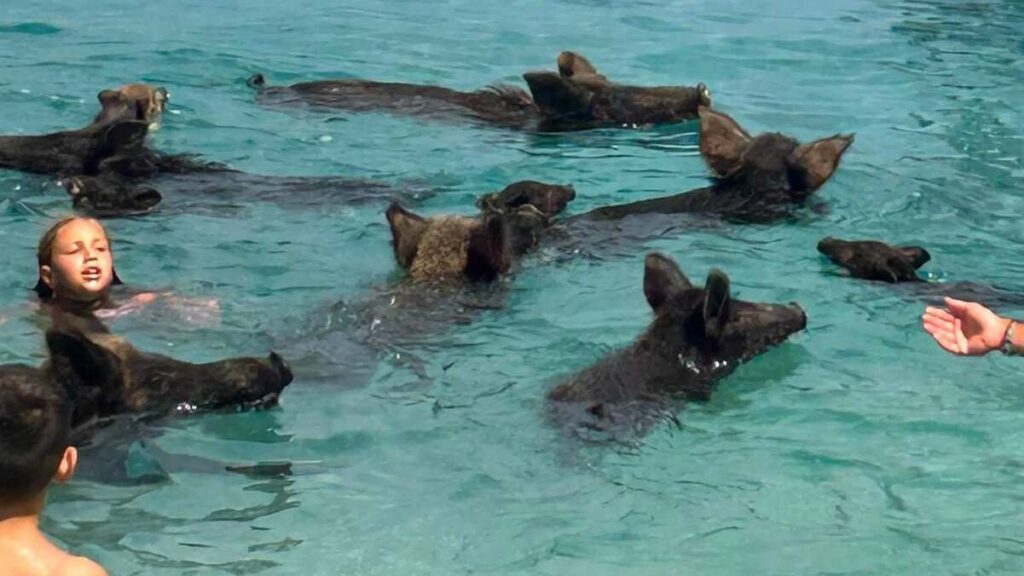
Take a bath with a boar Credit: Maria Enache/FB
You are paddling in the turquoise shallow waters, looking back at the stunning cove and a gorgeous shoreline. Now imagine it with a crowd of wild pigs swimming past your toes. The interesting thing is, people cannot get enough of it.
How a private island became “Piggy Island”
Atokos sits in the Ionian Sea, just off Ithaca, and until recently few travellers had reason to stop. The 4.5 sq km island is privately owned by shipping magnate Panayiotis Tsakos, largely uninhabited apart from a few goats, and protected under the EU’s Natura 2000 network for its rare marine life.
Everything changed when clips of black pigs roaming the sand and slipping into the sea started spreading on TikTok and Instagram. Suddenly, boat operators from Ithaca, Lefkada and Kefalonia began fielding requests for “pig trips”, with some skippers even carrying fruit to coax the animals closer.
Renato Bisha, who runs excursions from Ithaca, now makes several daily runs to Atokos as demand climbed through the summer. For many guests, the main goal is to take a dip with its hairy hosts. Social media fame has even spawned a new nickname: the island is now jokingly referred to as “Piggy Island” or “Pig Island” on tour listings and travel blogs.
Pigs that swim like locals
Local reports describe the Atokos animals as a herd of feral pigs that have grown comfortable with people and treat the sea as a natural cooling pool. When temperatures rise, they wade out, paddle in shallow water and return to the sand to dry off. Their natural buoyancy and paddling instincts make for great footage.
Experts still urge caution. Although the animals appear relaxed, they are of course wild. Several tour operators now explicitly forbid feeding or touching the pigs, warning that handouts can make them aggressive and increase the risk of bites.
Costa del Sol boars to a Greek pig pool
On the Costa del Sol, wild boars have become a familiar, sometimes unwelcome, sight on beaches and around the streets, often linked to food-seeking behaviour. They are seen by many as a safety issue, not an attraction.
Both the Atokos swimmers and the Costa del Sol beachgoers belong to the same species, Sus scrofa, which covers wild boar, feral pigs and their hybrids; the key difference is that the Greek island herd is a small, isolated group of feral pigs habituated to tourists, while the Spanish animals are largely wild boar and wild boar–domestic pig hybrids living in and around dense urban areas.
As members of the same species, both populations can carry pathogens transmissible to humans and other animals, recent veterinary studies found that more than 90% of urban wild boar and feral pig samples carried at least one pathogen, and around 86% carried agents with zoonotic potential, prompting health warnings about close contact, feeding and bites.
Atokos pigs have not been subject to the same large-scale urban disease surveys, but experts still classify them as wild animals capable of biting and transmitting infection if people feed, touch or corner them, especially sows with piglets.
In both settings, the practical advice is similar, keep your distance, do not feed the animals, and seek medical attention for any bite or scratch that breaks the skin
Two coves, one island, no guarantees
Most boat tours anchor at two named bays: a smooth white-pebble inlet known locally as “House Bay”, and a rougher, cliff-backed cove often called “Wild Boar Beach”, where families of pigs are most often spotted.
Sightings are unpredictable. Some days whole groups of pigs roam the shore and wade into the shallows; other days visitors see none at all. That uncertainty has become part of the attraction. Atokos has no villages, no pier and no places to buy food or drink. Visitors must bring their own water, snacks and shade, and take all rubbish back with them.
Question is, would you take a bath with the boars??
Follow Euro Weekly News on Google News
Get breaking news from Spain, travel updates, and expat stories directly on your Google News feed.
Follow on Google NewsSign up for personalised news
Subscribe to our Euro Weekly News alerts to get the latest stories into your inbox!
By signing up, you will create a Euro Weekly News account if you don't already have one. Review our Privacy Policy for more information about our privacy practices.

Lucy Ramnought
Lucy Ramnought is a local news writer and mother of 4 from the UK who has lived in the Costa Del Sol for just over 4 years. With a background in content writing and social media for various companies, and with vast experience in PA and project management, Lucy is committed to producing accurate, engaging and reliable stories to her work at Euro Weekly News.
Comments