Spain’s answer to the Ceuta crisis opens in chaos as police struggle to contain rush

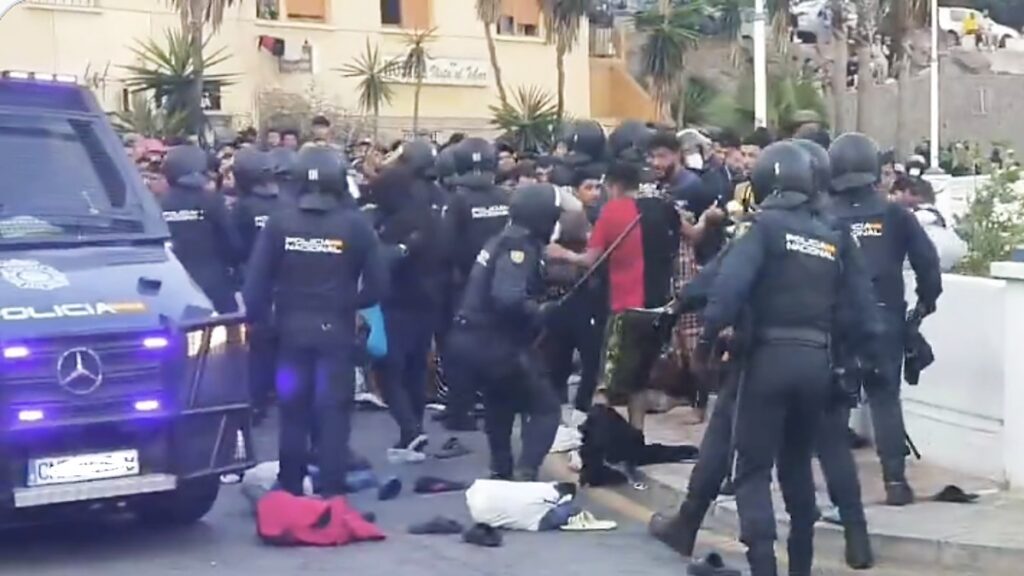
Spanish National Police officers intervene as a large crowd gathers during the Ceuta camp operation.

Spanish National Police officers move in as tension rises during the transfer operation to Ceuta’s new temporary camp. Credit: Social media video screenshot

Spain opened its new Ceuta camp this morning. Within hours, police were struggling to control a rush of migrants desperate to get inside. See video below

The camp was supposed to bring order after weeks of people sleeping on beaches around the city. Instead, the first transfers exposed the pressure that has been building since the mass entry from Morocco.

People waiting at the beaches of El Trampolín and Benítez rushed towards the new site at Ceuta port after fearing they would be left without a place. Police tried to organise the move in groups, but the initial transfer quickly became chaotic. Officers fired warning shots into the air and used force before the operation was brought back under control.

El País reported the tense first transfer to the new camp here.

For Ceuta residents, it was a troubling start to a project Madrid had presented as a practical response to a crisis that has already stretched the city’s services, public spaces and patience to their limit.

A camp was meant to restore order

The government is moving people from the beaches into a temporary facility at the port, with space intended for around 1,800 people.

Providing shelter is necessary. Nobody should be sleeping in unsafe and unsanitary conditions on public beaches. But the events of the first morning show that accommodation alone is not a policy.

Madrid has built a camp, but it has still not explained clearly what happens after people enter it.

How long will they remain there? How many are being processed for return? How many are minors? How many have sought asylum? How many cases are waiting for documentation or agreement from Morocco?

Those are the questions residents need answered.

For the wider background to why Ceuta has become one of Spain’s biggest political flashpoints, see our guide, Ceuta explained. Why this Spanish city in Africa is suddenly making headlines.

Spain promised returns

At the height of the mass entry, Spain said people crossing illegally into Ceuta would be returned to Morocco. Tens of thousands did go back in the first days of the crisis.

Spain and Morocco agreed to accelerate returns, while the Spanish government insisted that the border had been breached and that order would be restored.

Euro Weekly News reported that 200 people had been expelled from Ceuta as concerns over security mounted.

The European Commission has also called for stronger protection of EU external borders, closer cooperation with Morocco and more effective returns for people with no legal right to stay.

European Commission President Ursula von der Leyen said the returns system had worked during the first phase of the crisis. She called for stronger border controls, early warning systems and more action on returns. Her statement following the Ceuta crisis is reported here.

That makes the current situation harder for Madrid to explain.

If returns worked when the crisis first erupted, why has the government not published a clear timetable for the thousands who remain?

Why the process has slowed

Spain cannot legally return every person still in Ceuta without first examining their individual case.

The Supreme Court has ruled that people who enter by swimming around the border cannot automatically be subjected to the same immediate return procedure used for people stopped at the physical land fence.

Identity, nationality, age, vulnerability and any asylum claim must be checked. Children have additional legal safeguards. Some people who crossed from Morocco may not be Moroccan nationals.

El País explained the Supreme Court ruling on sea arrivals here.

Those rules matter. They should be followed properly.

But proper process must not become permanent delay.

The court ruling does not say Spain cannot return people who entered illegally by sea. It says the government must follow due process. That requires staff, coordination, transparency and urgency.

Ceuta needs more than a temporary camp

The chaos at the camp’s opening is a warning that Madrid cannot simply move the crisis from the beaches into a fenced area at the port and call the job done.

The government should now publish weekly figures on how many people remain in Ceuta, how many cases are being processed for return, how many are minors and how many have claimed asylum.

It should also say when the camp is expected to close.

Ceuta is a Spanish city and an external border of the European Union. Its residents should not be asked to live indefinitely with the effects of slow procedures and vague promises.

A camp can offer short term shelter. It cannot replace a clear plan to restore order, process cases quickly and return those with no legal right to remain.

Google News

Follow Euro Weekly News on Google News

Get breaking news from Spain, travel updates, and expat stories directly on your Google News feed.

Follow on Google News
Written by

Nazario Rodriguez

I’ve worked in news media for over 10 years, previously as Production Manager at Euro Weekly News, and I now focus on audience strategy and content performance. I specialise in understanding what readers engage with and shaping content that serves them well.

Comments


    • Cati

      18 September 2026 • 10:55

      You ask: “How long will they remain there? How many are being processed for return? How many are minors? How many have sought asylum? How many cases are waiting for documentation or agreement from Morocco?”, but how can those questions be answered without processing those people first, are you suggesting they be processed in camps on the beaches? Of course they need to be moved into a facility to enable the authorities to answer your questions.

      Reply
      • Nazario Rodriguez

        18 September 2026 • 11:01

        The camp is necessary, but it only provides around 1,800 places. Estimates of the number still sleeping on Ceuta’s beaches have reached more than 10,000.

        After around 50 days, that leaves a major gap between the scale of the problem and Madrid’s response. The government needs to explain where the remaining people will be accommodated, how cases will be processed and when Ceuta can expect this emergency to end.

        Reply

    Leave a comment

    Your email address will not be published. Required fields are marked *