Why abandoned cars can take months to disappear from Spain’s streets
By Adam Woodward • Published: 19 Sep 2026 • 11:41 • 3 minutes read
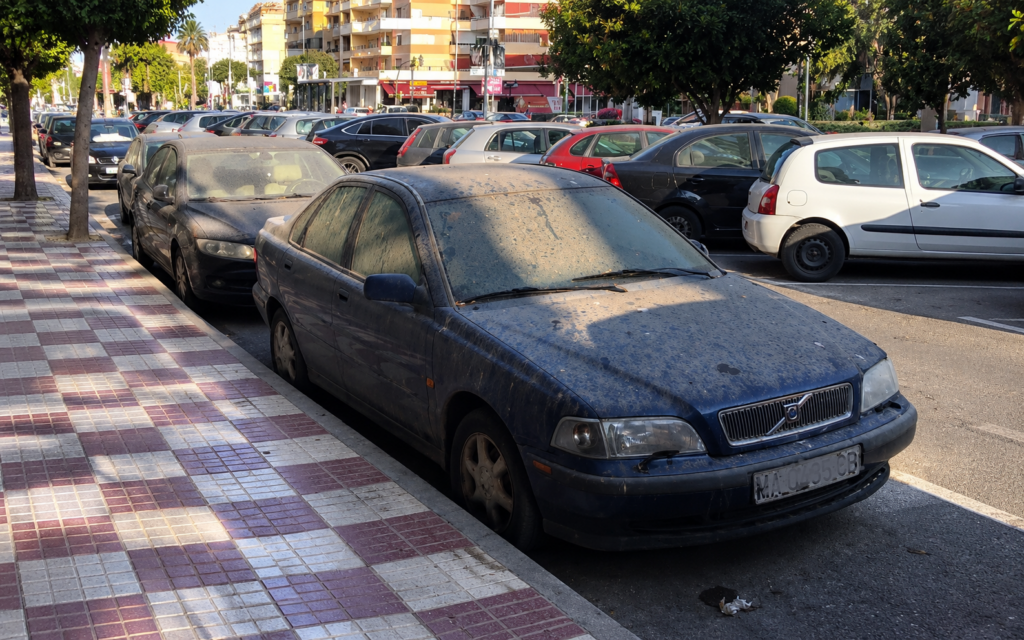
Abandoned for 3 months on the streets of Marbella. Credit: MsQ
A car that looks abandoned cannot simply be towed away. Spanish law requires authorities to follow a set process.
You may have seen one on your street: a car that has not moved for weeks, covered in dust, with flat tyres or visible damage. For neighbours, it can seem obvious that the vehicle has been abandoned. But getting it legally removed from a Costa del Sol street is not always as simple as calling a tow truck. Spanish traffic law sets out specific conditions before a vehicle can enter the process for removal and eventual destruction.
Under Article 106 of the national Traffic Law, a vehicle can be treated as requiring “tratamiento residual” if it has been parked in the same place for more than one month and has damage making it impossible to move under its own power, or if it is missing its number plates. But reaching that one-month point does not mean the vehicle is immediately taken away.
EWN recently reported how Marbella police towed more than 150 abandoned cars in just two months, showing how the issue is affecting the streets of major Spanish towns.
The owner gets another month
Once the council and local police have established that the vehicle meets the conditions, they must require the registered owner to remove it. The owner must be warned that the vehicle will be transferred to an authorised treatment centre if it is not removed within one month.
That means the process can already stretch well beyond the period during which residents may have been watching the same car occupy a parking space. Fuengirola’s official procedure provides a useful real-world example. Local Police first check the vehicle and establish whether it meets the legal requirements. If it qualifies, a warning sticker is placed on it before the registered owner is contacted and given one month to resolve the situation. If the owner cannot be located, the process becomes more complicated.
When the owner cannot be found
Fuengirola says details can then be published in the Boletin Oficial del Estado (BOE). After publication, another 30 days must pass before the vehicle can be removed. Once the relevant periods have expired, the vehicle can be taken from the street and sent to an authorised vehicle treatment centre.
Fuengirola says its complete procedure takes approximately 90 calendar days. That is not a universal three-month legal deadline across Spain. Instead, it shows how the various stages involved in identifying a vehicle, contacting its owner and completing the required notifications can add up.
Not every abandoned-looking car has to wait
There is an important difference between an apparently abandoned vehicle and one that is causing an immediate problem. Under Article 105 of the Traffic Law, authorities can remove vehicles that create a danger, seriously disrupt traffic or pedestrians, damage public services or property, or obstruct, impede or endanger traffic.
Those powers mean a vehicle creating a serious obstruction does not necessarily have to go through the full abandoned-vehicle procedure before being removed.
What happens after removal?
A vehicle that enters the residual-treatment process cannot simply be dumped. Spanish law requires end-of-life vehicles to be sent to an authorised treatment centre, where they are processed and decontaminated. Once the vehicle has been destroyed, the centre issues the relevant certificate and the vehicle can be permanently deregistered.
For anyone returning to the Spanish Costas after a long absence, the message is therefore worth remembering: leaving a car parked on the street for months is not the same as legally storing it there. EWN has also looked at why UK drivers’ cars can be towed away in Spain, particularly when vehicles are left on public roads for extended periods.
A vehicle that looks forgotten may still be working its way through a formal administrative process before the municipal crane is finally able to take it away.
And for residents wondering why an apparently abandoned car can occupy the same parking space for so long, the answer is often paperwork rather than a lack of action.
Follow Euro Weekly News on Google News
Get breaking news from Spain, travel updates, and expat stories directly on your Google News feed.
Follow on Google NewsSign up for personalised news
Subscribe to our Euro Weekly News alerts to get the latest stories into your inbox!
By signing up, you will create a Euro Weekly News account if you don't already have one. Review our Privacy Policy for more information about our privacy practices.





Adam Woodward
Adam is a writer who has lived in Spain for over 25 years. With a background in English teaching and a passion for music, food, and the arts, he brings a rich personal perspective to his work at Euro Weekly News. As a father of three with deep roots in Spanish life, Adam writes engaging stories that explore culture, lifestyle, and the everyday experiences that shape communities across Spain.
Comments