Pedro Sánchez’s wife Begoña Gómez to face jury trial over public money and influence claims
By Nazario Rodriguez • Updated: 21 Sep 2026 • 15:46 • 3 minutes read
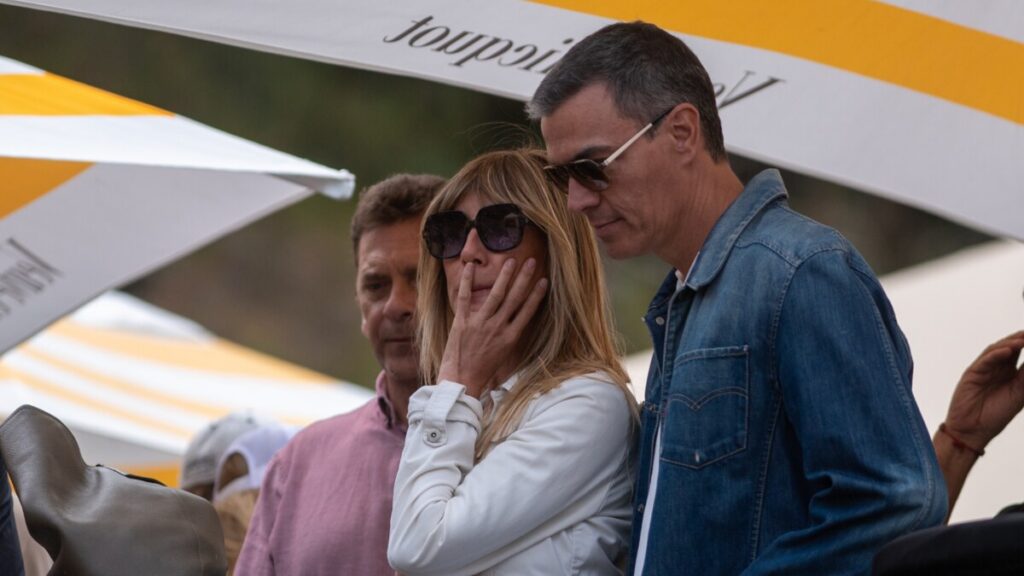
Begoña Gómez and Spanish Prime Minister Pedro Sánchez at a public event. Gómez denies the allegations that will be examined at trial. Photo Credit: Shutterstock / martin SC photo
Nine ordinary Spaniards could soon be handed the most difficult task in Spanish public life, deciding whether Pedro Sánchez’s wife committed crimes linked to influence and public funds, after years of political fury, endless headlines and claims of persecution from the Prime Minister’s Government.
Begoña Gómez is heading for trial before a jury after Madrid judge Juan Carlos Peinado opened oral proceedings against her over alleged influence peddling and misuse of public funds.
Her adviser at La Moncloa, Cristina Álvarez, will also face trial over the alleged misuse of public funds charge.
It is a major moment for Sánchez, even though he is not accused in the case.
His Government has repeatedly argued that the investigation is politically motivated. Gómez denies any crime, and Spain’s Prosecutor’s Office has maintained that there is no criminal case to answer.
But the case has now reached the point where the allegations will be tested in public, before people selected from the public, rather than simply fought through political statements from La Moncloa and the opposition.
What Begoña Gómez is accused of
The case focuses on Gómez’s connection to the Extraordinary Chair of Competitive Social Transformation at Madrid’s Complutense University, and a related digital platform.
The Madrid Provincial Court allowed the case to continue in July over alleged influence peddling and misuse of public funds, while dropping allegations of private sector corruption and misappropriation. It also removed entrepreneur Juan Carlos Barrabés from this jury case and limited the accusation against Álvarez to the alleged misuse of public funds connected with the software project.
According to the court ruling reported by El País, judges found it plausible that Gómez may have benefited from her privileged position as the Prime Minister’s wife in relation to the creation of the university chair and her appointment as its director.
The court also examined claims that a platform developed within the university project was later transferred to Gómez’s company, Transforma TSC SL. The university’s alleged financial exposure has been placed at more than €108,000, alongside money contributed by private sponsors.
Those are allegations, not findings of guilt. Gómez says the chair was created legally, she worked without payment and the platform remained at the university’s disposal. Álvarez also denies criminal wrongdoing.
Readers can follow the earlier stage of the case in our report on Gómez being sent towards trial.
The jury faces an extraordinary burden
This is not a normal jury case. The people selected will be asked to assess allegations involving Spain’s most powerful political office, a university project, public employees, private sponsors, competing media claims and a Prime Minister whose supporters insist the whole case is persecution.
Their verdict must be based only on the evidence presented at trial. In reality, they will enter the courtroom after two years of headlines, television debates and political warfare.
That is an enormous burden for any jury. Spain’s jury system gives nine citizens the task of deciding which facts are proven and whether defendants are guilty or not guilty, under the direction of a professional judge. The law specifically includes alleged influence peddling and misuse of public funds within its scope. Spain’s Jury Law can be read here.
The concern is not whether Gómez deserves the same right to a jury trial as any other defendant. She does.
The concern is whether ordinary citizens can be protected from the intense political pressure surrounding a case that has become a referendum on Sánchez himself.
A jury must not punish someone because they are married to the Prime Minister. Equally, it must not ignore evidence because the defendant is married to the Prime Minister.
That is the impossible balance at the centre of this case.
Sánchez cannot simply dismiss the questions
Pedro Sánchez is right about one essential point. His wife is presumed innocent and should not be treated as guilty before a verdict.
But that principle does not mean the Prime Minister can keep answering every development by calling the case an attack on his family.
The Madrid Provincial Court has already narrowed the case significantly. That matters. It removed two alleged offences, ended the earlier passport restrictions and separated Barrabés from the jury proceedings.
Yet it still allowed a trial to continue over two serious alleged offences.
That leaves Sánchez with a political problem he cannot solve through rhetoric alone. The allegations concern influence, public resources and the distance between private projects and public power.
The Government may continue to argue that the investigation is unfair. Gómez may be acquitted. The Prosecutor’s Office itself says there is no criminal wrongdoing.
But a jury of ordinary Spaniards will now be asked to make sense of a case that politicians, journalists and commentators have spent two years trying to decide for them.
The outcome will affect Gómez directly. The political consequences will land at the door of Pedro Sánchez.
For more background on the tensions surrounding Judge Peinado’s earlier decisions, see our report on the political backlash over his reference to Bettino Craxi.
Follow Euro Weekly News on Google News
Get breaking news from Spain, travel updates, and expat stories directly on your Google News feed.
Follow on Google NewsSign up for personalised news
Subscribe to our Euro Weekly News alerts to get the latest stories into your inbox!
By signing up, you will create a Euro Weekly News account if you don't already have one. Review our Privacy Policy for more information about our privacy practices.




Nazario Rodriguez
I’ve worked in news media for over 10 years, previously as Production Manager at Euro Weekly News, and I now focus on audience strategy and content performance. I specialise in understanding what readers engage with and shaping content that serves them well.
Comments