Is your supermarket kefir really kefir? Spanish study raises a surprising question
By Molly Grace • Published: 25 Sep 2026 • 0:20 • 3 minutes read
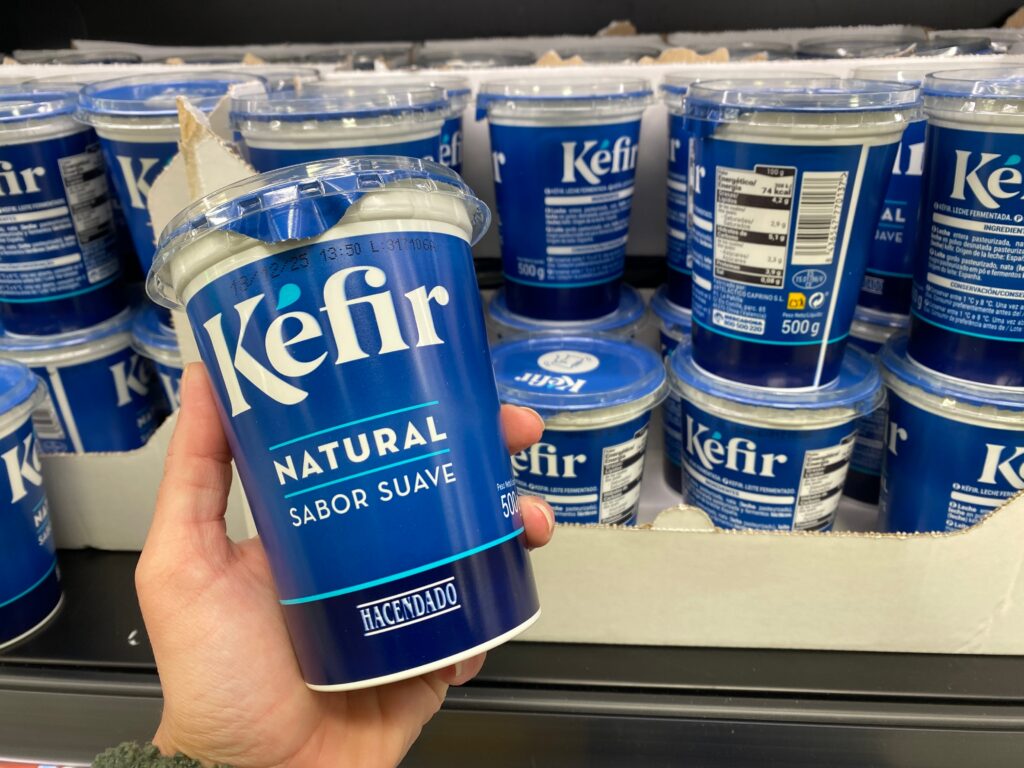
The researchers found considerable differences depending on the type of product. Photo credit:Tetyana_Pidkaluyk / Shutterstock.com
Kefir has gone from something most people had barely heard of to a regular fixture in Spanish supermarket fridges. It is sold as a healthy fermented drink, often bought by people looking for an easy way to add beneficial bacteria and other microorganisms to their diet. But there is a rather awkward problem hiding behind the label. A study by researchers at Spain’s Universitat Rovira i Virgili has found that you cannot reliably tell from the packaging whether the kefir you are buying contains yeast, one of the microorganisms traditionally found in kefir fermentation.
Researchers examined 170 kefir products sold in Spain and initially found that just 36 mentioned yeast on their labels. After one manufacturer corrected an apparent labelling error affecting two products, that figure rose to 38. So, in a supermarket aisle packed with bottles proudly calling themselves kefir, the name alone may not tell you very much about what is actually inside.
What makes kefir kefir?
The distinction is important because traditional kefir is rather more complicated than ordinary yoghurt. Kefir is produced through fermentation involving a community of microorganisms. These include lactic-acid bacteria, acetic-acid bacteria and yeasts, which work together during the fermentation process. That mixture is part of what gives traditional kefir its particular characteristics.
The researchers compared Spanish supermarket products with the international Codex Alimentarius definition of kefir, which recognises the combination of bacteria and yeasts involved in its production. The problem is that European food labelling rules do not require manufacturers to list every microorganism present in a fermented product. That leaves shoppers with a surprisingly simple problem: the front of the bottle may say kefir, but the label may not tell them whether yeast is actually part of the fermentation.
Researchers checked 170 supermarket products
The study was carried out in August 2025 and looked at 170 products from 46 brands sold through national and regional supermarket chains covering around 60 per cent of the Spanish market. The researchers recorded information including the type of milk or other base used, whether the kefir was drinkable or spoonable, its price, whether it was organic and what manufacturers said about its microorganisms. Only 36 products, or 21.2 per cent, explicitly mentioned yeast.
The researchers later issued a correction after Danone informed them that two Activia kefir products did contain yeast, despite it not appearing on their packaging because of an error during the production of the labels. That brings the number to 38 products, or 22.35 per cent. The finding does not mean that the other 132 products were fake kefir or contained no yeast. The study was primarily an examination of product information and labelling, rather than a laboratory test proving the microbial composition of every bottle, that distinction is crucial.
Some kefir products were more transparent
The researchers found considerable differences depending on the type of product.Among cow’s milk kefirs, yeast was declared on 29.9 per cent of labels. None of the goat’s milk, sheep’s milk, mixed goat-and-sheep, plant-based or water kefirs in the sample declared yeast. Drinkable products were also more likely to mention it than spoonable kefirs. Yeast appeared on the labels of 35.7 per cent of drinkable products, compared with 13.1 per cent of spoonable versions. There were differences according to where the products were made, too.
Yeast was declared by 14.7 per cent of nationally produced products, compared with 53.3 per cent of products whose origin was not Spanish. The figures produced another unexpected result when researchers looked at price. Among the cheapest products, 36.8 per cent declared yeast. That fell to 28.1 per cent in the middle price group and just one of the 56 products in the highest-price group. Organic kefir was even more striking. None of the 63 organic products examined declared yeast, compared with 35.5 per cent of conventional products.
What should Spanish shoppers make of it?
The study does not mean people should stop buying kefir, nor does it show that most supermarket kefir is somehow fraudulent. What it does show is that consumers cannot use the label alone to establish the microbial composition of many products sold as kefir. For people buying it specifically because they want traditionally fermented kefir, that lack of information is significant. The researchers argue that clearer labelling would give consumers a better understanding of what they are buying.
They also point to the lack of specific microbiological requirements for kefir under current European rules, compared with the international Codex standard. Kefir may have become a familiar sight in Spanish supermarket fridges, but the research suggests that the name on the bottle does not necessarily give shoppers the full story. And when the whole reason for buying a fermented food is what is happening inside it, that seems like a fairly important detail to leave off the label.
Follow Euro Weekly News on Google News
Get breaking news from Spain, travel updates, and expat stories directly on your Google News feed.
Follow on Google NewsSign up for personalised news
Subscribe to our Euro Weekly News alerts to get the latest stories into your inbox!
By signing up, you will create a Euro Weekly News account if you don't already have one. Review our Privacy Policy for more information about our privacy practices.



Molly Grace
Molly is a British journalist and author who has lived in Spain for over 25 years. With a background in animal welfare, equestrian science, and veterinary nursing, she brings curiosity, humour, and a sharp investigative eye to her work. At Euro Weekly News, Molly explores the intersections of nature, culture, and community - drawing on her deep local knowledge and passion for stories that reflect life in Spain from the ground up.
Comments