Could your Spanish health centre lose its reception desk? Galicia is already testing the change
By Molly Grace • Published: 28 Sep 2026 • 16:33 • 3 minutes read
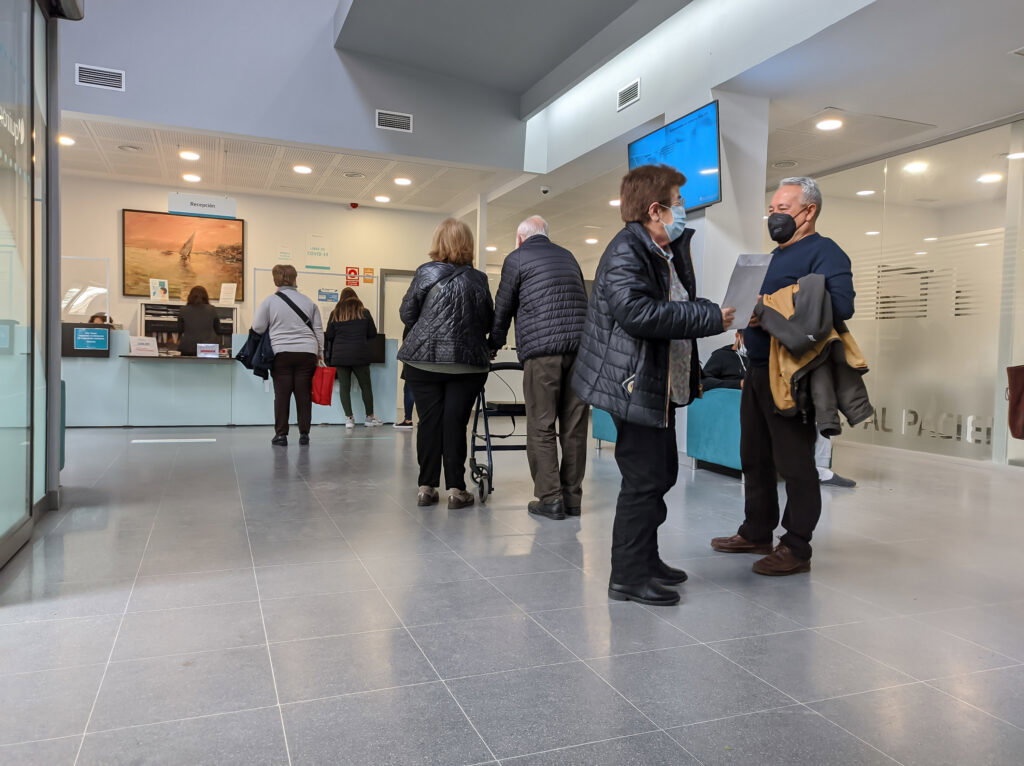
the physical layout of a reception area can make that difficult. Photo credit: agsaz/Shutterstock
If you have ever stood at a health-centre reception trying to explain something personal while people wait behind you, you probably know the uncomfortable feeling. You lower your voice, glance around and hope nobody is listening, but there is often nowhere else to go.
That could be about to change, at least in some parts of Spain. Galicia is testing a new approach that replaces the traditional open reception counter with individual spaces designed to give patients more privacy. If the experiment works, it could provide a model that other health services may consider. For patients, it tackles a surprisingly simple problem: how do you discuss something private when the person next to you can hear every word?
Your medical information should be private
This is not simply about making a health centre more comfortable. Spain’s national Patient Autonomy Law states that everyone has the right to confidentiality regarding information about their health, while healthcare centres must take measures to protect that right. Yet the physical layout of a reception area can make that difficult. Patients may need to explain why they need an appointment, ask about medical documentation, discuss a referral or sort out a sensitive administrative issue before they even reach a doctor.
Doing that at an open counter, with a queue immediately behind you and a waiting room nearby, can mean your conversation is not particularly private. Research into primary-care reception areas has also found that the design of the space can affect confidentiality, with queues close to desks, chairs facing reception and a lack of physical barriers among factors that can make conversations easier to overhear. The issue has also been examined in Spain, with research into confidentiality in patient-service areas at primary-care centres looking at how changes around reception desks could improve patients’ perception of privacy.
Galicia is trying something different
Now Galicia is putting a physical solution to the test, the Xunta is spending almost €1 million on a project across six health centres, replacing traditional reception counters with individualised patient-service spaces and glazed booths. The aim is to allow administrative conversations to take place in a setting that offers greater confidentiality, while also changing the way patients interact with administrative staff.
The six centres involved are Ordes, Os Rosales in A Coruña, Pontedeume, A Guarda, Monforte de Lemos and Virxe da Peregrina in Pontevedra. Work has already been completed at Ordes and Os Rosales, while construction is progressing at the remaining centres. The project forms part of Galicia’s wider strategy for humanising healthcare and improving patient-facing spaces. Rather than asking patients to whisper their personal business across a large counter, the new design gives each conversation its own space.
Could other parts of Spain follow?
This is where things become interesting for patients outside Galicia. There is no national announcement that reception counters are being replaced across Spain, and the Galician project does not automatically mean that health centres in Madrid, Andalucía, Valencia, Murcia or the Balearics will receive the same redesign. Healthcare organisation is largely handled by the autonomous communities, meaning each regional health service can make its own decisions about how primary-care facilities are designed and operated.
But Galicia is not the first Spanish health service to experiment with changing the reception environment. The Basque health service, Osakidetza, has previously redesigned patient-attention areas, including replacing traditional counters with individual desks. Its stated objectives included improving accessibility, comfort and confidentiality for users. That means the idea itself is not entirely new in Spain. Galicia’s current project is significant because it is now being tested across six primary-care centres as part of a specific humanisation initiative.
Patients could have a say
For someone sitting in a waiting room elsewhere in Spain, the question is therefore not whether their local reception desk is definitely about to vanish. It is whether regional health authorities will look at projects such as Galicia’s and decide that patients should not have to discuss private matters within earshot of everyone waiting for their appointment. The legal right to confidentiality already exists. The challenge is making sure the environment in which patients receive administrative care makes that possible in practice.
If Galicia’s new spaces prove effective, they could give other regions something concrete to examine rather than simply asking staff and patients to be more careful about what can be overheard. For anyone who has ever found themselves standing at a crowded health-centre desk, trying to explain something they would rather nobody else knew about, that could be a welcome change.
Follow Euro Weekly News on Google News
Get breaking news from Spain, travel updates, and expat stories directly on your Google News feed.
Follow on Google NewsSign up for personalised news
Subscribe to our Euro Weekly News alerts to get the latest stories into your inbox!
By signing up, you will create a Euro Weekly News account if you don't already have one. Review our Privacy Policy for more information about our privacy practices.



Molly Grace
Molly is a British journalist and author who has lived in Spain for over 25 years. With a background in animal welfare, equestrian science, and veterinary nursing, she brings curiosity, humour, and a sharp investigative eye to her work. At Euro Weekly News, Molly explores the intersections of nature, culture, and community - drawing on her deep local knowledge and passion for stories that reflect life in Spain from the ground up.
Comments