Gibraltar reminds everyone what country they are in with red phone boxes and London-style bus stops
By Adam Woodward • Published: 30 Sep 2026 • 18:17 • 4 minutes read
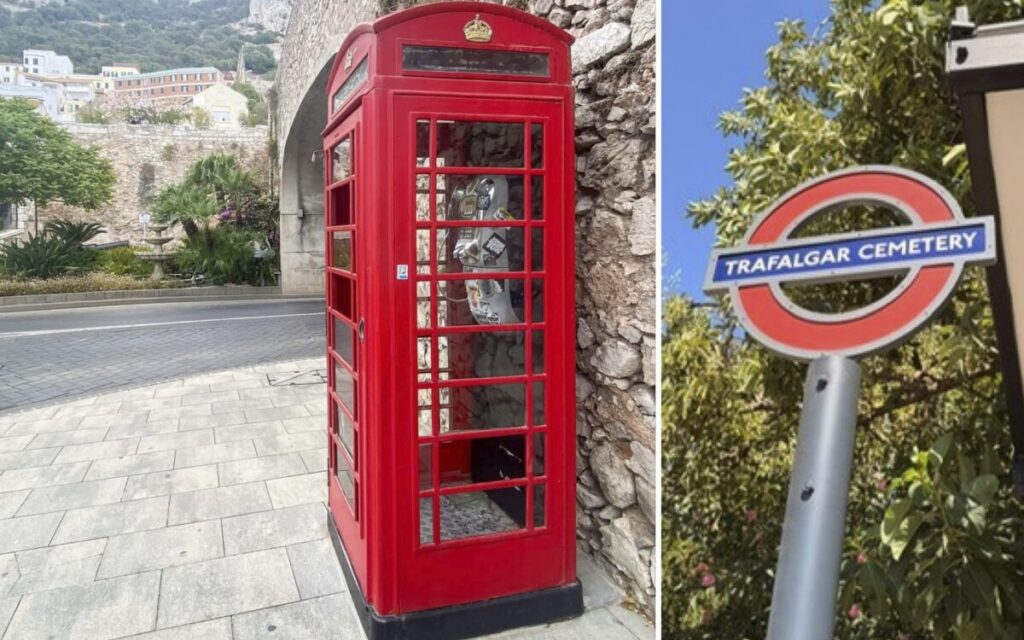
More symbols of identity added. Credit: GibGov
As Gibraltar becomes physically and economically more connected to Spain, something rather British is appearing on its streets.
Eight new red telephone boxes are planned to be added for some of the Rock’s best-known tourist locations, including Casemates Square, Europa Point and the Alameda Gardens.
Nobody will actually be able to make a phone call from them. The traditional K6-style boxes are decorative, designed to preserve one of the most recognisable symbols of British life and give visitors another familiar photo opportunity. That might sound like little more than a tourism project, but the timing makes the idea rather more interesting.
Eight red phone boxes for Gibraltar
Gibraltar’s Tourist Office has submitted plans for eight new telephone boxes at seven locations.
Cathedral Square, the American War Memorial, Casemates Square, Europa Point, Princess Caroline’s Battery, the Alameda Gardens and the Pillars of Hercules on the Upper Rock are all included. Casemates Square will get two, joining an existing red telephone box to create a row of three.
Each new structure will follow the classic K6 design created by British architect Sir Giles Gilbert Scott. Introduced in 1935 for the Silver Jubilee of King George V, the design became one of the most recognisable pieces of British street furniture.
The new boxes will stand about 2.5 metres high and measure roughly 90 centimetres wide and deep. They will have red finishes and safety glazing, but their telephones will not work. Gibraltar has already shown that it regards these symbols as more than outdated street furniture. A 2024 public consultation looked at the future of existing telephone boxes after vandalism caused maintenance problems, with the traditional designs retaining public support.
Is Gibraltar becoming more visibly British?
A bigger question sits behind the new phone boxes. Since July, Gibraltar has been much more closely connected to Spain for everyday movement. Routine checks at the land frontier disappeared on July 15 under the new UK-EU treaty, creating much easier movement between Gibraltar and La Linea and giving businesses and workers a new framework for operating across the border.
Gibraltar’s Government has repeatedly stressed that closer practical ties with Spain do not change the territory’s constitutional position. Chief Minister Fabian Picardo described the July agreement as providing greater fluidity at the frontier while protecting what he called Gibraltar’s exclusively British sovereignty. National Day celebrations in September also put British and Gibraltarian identity firmly at the centre of the public conversation. That makes the new street furniture an interesting visual backdrop to the changes.
London-style bus stops add to the picture
Telephone boxes are not the only recent addition with an unmistakably British feel. In September, Gibraltar introduced a new bus-stop design modelled on signs used across London. Gibraltar’s Government explicitly said the initiative was intended to promote the territory’s “unique Britishness”, while describing the new signs as adding British character to the urban landscape.
Signs have been installed at locations including Market Place, Convent Place, the British War Memorial, Commonwealth Park, Kingsway, the Frontier, Europort, Europa Point, Eastern Beach, Rosia, Catalan Bay and Trafalgar Cemetery.
Taken separately, a red telephone box or a London-style bus stop is hardly a political statement. Taken together, however, they form a recognisable visual language.
A border can disappear without an identity disappearing
Gibraltar’s Deputy Chief Minister Gemma Arias-Vasquez made precisely this point during debate over the new treaty earlier this year. She argued that Gibraltar’s identity does not depend on a physical barrier and said closer cooperation with Europe would not make her feel less British or less Gibraltarian. That distinction is important.
The old frontier was one of the most obvious physical reminders that Gibraltar and Spain belonged to different political systems. With routine checks now gone, that daily visual separation has changed dramatically.
Gibraltar’s response has not been to retreat from closer links with its neighbour. Instead, official statements have repeatedly presented the new arrangements as compatible with British sovereignty and Gibraltarian identity.
Heritage is becoming part of that message too. Historic structures around the former frontier have been given formal protection so they can continue to tell the story of the boundary that once divided the Rock from Spain.
More connected to Spain, but still recognisably Gibraltar
For British visitors, the red telephone boxes will be instantly familiar. For Spanish visitors from the Campo de Gibraltar, they provide another reminder that crossing into Gibraltar still means entering a place with its own distinctive British-influenced culture. That is perhaps why these apparently old-fashioned objects have found a new role.
Gibraltar no longer needs a physical queue at the frontier to make its separate identity visible. A row of red telephone boxes in Casemates Square can do something rather different: turn a piece of British street history into a tourist attraction.
Whether that is deliberate cultural messaging or simply good tourism design is impossible to say without the Gibraltar Government making that connection itself. What is clear is that the Rock is becoming easier to reach from Spain while continuing to put its British character firmly on display.
And that leaves an intriguing question for anyone watching Gibraltar’s next chapter. So, when you next pop into the Rock, take a photo of yourself next to one of the new phone boxes, just so everyone knows exactly where you are, and what country you are in.
Follow Euro Weekly News on Google News
Get breaking news from Spain, travel updates, and expat stories directly on your Google News feed.
Follow on Google NewsSign up for personalised news
Subscribe to our Euro Weekly News alerts to get the latest stories into your inbox!
By signing up, you will create a Euro Weekly News account if you don't already have one. Review our Privacy Policy for more information about our privacy practices.


Adam Woodward
Adam is a writer who has lived in Spain for over 25 years. With a background in English teaching and a passion for music, food, and the arts, he brings a rich personal perspective to his work at Euro Weekly News. As a father of three with deep roots in Spanish life, Adam writes engaging stories that explore culture, lifestyle, and the everyday experiences that shape communities across Spain.
Comments