Ten valuable horses hurt in horror crash as lorry overturns on Spain’s A-5 motorway
By Molly Grace • Published: 19 Oct 2026 • 22:30 • 3 minutes read
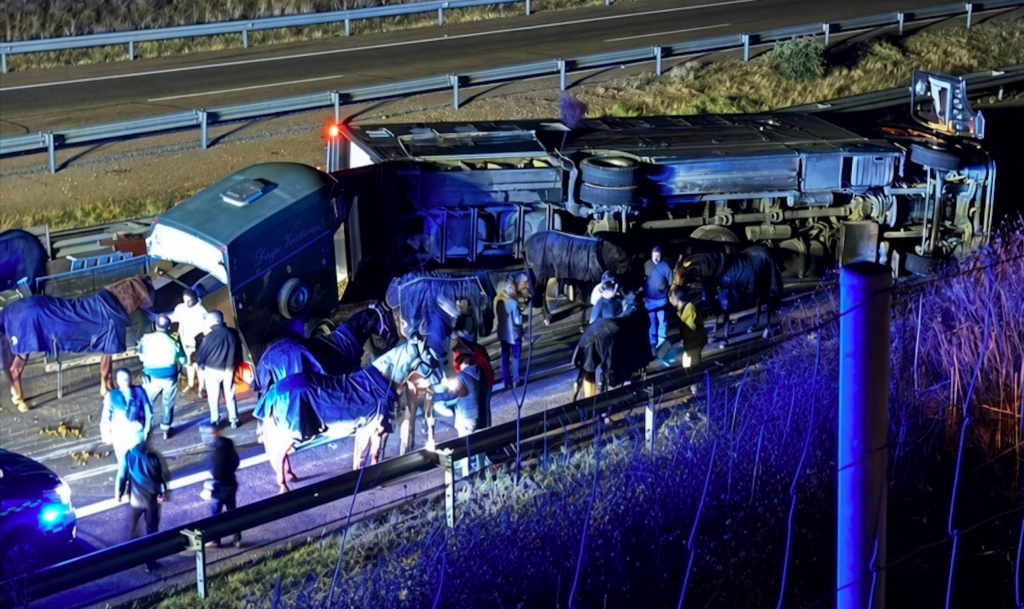
Removing the horses from the overturned vehicle was complicated. Photo credit: Eurotruckstar on Facebook
Nothing can be more distressing than seeing an injured animal on the road, but when that animal is a highly trained horse worth potentially hundreds of thousands of euros, the consequences can be devastating. Ten horses belonging to Diego Ventura, one of the world’s leading bullfighters on horseback, were involved in a serious lorry accident with two of his star horses among the most badly injured.
The lorry overturned near Trujillo in Cáceres province in the early hours of Monday, October 19, as it returned from Zaragoza following the final bullfight of the season. Brillante and Fouto suffered the most serious injuries, while the other horses also sustained injuries of varying severity.
A difficult rescue on the A-5
The accident happened at kilometre 266 of the A-5, near Santa Cruz de la Sierra, as the vehicle travelled south towards Badajoz. The horses were returning from Zaragoza, where Ventura had performed at the Feria del Pilar on Sunday evening. The lorry was carrying ten horses, along with two drivers and two members of the stable staff. Ventura himself was not travelling in the vehicle. When news of the accident reached his team, his manager Andrés Caballero travelled from Madrid to the scene. Members of the stable staff were helped by people travelling in a vehicle carrying horses belonging to Portuguese rider Rui Fernandes, which was following behind. Ventura later went to the scene himself.
Removing the horses from the overturned vehicle was complicated by the internal partitions used to keep them separated during transport. All ten animals were injured, with Brillante and Fouto reported to be in the most serious condition. Initial reports said neither was in danger of dying, although further veterinary examinations were needed to establish the full extent of their injuries.
The driver suffered minor injuries, while a Guardia Civil traffic officer was taken to Cáceres University Hospital after being kicked in the knee by one of the horses. The officer had been attempting to move the animal away from the carriageway. The crash forced the closure of the A-5 towards Badajoz. Traffic was diverted from kilometre 248 onto the A-58, before joining the A-66 towards Mérida. The road reopened around lunchtime after the lorry was removed and the carriageway cleared. The cause of the overturning had not been established in the initial reports but it is believed that the driver fell asleep at the wheel.
Who is Diego Ventura?
Born in Lisbon in 1982, Diego Ventura is a prominent figure in rejoneo, the form of bullfighting in which a rider performs on horseback. He built his career in Spain and became a regular name at major bullrings, including Madrid’s Las Ventas. His performances have earned him a substantial following among fans, and he is known for his extensive stable of specialist horses.
In rejoneo, horses are trained to work close to a bull during a performance, responding to the rider’s cues as they turn, approach and move away from the animal. Different horses may have different roles in the ring, and developing one capable of performing at this level takes years of training. A proven horse is therefore not easily replaced: its value lies not just in its physical qualities, but in its experience and the partnership it has developed with its rider.
What can a rejoneo horse be worth?
There is no confirmed public valuation for Brillante or Fouto, so their individual worth cannot be stated reliably. However, horses trained for elite rejoneo can command substantial sums, depending on their breeding, ability, training and record in the ring. In a 2011 interview with Mexican newspaper El Economista, Ventura discussed the high value of horses in his profession, citing figures of around €400,000 to €500,000 for an animal with the qualities required at that level but that of course is a historical estimate, not a current appraisal of either horse involved in the crash.
The cost of a professional stable extends well beyond buying the horses. Their care involves specialist training, feed, veterinary treatment, transport and experienced staff. An injury can also mean months of rehabilitation, depending on its severity, with no guarantee that a horse will be able to return to the ring. For now, the priority is the veterinary care of the ten injured horses, particularly Brillante and Fouto. Their recovery will depend on the injuries they have sustained and how they respond to treatment.
Follow Euro Weekly News on Google News
Get breaking news from Spain, travel updates, and expat stories directly on your Google News feed.
Follow on Google NewsSign up for personalised news
Subscribe to our Euro Weekly News alerts to get the latest stories into your inbox!
By signing up, you will create a Euro Weekly News account if you don't already have one. Review our Privacy Policy for more information about our privacy practices.
Molly Grace
Molly is a British journalist and author who has lived in Spain for over 25 years. With a background in animal welfare, equestrian science, and veterinary nursing, she brings curiosity, humour, and a sharp investigative eye to her work. At Euro Weekly News, Molly explores the intersections of nature, culture, and community - drawing on her deep local knowledge and passion for stories that reflect life in Spain from the ground up.
Comments