Spain’s ozone pollution hits highest levels since 2010: Which areas are worst affected?
By Farah Mokrani • Published: 20 Oct 2026 • 11:48 • 4 minutes read
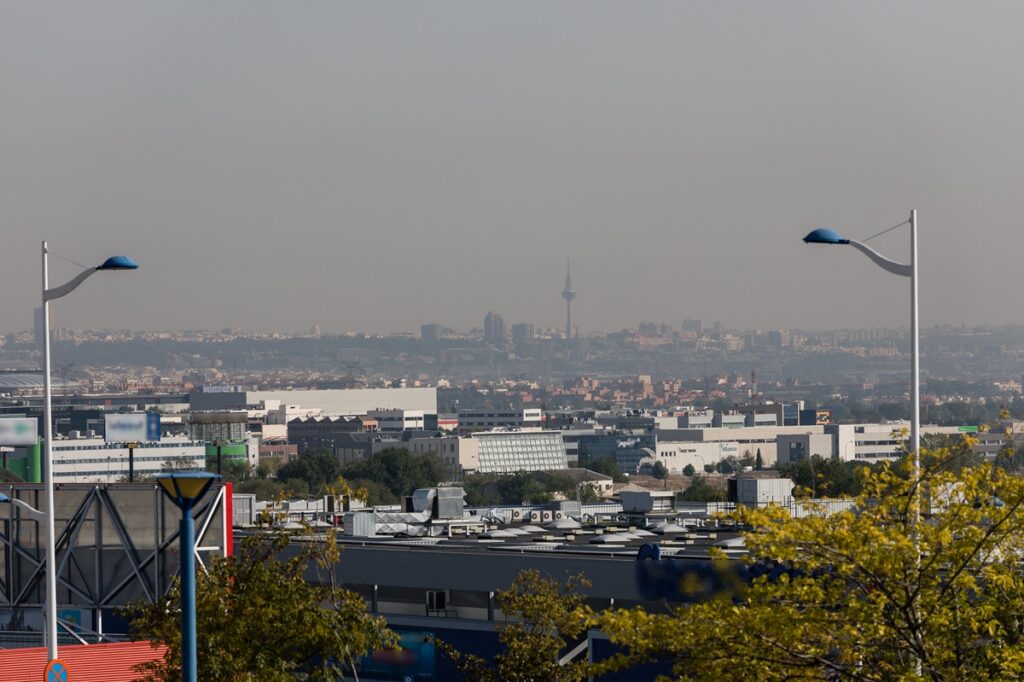
Hazy skies over Madrid as Spain reports its highest ozone pollution levels since 2010. Credit : Jose Luis Vega, Shutterstock
Spain has recorded its highest ozone pollution levels since at least 2010, with millions of residents exposed to concentrations exceeding European air quality targets. Madrid and Catalonia are among the areas most affected, alongside parts of Andalusia, Murcia and the Valencian Community.
This information is contained in a new report published on 19 October by environmental organisation Ecologistas en Acción, which analysed the readings from almost 500 stations located in all provinces of Spain between January and September of this year.
According to the report, approximately 16.9 million people, or 34.3 per cent of Spain’s population, were exposed to ozone pollution exceeding the stricter European Union target set for 2030, based on measurements assessed over the 2024–2026 period.
These figures relate to the average annual level of exposure and not to the current state of the air. This also highlights an important difference between the standards currently in force and the stricter European standards, which will come into effect in 2030.
Which parts of Spain have the worst ozone pollution?
Madrid and Catalonia are two of the worst affected regions, according to the full report on ozone pollution in Spain in 2026.
Madrid’s ozone pollution reached the highest levels ever recorded. The average across the city’s measuring stations registered double the number of exceedance days permitted under the current safety goal.
In Catalonia, too, ozone pollution also reached concerning levels. The organisation has reported that 12 of its 14 air-monitoring zones exceeded that upcoming European target at one or more stations. These zones are home to nearly eight million people.
Other affected locations included:
- Andalusia: Nine of the region’s 12 monitoring zones exceeded the future European target at one or more stations, covering areas with approximately 6.5 million residents.
- Castilla y León: Six of its 12 monitoring zones were affected, covering approximately 1.6 million people.
- Murcia: The Altiplano, Vega Oriental and Murcia metropolitan areas were among the affected locations, covering around 860,000 residents.
- Valencian Community: Five of the region’s 18 monitoring zones exceeded the future target at one or more stations, covering areas with 675,000 inhabitants.
- Extremadura and Castilla-La Mancha: Parts of both regions were identified among the areas experiencing significant ozone pollution.
The report also highlighted areas around Valencia, the interior of Catalonia, the outskirts of Madrid, and Maó in Menorca.
However, these figures should not be confused with the population of the affected zones of surveillance with the population estimated to have been exposed above the European target. In this study, these two figures are calculated by different methods.
In the Valencian Community, for example, the organisation calculated that about 400,000 inhabitants would be exposed to pollution above the future European standards, and that 675,000 inhabitants lived in areas where at least one monitor exceeded these standards.
Across Spain, 53 monitoring zones in ten autonomous communities exceeded the future target at one or more stations during the three-year assessment period.
However, the report also identified regional differences. While ozone exceedances increased sharply in parts of central and northern Spain, they declined in Murcia, the Balearic Islands, the Canary Islands and several other regions. Andalusia and the Valencian Community recorded broadly unchanged levels of exceedances compared with the pre-pandemic reference period.
Why did ozone pollution increase so sharply in 2026?
Spain’s exceptionally hot summer played a major role. Unlike pollutants emitted directly into the air, ground-level ozone forms when sunlight triggers chemical reactions involving pollutants released by road traffic, industrial activities and power generation.
High temperatures and intense sunlight promote the chemical reactions that lead to ozone pollution, so spring and summer are the most difficult seasons.
The rise is attributed to the four summer heatwaves that resulted in high temperatures and in a corresponding increase in the level of ozone.
The wildfires of July and August also contributed to poor air quality.
The report shows that the number of exceedances of the current legal ozone target has risen by about 25 per cent nationally compared with the average for the period from 2012 to 2019. The increase was especially marked in the central region of Spain, in the valley of the Ebro, and in parts of the northern coast. But not everywhere was the trend uniform.
The organisation recorded 288 exceedances of the public information threshold in 2026 above the official limit for public notification, particularly in Catalonia.
The Barcelona area and the Puertollano district in Ciudad Real also recorded seven exceedances of the higher alert threshold.
These observations do not mean that Spain is experiencing a nationwide ozone alert in October. They describe pollution recorded primarily during the warmer months.
What does ozone pollution mean for your health?
Ozone at ground level is not the same as the protective layer of ozone high in the atmosphere, and when inhaled can cause an irritation of the respiratory system and aggravate the breathing conditions.
Children, older people, pregnant women, and people with asthma or other heart or lung diseases may be particularly at risk.
Ozone exposure may cause coughing, sore throats and breathing difficulties, especially during outdoor physical activity when ozone concentrations are high.
This report also illustrates how the estimated scale of exposure varies with the air quality standard adopted.
The present assessment shows that, in accordance with the current European air-quality objective, around 8.6 million people, or 17.4 per cent of the population of Spain, were exposed to excess ozone in the three-year period from 2024 to 2026.
If one takes the tighter target, the figure rises to 16.9 million people, which represents 34.3 percent.
Under the World Health Organisation’s most protective precautionary standards, the number of inhabitants exposed to excessive ozone amounts to 48.4 million, or 98.6 percent of the population.
These figures do not mean that everyone who is exposed will be affected by these influences, nor that the same degree of pollution is found everywhere.
Those living in the area are particularly well advised to check the latest monitoring information during sunny hot weather. When ozone concentrations are high, limiting strenuous outdoor exercise, particularly during the afternoon, can help reduce exposure.
Ecologistas en Acción has called for the reduction of the emissions which contribute to ozone formation, together with clearer public information during pollution episodes on days of high ozonation.
The organisation also wants Spain to pass its ozone plan that has been long in the making and comply with the revisions to European air quality laws.
This report is a reminder to Spanish people that air pollution is not confined to major cities. Ozone can also be present in the countryside, in the middle of the country, and even in the interior, sometimes quite remote from the industrial and traffic sources that contribute to its formation.
Follow Euro Weekly News on Google News
Get breaking news from Spain, travel updates, and expat stories directly on your Google News feed.
Follow on Google NewsSign up for personalised news
Subscribe to our Euro Weekly News alerts to get the latest stories into your inbox!
By signing up, you will create a Euro Weekly News account if you don't already have one. Review our Privacy Policy for more information about our privacy practices.




Farah Mokrani
Farah is a journalist and content writer with over a decade of experience in both digital and print media. Originally from Tunisia and now based in Spain, she has covered current affairs, investigative reports, and long-form features for a range of international publications. At Euro Weekly News, Farah brings a global perspective to her reporting, contributing news and analysis informed by her editorial background and passion for clear, accurate storytelling.
Comments