Too big for Spain? Modern cars are struggling to navigate the narrow streets of Andalucia’s white villages
By Adam Woodward • Updated: 16 Nov 2026 • 14:48 • 2 minutes read
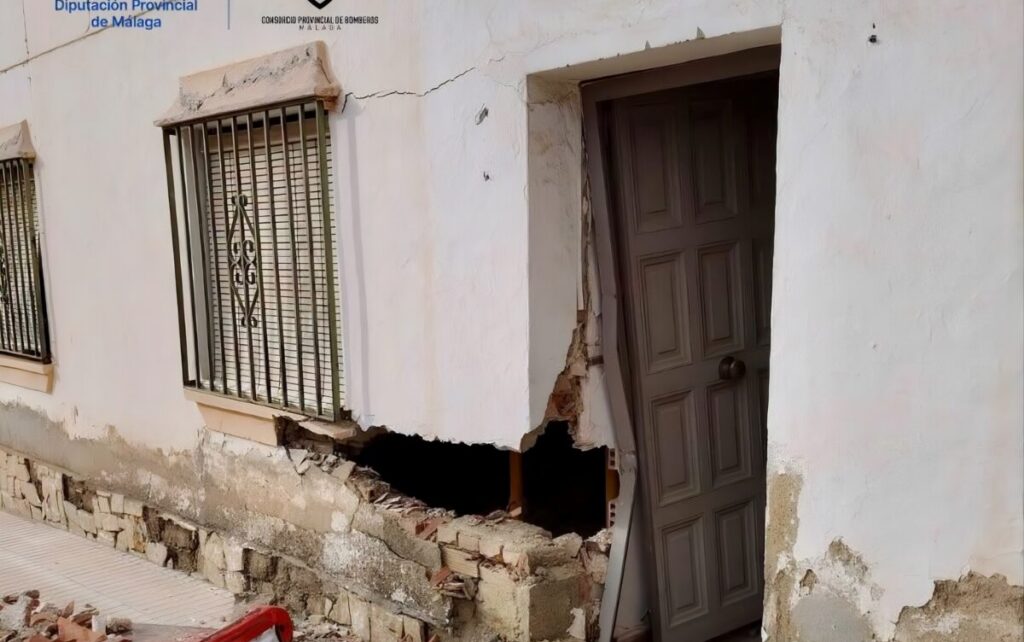
Van was turning the corner, when .... Credit: CPBD Malaga
A recovery truck crashed into a house in Velez-Malaga on Sunday, November 15, damaging a load-bearing wall and causing firefighters to need to shore up the building’s facade.
The incident happened in Calle Baeza, where the Consorcio Provincial de Bomberos de Malaga was called in by Local Police after the vehicle struck the property.
Firefighters worked together with council services, following instructions from a town hall technical officer, to install temporary supports because the impact had affected a structural wall. Fortunately, nobody was injured and the house didn’t fall down completely.
The circumstances of the collision have not been disclosed, but the incident draws attention to a growing drivers issue in Spain: how easily can today’s increasingly large vehicles negotiate the country’s traditional Andaluz villages?
Spain’s narrow streets meet modern motoring
Many of Andalucia’s famous Pueblos Blancos were built long before cars existed. Their winding streets, sharp corners and narrow passages developed around pedestrians, pack animals and carts, rather than modern family cars and large delivery vehicles.
In places such as Frigiliana, Comares, Casares and Mijas Pueblo, negotiating the older streets can be a nigh on impossible even for experienced drivers. Visitors unfamiliar with the layout can find themselves in difficulty, particularly when driving larger hire cars.
Granada provided a recent example on October 2, when an SUV became trapped in the narrowest section of Calle San Juan de los Reyes in the historic Albaicin district. The driver eventually managed to get through, but not before the vehicle suffered scratches and other damage.
Yo también creo que pasa. 😂😂😂 https://t.co/3b8CRTarrC
— 𝙘 𝙚 𝙣 𝙩 𝙞 𝙣 𝙚 𝙡 𝙖 (@centinela_ev) October 2, 2026
The street is so restricted that even some ordinary cars have to fold in their wing mirrors to pass. Local warnings about the limited space have not prevented motorists from attempting the route. And Google Maps doesn’t always know better!
Are cars getting too big?
The problem may become more common as manufacturers continue to increase the dimensions of new vehicles. Research published in June 2026 by European transport organisation Transport & Environment (T&E) found that new cars are getting an average of 1.2 centimetres longer every year and 0.5 centimetres taller. Previous research also identified an average annual increase in width of 0.5 centimetres.
If the trend continues, the average new car could measure 4.56 metres long and 1.90 metres wide by 2040, compared with 4.09 metres by 1.69 metres in 2000. The growing popularity of SUVs is one factor behind the trend, with larger vehicles taking up more room on roads and in parking spaces.
Small cars still have their place in traditional Spain
There is a reason smaller four-wheel-drive vehicles such as the Suzuki Jimny have retained a following in rural Andalucia. Their compact dimensions make them particularly useful on mountain roads, tracks and in villages where space is limited.
Euro Weekly News previously explored why the Suzuki Jimny remains so popular in Andalucia, partly because of its ability to negotiate the region’s narrow village streets. Satnavs can add another complication, directing unfamiliar drivers into streets that are entirely unsuitable for their vehicles.
For anyone visiting a traditional Spanish village, the sensible advice is to pay attention to vehicle-width warning signs, check restrictions before setting off and use designated car parks rather than attempting to drive right into the historic centre.
The charm of the Pueblos Blancos lies partly in their centuries-old streets. But motorists may increasingly have to accept that the best way to explore them is on foot, rather than behind the wheel of an oversized car.
The original cars with their much larger restyling versions issued years later
[📹 roma_urraco] https://t.co/FWkyTlwx8L
— Massimo (@Rainmaker1973) July 21, 2026
Follow Euro Weekly News on Google News
Get breaking news from Spain, travel updates, and expat stories directly on your Google News feed.
Follow on Google NewsSign up for personalised news
Subscribe to our Euro Weekly News alerts to get the latest stories into your inbox!
By signing up, you will create a Euro Weekly News account if you don't already have one. Review our Privacy Policy for more information about our privacy practices.


Adam Woodward
Adam is a writer who has lived in Spain for over 25 years. With a background in English teaching and a passion for music, food, and the arts, he brings a rich personal perspective to his work at Euro Weekly News. As a father of three with deep roots in Spanish life, Adam writes engaging stories that explore culture, lifestyle, and the everyday experiences that shape communities across Spain.
Comments