Italy runs out of patience with Europe and prepares to send in warships
By Nazario Rodriguez • Updated: 23 Nov 2026 • 23:14 • 4 minutes read
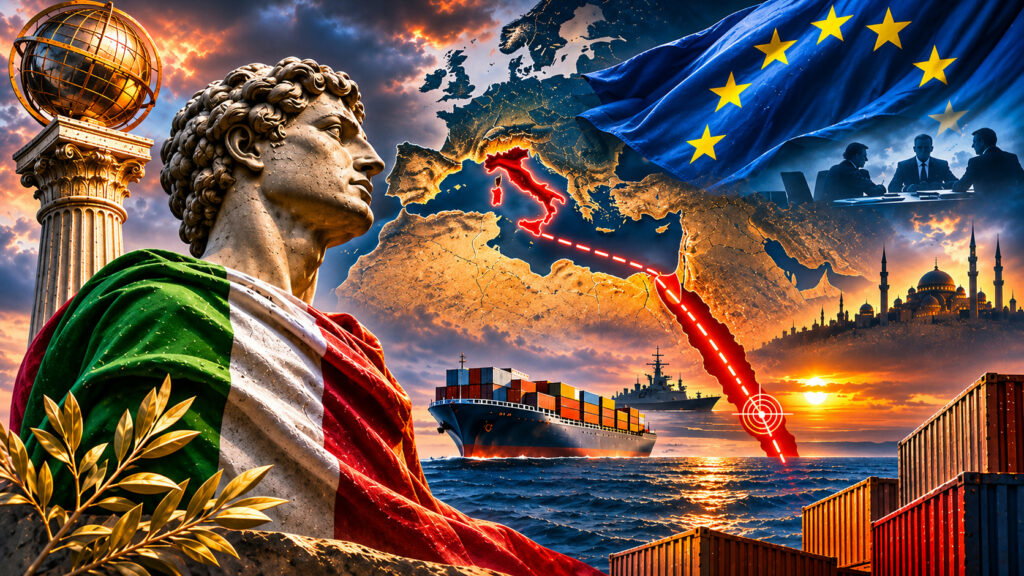
Italy is losing patience with Europe's response to Red Sea security threats as Rome prepares to protect its merchant ships independently. Credit: Euro Weekly News / AI editorial illustration.
Italy has warned it is ready to send its warships to escort commercial vessels through the Red Sea without waiting for Brussels to give the go ahead. Defence Minister Guido Crosetto has instructed military officials to prepare measures to protect Italian shipping, accusing European governments of failing to provide sufficient naval support. With missile attacks threatening one of the world’s most important trade routes, Rome has decided that European bureaucracy is becoming part of the problem.
Italy made its intentions clear in September, when Crosetto announced preparations for a possible independent naval mission near the Bab el Mandeb Strait. His frustration has only grown. On November 10, he told Reuters that other European governments had still failed to make concrete commitments to strengthen Operation Aspides, the EU mission established in 2024 to protect merchant vessels from attacks by Yemen’s Houthi forces.
Crosetto claims Italy already provides around a third of Europe’s operational contribution, while some considerably larger countries are doing substantially less. EU foreign policy chief Kaja Kallas has called for more naval support, with estimates suggesting that more than ten warships would be needed for effective protection. There is something peculiarly European about agreeing that a problem is urgent, establishing a mission to deal with it and then struggling to find the ships required to make it work.
Why Italy is prepared to act alone
Italy has good reason to be concerned. According to the Italian shipowners’ association Assarmatori, around 40 per cent of the country’s international trade passes through the Suez Canal. The route connects the Mediterranean with the Red Sea, allowing vessels travelling between Asia and Europe to avoid the considerably longer journey around Africa.
When shipping companies decide the passage is too dangerous, their vessels must travel around the Cape of Good Hope instead. That means additional fuel, longer delivery times, higher insurance premiums and increased transport costs. For Italian manufacturers and importers, the consequences can be substantial, particularly when businesses depend on goods arriving according to tightly organised schedules.
Crosetto first raised the possibility of acting independently on September 17, saying Italy could not afford to wait indefinitely for decisions from Brussels. He also made clear that any additional deployment would require decisions by the Italian government and Parliament. Rome has therefore prepared the ground for further action, but has not announced a separate new naval deployment.
A dangerous stretch of water
The threat comes largely from Yemen’s Houthi movement, which is aligned with Iran and controls significant territory along the country’s Red Sea coastline. The group has repeatedly attacked commercial vessels and strategic infrastructure, while fighting involving Saudi Arabia has added to the instability.
The Bab el Mandeb Strait, approximately 29 kilometres wide at its narrowest point, connects the Red Sea with the Gulf of Aden. It is one of the world’s most important maritime passages, carrying manufactured goods, machinery, raw materials and energy supplies towards Europe through the Suez Canal. A missile launched from the Yemeni coastline can therefore create problems for shipping companies and manufacturers thousands of kilometres away.
The danger has also prompted renewed diplomatic activity among Gulf governments. As Euro Weekly News reported in October, Saudi Arabia’s Defence Minister, Prince Khalid bin Salman, travelled to Abu Dhabi for talks with the UAE leadership amid growing Houthi threats. The visit raised the possibility of closer cooperation between the two countries, although analysts cautioned that their differences over Yemen and other regional conflicts had not disappeared.
The situation remains particularly grim for Yemen’s civilian population. Years of fighting have destroyed infrastructure, displaced families and left millions dependent on humanitarian assistance. Another prolonged confrontation threatens to deepen a humanitarian crisis that has already devastated much of the country.
Is Italy preparing for war?
Videos circulating on social media have suggested that Italy is heading into a war in the Middle East. The reality is more complicated. Italy has not declared war on Yemen, and the naval measures under consideration are intended to protect commercial vessels rather than launch offensive military operations against the Houthis.
That distinction matters, although escorting merchant ships through waters threatened by missiles and drones is hardly a routine naval assignment. Warships operating in the region face genuine risks, even when their mission is strictly defensive.
The Council of the European Union extended Operation Aspides until February 28, 2027, allocating nearly €15 million towards its common operating costs for the extended period. The mission is designed to protect freedom of navigation in the Red Sea and surrounding waters, rather than conduct offensive military operations.
Italy’s complaint is not that Europe has failed to recognise the danger. It is that recognising the danger and doing something about it appear to be two entirely different matters.
What the disruption could mean for Spain
Spain is not directly involved in Italy’s naval preparations, but its economy depends on many of the same international shipping routes. Major commercial ports such as Algeciras and Valencia handle goods arriving from Asia, while Spanish businesses rely on imported machinery, electronic components, clothing and raw materials.
When vessels are diverted around Africa, the additional costs can eventually reach importers, retailers and consumers. That does not mean every disruption produces an immediate price increase, but prolonged uncertainty makes international trade more expensive and less predictable.
Energy markets are another concern. The Red Sea and the nearby Strait of Hormuz are important routes for oil and other commodities, and instability in the region can influence transport costs and international energy prices. Any sustained increase would be unwelcome news for Spanish businesses already dealing with operating expenses, and potentially for households if those costs are passed on.
There is also a broader question about Europe’s dependence on international supply chains. Governments have spent decades encouraging businesses to source goods from across the world, often in pursuit of lower prices and greater efficiency. Now they are discovering that those savings depend on commercial vessels being able to navigate some of the world’s most unstable waters.
Italy has made its position clear. If European governments cannot agree on providing sufficient naval protection, Rome is prepared to consider acting independently to defend its commercial interests. Whether that pressure produces additional European support remains to be seen.
For Crosetto, the argument is no longer simply about how many warships Italy can deploy. It is about whether Europe’s larger economies are prepared to defend the shipping routes on which their prosperity depends. The goods keep moving, when they can. The political discussions, meanwhile, show no signs of running out of fuel.
Follow Euro Weekly News on Google News
Get breaking news from Spain, travel updates, and expat stories directly on your Google News feed.
Follow on Google NewsSign up for personalised news
Subscribe to our Euro Weekly News alerts to get the latest stories into your inbox!
By signing up, you will create a Euro Weekly News account if you don't already have one. Review our Privacy Policy for more information about our privacy practices.




Nazario Rodriguez
I’ve worked in news media for over 10 years, previously as Production Manager at Euro Weekly News, and I now focus on audience strategy and content performance. I specialise in understanding what readers engage with and shaping content that serves them well.
Comments