Granada tremor reaches as far as Malaga
By Adam Woodward • Published: 28 Nov 2026 • 17:41 • 2 minutes read
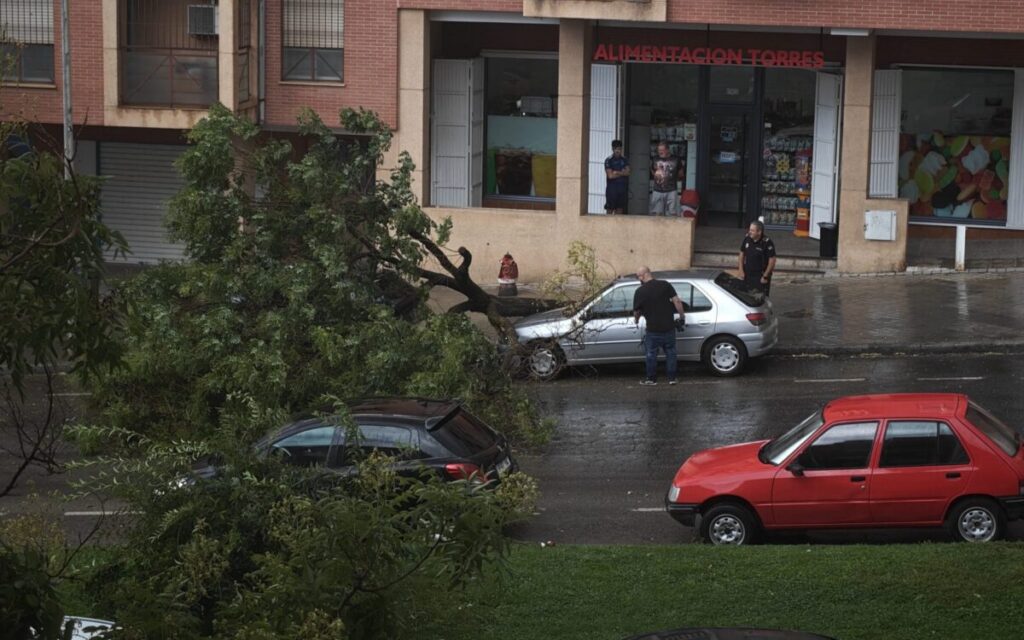
Fallen tree in Granada after earthquake. Credit: Bomberos
Saturday’s earthquake was felt across two provinces as experts explain why seismic waves can travel so far
Residents across Malaga province felt an earthquake centred in Granada Province on Saturday, November 28, with the tremor reaching towns along the coast and across Axarquia.
The earthquake registered a magnitude of 3.8 and struck at 12.45pm, according to Spain’s National Geographic Institute (IGN). Its epicentre was located near Moraleda de Zafayona, at a depth of 11 kilometres, according to the official earthquake record.
Despite being centred inland, the movement was felt in Malaga city, Velez-Malaga, Competa, Algarrobo-Costa and La Cala del Moral, in Rincon de la Victoria. No injuries or damage had been reported by the emergency services at the time of the initial reports.
Why was the earthquake felt so widely?
Earthquakes release energy that travels through the ground in the form of seismic waves. These waves can move over considerable distances, meaning that people may feel an earthquake even when they are many kilometres from its epicentre.
Saturday’s tremor was relatively shallow, with its source located just 11 kilometres beneath the surface. This meant that the seismic waves had less distance to travel through the Earth’s crust before reaching the surface. However, the distance from the epicentre is not the only factor that determines how an earthquake is felt.
Tras ser revisado, el #terremoto se queda con una magnitud de 3’8 y una profundidad de 11km
Se ha podido sentir en las provincias de #Málaga, #Córdoba y sobre todo #Granada con intensidad máxima de IV (aunque no haya registros en el IGN, en otras aplicaciones si hay) https://t.co/jqinrnpWcv
— MeteoFans (@MeteoFans) November 28, 2026
The type of ground beneath a town can affect how seismic waves travel. Some geological materials can amplify ground movement, while others may reduce it. Buildings can also influence what people experience. A tremor that is barely noticeable outdoors may be more apparent inside a building, where windows, crockery and furniture can vibrate.
The US Geological Survey explains how earthquake shaking changes with distance, including why the movement experienced at one location may differ from that felt elsewhere. This helps explain why an earthquake of moderate magnitude can be noticed across a wide area, even when it does not cause widespread damage.
Where was the shaking strongest?
The IGN recorded the highest intensity of the earthquake at level IV on the European macroseismic scale. In Malaga province, Competa and Velez-Malaga recorded intensity III, while Malaga city experienced shaking between levels II and III. Algarrobo-Costa and La Cala del Moral recorded intensity II.
These figures describe how the earthquake was experienced in different locations, rather than its overall magnitude. Magnitude measures the energy released at the earthquake’s source. Intensity describes the effects felt at a particular location, which can vary according to distance, local ground conditions and buildings.
Saturday’s earthquake was initially reported as magnitude 3.6 before the IGN revised its calculation to 3.8 and updated the epicentre. The tremor was also felt in Granada city and numerous other towns across the province.
Residents who felt the earthquake can report their experience through the IGN’s official earthquake questionnaire, helping scientists improve their understanding of seismic activity in southern Spain. The tremor follows other earthquakes felt across Malaga province, including a magnitude 3.8 earthquake in February.
For more background, readers can also see EWN’s coverage of Granada’s earthquake sequence in August and its guide to earthquake risk in southern Spain.
Follow Euro Weekly News on Google News
Get breaking news from Spain, travel updates, and expat stories directly on your Google News feed.
Follow on Google NewsSign up for personalised news
Subscribe to our Euro Weekly News alerts to get the latest stories into your inbox!
By signing up, you will create a Euro Weekly News account if you don't already have one. Review our Privacy Policy for more information about our privacy practices.




Adam Woodward
Adam is a writer who has lived in Spain for over 25 years. With a background in English teaching and a passion for music, food, and the arts, he brings a rich personal perspective to his work at Euro Weekly News. As a father of three with deep roots in Spanish life, Adam writes engaging stories that explore culture, lifestyle, and the everyday experiences that shape communities across Spain.
Comments