Ferry empire: How Baleària became Spain’s lifeline to the Balearics
By Adam Woodward • Published: 15 Apr 2026 • 22:46 • 2 minutes read
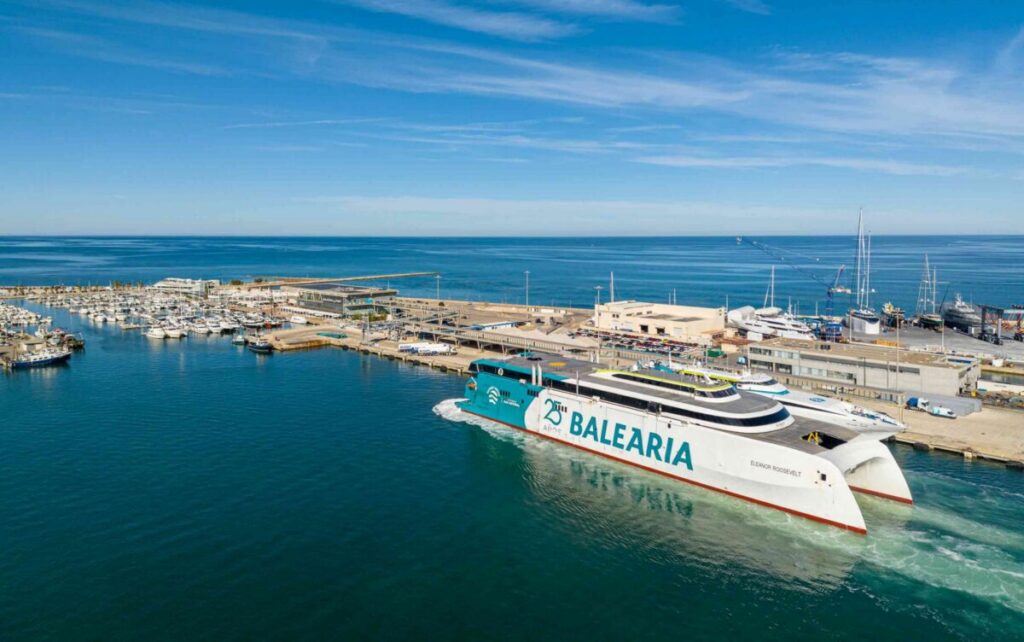
Ferry entering Denia port. Credit Balearia
One name in coastal travel that should never be taken for granted is one that has had remarkable success and become firmly held as an essential of many people in Spain. From being a smallscale ferry carrier with just three ships, to today with almost 40, the name has, for Spain, become as synonymous with ferry travel as Renfe is with rail and Iberia is with flights. Baleària.
Baleària is operating today not only as Spain’s most dominant ferry operator but also as a lifeline to populations of the Balearics including many expats, influencing their choices of where to choose to live and invest and also creating thriving economies on either side of their crossings.
All this has been thanks to a daring vision, a relentless pursuit of innovation and strategic expansion since its foundation more than a quarter of a century ago. Record 2025 results delivered €801 million in turnover together with 6.5 million passengers and 1.6 million vehicles carried.
Founding in 1998 after predecessor collapse
Adolfo Utor established Baleària in June 1998 after the collapse of predecessor Flebasa. He is still at the helm today. Operations began modestly with just three ships serving initial routes from Denia to Ibiza and Palma de Mallorca. Determination among the founding team of around 126 staff quickly turned early challenges into solid customer relationships and steady regional growth. Initial transport volumes remained modest, with the first full-year turnover in 1999 reaching only around €27 million.
Although, founder Adolfo Utor does not describe himself as a daring or a venture capitalist: he prefers “prudent”. In an interview in 2023, he gave the apt allegory of the stories of James Joyce’s Ulysses, or The Odyssey, long journeys full of doubt, mulling, questioning, and only then taking the right decision.
Fleet growth and strategic acquisitions
Continuous investment introduced never-before-seen high-speed ferries that cut crossing times dramatically for passengers and vehicles. Later additions embraced the more eco-friendly natural gas propulsion. Routes multiplied from additional ports, including Barcelona, Valencia and Denia. Baleària now maintains 28 services in six countries with a fleet approaching 40 vessels.
Acquisition of Trasmediterránea in 2003 boosted scale and prestige. Recent regulatory approval arrived for purchasing key assets from Armas Trasmediterránea. Plans called for a €45 million modernisation programme and construction of a new dedicated terminal in Barcelona.
Documentary reveals company journey
Baleària produced the documentary Una travesía de 25 años to recount its history through testimonies of 14 people. Experts from the maritime world and first-person accounts from the entire company trajectory narrated the companies’ massive achievements and challenges.
During the film, testimonies describe the launch of fast ferry Federico García Lorca as a turning point in company thinking. Founder Adolfo Utor says the 2008 crisis struck during the construction of four new ships, yet those vessels helped recovery.
Baleària today
Nearly half of passengers travel to or from Mallorca, Ibiza or Menorca annually. Local residents and businesses benefit enormously from year-round freight and passenger services. Tourism accounts for over 40 per cent of GDP in the islands where stable supply chains rely on vast cargo movements. Cumulative figures over 28 years show approximately 60 million passengers, 14 million vehicles and 87 million linear metres of cargo transported.
Innovation, sustainability and ethical responsibility form core values according to Adolfo Utor. Sustainability represents no option but a necessity for continued operations. There can be little doubt that the economies and communities of the Balearic Islands depend massively on the frequent service of the ferry services of Baleària. And while the name is a proud pillar of all aspects of life in the Balearics, it is not one that should ever be taken for granted.
Sign up for personalised news
Subscribe to our Euro Weekly News alerts to get the latest stories into your inbox!
By signing up, you will create a Euro Weekly News account if you don't already have one. Review our Privacy Policy for more information about our privacy practices.




Adam Woodward
Adam is a writer who has lived in Spain for over 25 years. With a background in English teaching and a passion for music, food, and the arts, he brings a rich personal perspective to his work at Euro Weekly News. As a father of three with deep roots in Spanish life, Adam writes engaging stories that explore culture, lifestyle, and the everyday experiences that shape communities across Spain.
Comments