How Long Does Earth Have Left? Scientists Reveal When Life Will End
By Sebastian • Published: 16 Apr 2026 • 7:30 • 3 minutes read
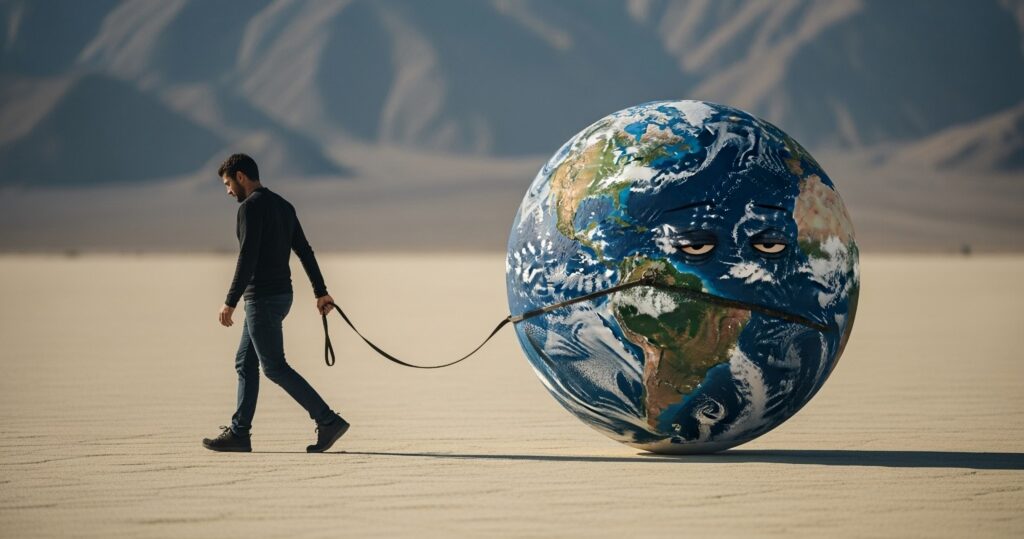
Scientists say Earth will gradually become uninhabitable as the Sun grows hotter. Photo Credit: Shutterstock
The question of how much time Earth has left is no longer just philosophical. It is grounded in science, and the answer is both fascinating and unsettling.
According to research from organisations such as NASA, Earth is not heading for a sudden disaster. Instead, the planet faces a slow and inevitable decline, including countries like Spain, driven by the evolution of the Sun.
Like all stars, the Sun changes over time. It is gradually becoming brighter, increasing its energy output by about one percent every 100 million years. That may sound small, but over vast timescales it has serious consequences.
Scientists estimate that in about one billion years, Earth will begin to move beyond the limits that make life possible.
Rising heat will slowly make Earth uninhabitable
As the Sun grows brighter, temperatures on Earth will continue to rise. At first, the changes may seem gradual, but the effects will build over time.
Earth’s systems are closely connected. As heat increases, the carbon cycle begins to break down. Plants struggle to survive, which leads to falling oxygen levels. Over time, complex life forms, including animals and humans, will no longer be able to exist.
This is not a sudden collapse. It is a slow shift that gradually makes the planet less and less hospitable.
The runaway greenhouse effect could transform Earth
At a certain point, Earth could reach a tipping point known as the runaway greenhouse effect.
This process has already turned Venus into one of the most extreme environments in the Solar System.
On Earth, the mechanism would be similar. Higher temperatures cause more water to evaporate. Water vapour traps heat in the atmosphere, which leads to even higher temperatures. This creates a powerful feedback loop.
Once this cycle begins, it cannot be stopped. The planet would heat rapidly, marking the true end of Earth as a habitable world.
When will Earth lose its oceans?
Water is essential for life, and its disappearance would be a major turning point.
Scientists estimate that within about two billion years, most of Earth’s oceans will evaporate. Solar radiation will break apart water molecules in the upper atmosphere, allowing hydrogen to escape into space.
At this stage, Earth will no longer be able to regulate its climate. Geological and atmospheric systems will weaken, and the planet will become a dry and hostile world.
Although Earth will still exist, it will already be lifeless.
The Sun’s final phase will decide Earth’s fate
The most dramatic chapter in Earth’s future is linked to the life cycle of the Sun.
In around five billion years, the Sun will run out of hydrogen in its core and expand into a red giant. During this phase, it will grow so large that it may reach Earth’s current orbit.
Scientists believe two outcomes are possible:
- Earth is engulfed by the expanding Sun
- Earth survives briefly but is completely scorched and torn apart
In both cases, the result is the same. The planet as we know it will cease to exist.
The final end of Earth
After the red giant phase, the Sun will shed its outer layers and collapse into a white dwarf. By this time, around seven to eight billion years in the future, Earth will either be destroyed or reduced to fragments.
It is important to note that life will have disappeared long before this point. The end of Earth and the end of life are not the same event.
Can humanity survive beyond Earth?
While these events are far in the future, they raise an important question. Can life continue beyond Earth?
Scientists and space agencies are already exploring possibilities such as:
- colonising other planets
- building self sustaining space habitats
- searching for habitable worlds beyond our Solar System
If humanity is to survive in the very long term, it may need to become a multi planet species.
A reminder that goes beyond today’s conflicts
While these changes are billions of years away, scientists say regions like southern Europe, including Spain, are already being studied for how climate extremes could shape future habitability on Earth.
At a time when global attention is often focused on wars and political tensions, these slow planetary changes continue in the background.
They do not depend on human timelines or decisions.
Earth has a finite lifespan. The bigger question is whether life can find a way to outlast it.
Sign up for personalised news
Subscribe to our Euro Weekly News alerts to get the latest stories into your inbox!
By signing up, you will create a Euro Weekly News account if you don't already have one. Review our Privacy Policy for more information about our privacy practices.




Sebastian
Comments