Spain drivers stunned as V16 beacon rule faces shake up and traffic fines may jump 500%
By Farah Mokrani • Published: 21 Apr 2026 • 5:55 • 3 minutes read
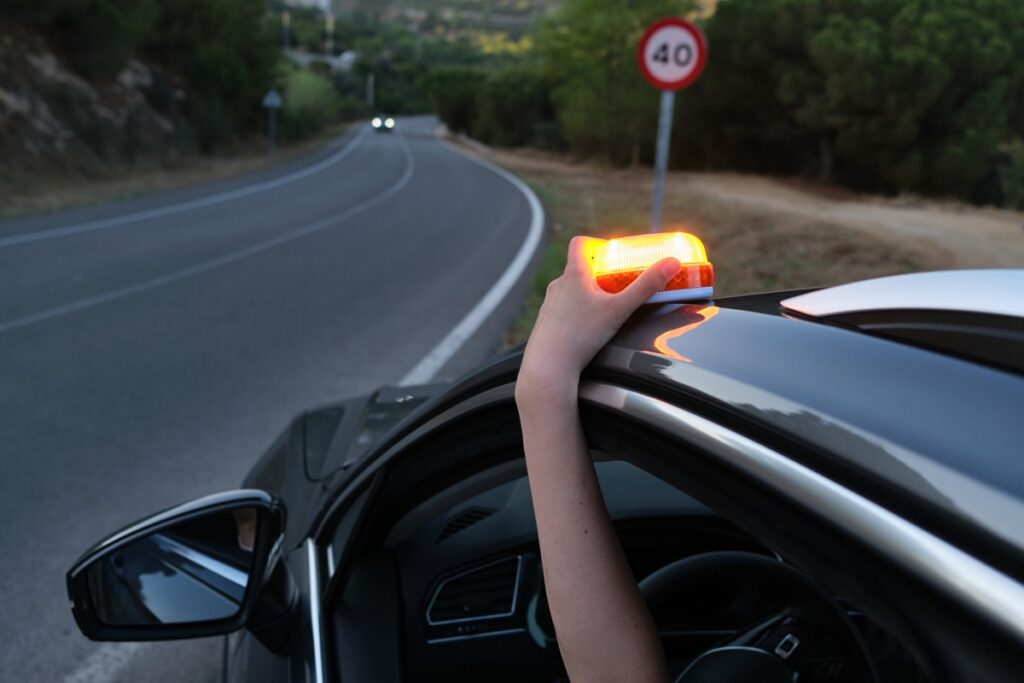
Spain’s V16 warning light rule is back at the centre of political debate Credit :jordi.magrans, Shutterstock
Spanish motorists could be affected by two eye catching proposals now being debated in Parliament. One would make the V16 emergency beacon optional and allow drivers to keep using traditional warning triangles. Another would raise traffic fines for the highest earners by as much as 500 per cent. If either move advances, millions of drivers in Spain may need to pay attention.
The proposals come at a time when many motorists are already trying to keep up with changing road rules, low emission zones and new enforcement technology. Now, the roadside breakdown kit in your boot and the size of your next fine could both become political talking points.
Why the V16 beacon has become controversial
The V16 warning light was introduced as a safer alternative to the old reflective warning triangles.
Anyone who has broken down on a fast road knows the risk. Getting out of the car, walking behind the vehicle and placing triangles can be dangerous, especially at night, in bad weather or on a busy motorway. The beacon is meant to solve that problem. It can be placed quickly on the roof of the car, making the vehicle visible without forcing the driver to walk onto the road.
For many people, that sounds sensible. But not everyone agrees it should be compulsory.
Vox has tabled an amendment that would make the device optional and keep warning triangles legally valid after the planned changeover. The party also wants the beacon to be non connected, meaning no obligation for it to link to traffic systems or use geolocation functions.
That last point matters because connected V16 devices are designed to send the location of a stranded vehicle to traffic management systems.
Supporters say that could improve safety and warning systems. Critics see it as unnecessary complexity and extra cost for something that used to be simple.
Why some drivers are frustrated
The debate is not only political. It reflects real irritation among some motorists.
Many drivers already own warning triangles that they bought in good faith years ago. They do not understand why equipment that still works should be replaced. Others are confused about deadlines, approved models and whether all V16 devices on sale are future proof.
There is also the cost issue. For a family already paying insurance, fuel, road tax, servicing and rising living costs, another compulsory purchase can feel like one more burden.
That is why the subject keeps resurfacing. It speaks to a wider feeling many motorists have: rules keep changing, and drivers keep paying.
At the same time, road safety campaigners point to the number of serious incidents that happen after breakdowns. For them, the safety argument remains stronger than the inconvenience.
The second proposal could hit wealthy drivers much harder
While one side is arguing over emergency beacons, another is focusing on fines.
Sumar has proposed a sliding scale where some traffic penalties would rise depending on income. Under the plan, drivers earning over certain thresholds would pay more than the standard amount, with the highest bracket facing increases of up to 500 per cent.
The reasoning is straightforward.
A €200 fine can be a serious problem for one person and barely noticeable for another. If the purpose of a fine is deterrence, supporters say it should hurt enough to change behaviour regardless of income.
That argument is not unique to Spain. Several European countries have used income linked penalties in some form, especially for serious offences.
For backers of the idea, it is about fairness. For critics, it is about unequal punishment for the same offence.
Why many drivers will dislike the idea
Opponents are likely to say a traffic offence should carry the same penalty for everyone.
If two drivers commit the same speeding offence, they argue, both should receive the same sanction. They may also question how earnings would be checked, whether tax data would be used, and how long appeals or disputes could take.
Others will simply see it as another way of raising revenue.
That makes the proposal politically sensitive, especially at a time when many households already feel squeezed.
What changes right now
At present, these are proposals under debate, not automatic new rules.
Drivers do not need to rush out and throw away their triangles tonight, nor should they assume their next fine will suddenly be five times higher.
But they should keep watching developments.
Motoring law in Spain has changed repeatedly in recent years, and measures that start as political headlines can later become everyday reality.
Why this matters to ordinary people
Most road policy stories only attract attention when they affect daily life directly.
This one does. It touches the breakdown equipment you carry, the rules you follow after a roadside emergency, and the money you might owe if you make a mistake behind the wheel.
That is why the debate is likely to continue and for Spanish drivers, it is not abstract politics in Madrid. It could shape what happens the next time your car stops on the hard shoulder or a fine lands in the letterbox.
Sign up for personalised news
Subscribe to our Euro Weekly News alerts to get the latest stories into your inbox!
By signing up, you will create a Euro Weekly News account if you don't already have one. Review our Privacy Policy for more information about our privacy practices.


Farah Mokrani
Farah is a journalist and content writer with over a decade of experience in both digital and print media. Originally from Tunisia and now based in Spain, she has covered current affairs, investigative reports, and long-form features for a range of international publications. At Euro Weekly News, Farah brings a global perspective to her reporting, contributing news and analysis informed by her editorial background and passion for clear, accurate storytelling.
Comments