The back-home budget: How remittances shape household finances
By Guest Writer • Updated: 30 Apr 2026 • 12:13 • 3 minutes read

Image: Shutterstock
Buena Park, California, April 2026 – For millions of families around the world, financial support from relatives living abroad carries significant economic weight and serves as a primary source of stability for households globally.
Ria Money Transfer, one of the world’s leading money transfer companies, has published a new study analysing the profound impact of remittances in key recipient countries, including Mexico, India, and Colombia. The report explores how these funds are integrated into the daily budgets of households and the critical role they play in both local economies and times of urgent need.
A key contribution to the national economy
The data reveals that remittances represent a meaningful share of the national economy in these regions. According to 2024 data from the World Bank, remittances account for approximately 3.7% of the national GDP in Mexico, 3.5% in India, and 2.8% in Colombia.
Those percentages are billions of dollars that directly support communities and promote economic activity.” In certain cases, that share competes with what these countries earn from tourism or key exports — and that puts remittances in a different light from the tiny, private transactions they often appear to be, highlighting their significant role in national economies and the livelihoods of families relying on these funds.
Reports from institutions such as the World Bank, the Federal Reserve Bank of Dallas, and CSIS indicate a clear pattern: when families receive remittances, the money is primarily used to cover basic household needs. These funds are consistently directed toward:
- Basic household consumption, including food, essential goods, and routine expenses.
- Health, covering doctor visits, medical treatments, and unexpected health-related costs.
- Education, helping to pay for tuition, school supplies, and continued training.
- Housing, supporting repairs, improvements, and overall living conditions.
These regular transfers provide immediate stability to daily life and strengthen long-term financial security for receiving families. What makes this pattern striking is how consistent it is across three completely unique countries. Whether the money lands in a village in Oaxaca, a city in Maharashtra, or a neighborhood in Bogotá, It tends to go to food on the table, a doctor’s visit, and the children’s school fees.
A vital safety net during times of crisis
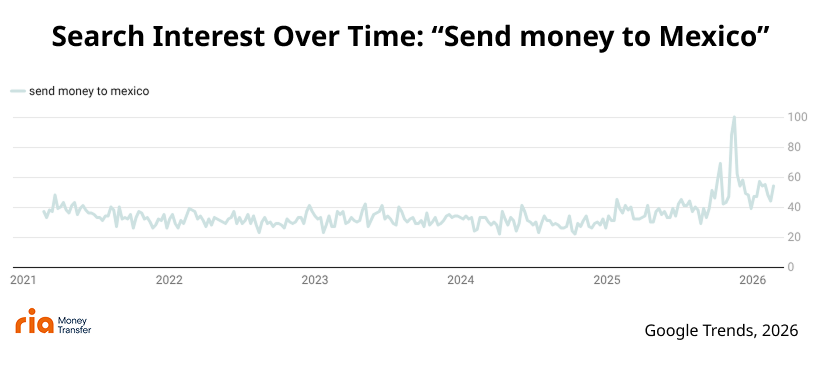
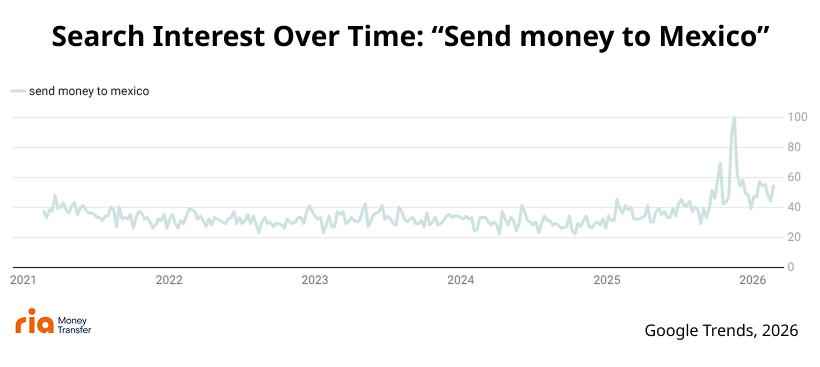
While remittances are primarily used for everyday essentials, the Ria Money Transfer study also highlights how this support intensifies when families face serious disruptions. By analysing search behavior, the report shows clear spikes in the urgency of sending money linked to climate-related emergencies.
In November 2025, for example, searches for “send money to Mexico” reached their highest level of the year during severe flooding in the country.
A similar pattern appears in other destinations such as India, where interest in sending money increased sharply during the most intense periods of last year’s monsoon season.
In Colombia, increases were also recorded during episodes of flooding and climate-related emergencies throughout 2025.
The data clearly reflects that while family support is ongoing, it becomes a rapid response mechanism when crises directly impact households. For the many people living in Europe who send money home regularly, that ability to act fast is critical. When a flood or a health crisis hits, they are already on their phones, sending what they can.
A perspective close to home
That instinct will feel familiar to a good many readers here. Across Spain and the rest of Europe, hundreds of thousands of people maintain financial ties to countries far away, sending money monthly, or whenever it is needed most. The mechanics change but the impulse does not.
The figures in this report belong to Mexico, India, and Colombia, but the story behind them is one that crosses every border. Keeping a family afloat from a distance, through good months and difficult ones, is something that requires both commitment and trust in the tools available to do it. In that sense, remittances are a continuous act of care that totals billions of dollars and stabilises millions of households.
On the other hand, the decision of many people in this scenario is to choose a rapid and reliable service. Fees, exchange rates, and transfer times all matter, and over a year those things add up. “Ria and other such services have built their entire business model around making it easy to transfer money home without losing a lot of it in the process.
Family assistance that crosses borders
The study underscores that remittances are a steady source of support woven into the lives of millions of households. Behind every transfer is a decision rooted in care and responsibility, helping families stay close and support one another from thousands of miles apart.
Read the full report to discover what the data reveals about the economic weight of money transfers, and understand how these “back-home budget” transfers influence the daily finances and resilience of many international households.
Sign up for personalised news
Subscribe to our Euro Weekly News alerts to get the latest stories into your inbox!
By signing up, you will create a Euro Weekly News account if you don't already have one. Review our Privacy Policy for more information about our privacy practices.




Guest Writer
Comments