Spanish parliament backs motion urging Pedro Sánchez to resign or call confidence vote
By Molly Grace • Published: 25 Jun 2026 • 19:00 • 4 minutes read
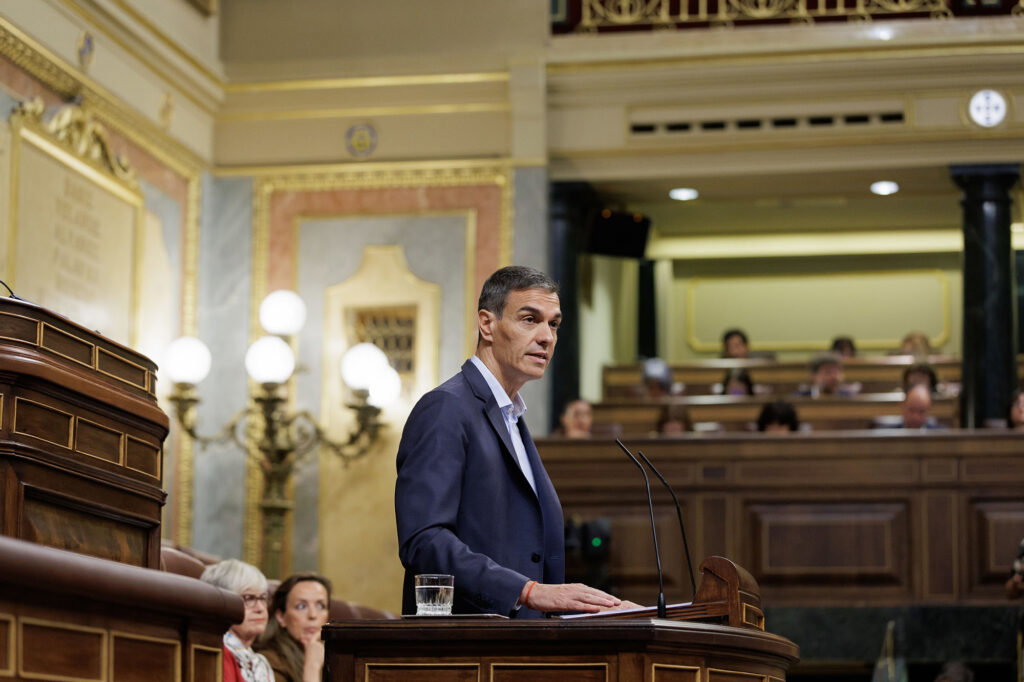
The vote ended with 178 in favour and 171 against. Photo credit: Pool Moncloa, Congreso de los Diputados, Madrid
The Spanish Congress has approved a resolution calling on Prime Minister Pedro Sánchez to either submit to a formal vote of confidence or resign. The move is politically symbolic and indicates growing tension in a fragmented parliament. The motion was put forward by the opposition Popular Party and passed in Madrid on Thursday with support from Vox and the Catalan party Junts. Although it secured a majority, the resolution is not legally binding and does not require Sánchez to act on it.
Lawmakers voted 178 in favour and 171 against. The result showed a rare alignment between the centre-right opposition, the far-right Vox party and Junts, which has previously supported the Socialist-led government on key votes.
Junts the decisive role in outcome
Junts was the deciding factor in the vote. The Catalan party has often been a crucial parliamentary partner for Sánchez since the 2023 general election, where his government fell short of an outright majority and has relied on support from several smaller parties. In this case, however, Junts sided with the opposition.
The party said the political situation in Spain shows signs of instability and argued that the government no longer enjoys clear parliamentary confidence. Junts has increasingly adopted a case-by-case approach to voting in Congress. Its support for or against legislation has been driven largely by Catalan interests and negotiations with Madrid rather than long-term alignment with either major political bloc.
Non-binding resolution with no legal effect
Although the vote carries political weight, it has no legal consequences. Under Spain’s constitution, only the prime minister can call a vote of confidence. A motion of no confidence, if formally tabled and passed, would be the only mechanism capable of forcing a change of government.
This resolution is therefore advisory in nature. It expresses the position of a parliamentary majority on this issue but does not compel the government to act. Justice Minister Félix Bolaños rejected the significance of the vote. He said it has no legal effect and does not change the government’s mandate. He added that the administration continues to operate with full legitimacy following the 2023 general election.
Opposition demands resignation
The PP described the result as evidence that Sánchez no longer has stable support in parliament. Party leaders said the prime minister should either seek renewed confidence from Congress or step down. After the vote, PP deputies called for Sánchez to resign inside the chamber.
The response reflected the increasingly hostile tone of political debate in Spain, where exchanges between government and opposition have become more confrontational in recent months. Vox supported the motion and echoed criticism of the government’s handling of ongoing political controversies. The party has repeatedly accused the Socialist Party of failing to address corruption risks within its wider political network.
Political pressure linked to corruption investigations
The vote took place against a backdrop of continuing judicial investigations involving individuals connected to the Socialist Party. While Sánchez has not been directly implicated in any wrongdoing, opposition parties have used the investigations to question the credibility of his government.
These cases have contributed to a more tense political atmosphere in Congress, with repeated clashes over legislation and accusations of weakening institutional standards.
Government relies on fragile alliances
Sánchez leads a minority government that depends on a broad and often unstable coalition of regional and left wing parties. Since the 2023 election, this arrangement has required constant negotiation to pass laws and maintain parliamentary support. Junts has played a particularly important role in this balance.
The party has supported key government measures in exchange for political concessions related to Catalonia, including funding arrangements and autonomy discussions. However, its backing has become less predictable. The party has increasingly voted independently, reflecting domestic pressures within Catalan politics and dissatisfaction with the pace of negotiations with Madrid.
Parliamentary numbers remain unchanged
Despite the symbolic defeat for the government, the overall balance of power in Congress has not changed. The opposition, even with Junts, does not currently have enough seats to pass a motion of no confidence.
This means Sánchez remains in office with full constitutional authority. His government continues to function and retains the ability to propose and pass legislation where it can secure sufficient support.
A reflection of broader political fragmentation
The vote indicates the continuing fragmentation of Spanish politics. No single party or stable bloc holds a majority in Congress, meaning governments must rely on shifting alliances to survive.
This creates a situation where parliamentary outcomes are often unpredictable. Parties that normally sit on opposite sides of the political spectrum can temporarily align on specific issues, as seen in this vote. For the government, this increases the difficulty of maintaining consistent support. For the opposition, it underscores the challenge of translating parliamentary dissatisfaction into a formal change of leadership.
Sánchez remains in office but pressure continues
Pedro Sánchez has not indicated that he has any intention to call a confidence vote. His government maintains that it retains democratic legitimacy. However, the latest vote adds to ongoing political pressure and reflects a more unstable parliamentary environment. Even non-binding motions now serve as indicators of shifting alliances and growing friction within Congress.
While the resolution does not change the legal position of the government, it reinforces the extent of division within Spanish politics and highlights the increasingly delicate balance required to govern without a clear majority.
Follow Euro Weekly News on Google News
Get breaking news from Spain, travel updates, and expat stories directly on your Google News feed.
Follow on Google NewsSign up for personalised news
Subscribe to our Euro Weekly News alerts to get the latest stories into your inbox!
By signing up, you will create a Euro Weekly News account if you don't already have one. Review our Privacy Policy for more information about our privacy practices.





Molly Grace
Molly is a British journalist and author who has lived in Spain for over 25 years. With a background in animal welfare, equestrian science, and veterinary nursing, she brings curiosity, humour, and a sharp investigative eye to her work. At Euro Weekly News, Molly explores the intersections of nature, culture, and community - drawing on her deep local knowledge and passion for stories that reflect life in Spain from the ground up.
Comments