The Tour de France has a secret team with one very unusual job
By Harry Dennis • Published: 04 Jul 2026 • 23:00 • 3 minutes read
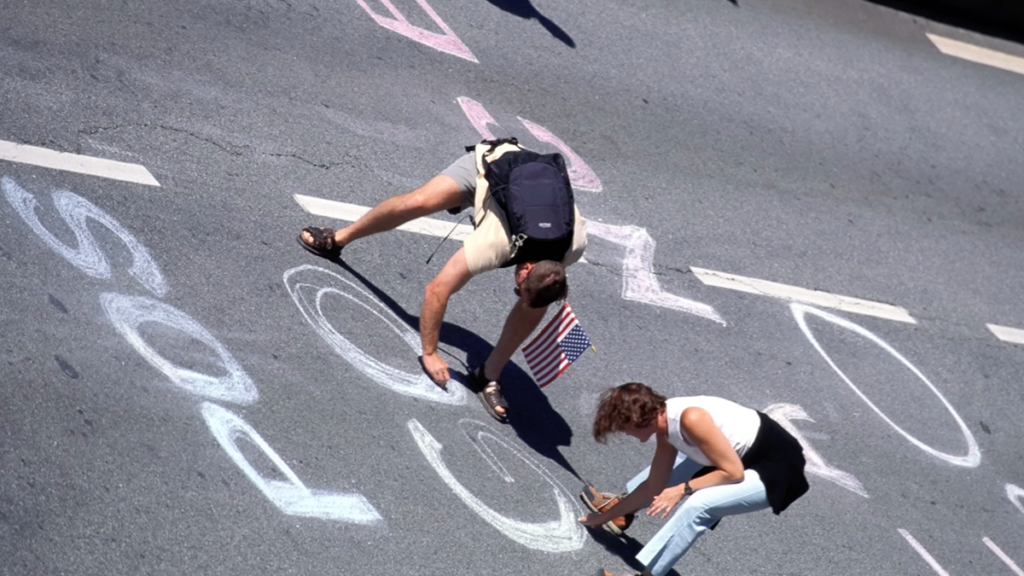
If you see any woodland creatures painted on the road, you’ll know the erasure team was there. Credit: GCN/NOS Sport
As the Tour de France begins in Barcelona, one unusual team has a job very few viewers ever think about. Before the cyclists and TV cameras arrive, they search the roads for giant penises painted on the tarmac and make them disappear.
The Tour de France team that erases rude road drawings
Patrick Dancoisne, a 65-year-old retired undertaker from north-eastern France, has spent 15 years working what may be the Tour’s strangest shift. Each morning before a stage, he and a colleague drive the route in a white van, scanning the asphalt and surroundings for obscene drawings, political slogans and unauthorised marketing messages that organisers do not want broadcast to the world.
The most common find, Patrick told L’Équipe in a 2025 profile, is anatomical. “The drawing we find most on the road is the male organ,” he said. “I turn them into owls, rabbits or butterflies. But this year, I’m making a lot of rabbits.”
The penis-to-woodland creature work is part of a wider logistical operation run by Doublet, a French company that handles signage, barriers and banners for the Tour. Patrick and his colleague are among an 80-person team that sleeps in sleeper buses, eats in mobile canteens and rebuilds the entire race infrastructure every night.
Why the job matters on live television
The Tour de France is broadcast globally across more than 190 countries and reaches an estimated 150 million viewers in Europe alone, according to the race’s official figures. Helicopter cameras and motorbike crews film the peloton from above and alongside, meaning anything painted on the road surface can end up on screen in real time.
The problem drew widespread attention in 2016, when footage of giant genitalia painted on the tarmac circulated during the broadcast. Since then, the erasure team has become a permanent fixture of the race’s behind-the-scenes operation.
Patrick told L’Équipe: “It must be remembered that the Tour is seen all over the world. It must remain clean, and above all remain a celebration.”
As previously mentioned, political messages are also targeted. In 2025, Patrick said many road slogans referenced the Israel-Gaza conflict. Those are erased. Encouraging messages for riders, declarations of love and marriage proposals are left untouched (but only the clean ones).
From rude graffiti to butterflies and owls
Patrick and his team do have to get quite creative. Because there is rarely time to scrub off the paint, he uses quick-drying white paint and a roller to transform the offending image into something harmless. One part may become a tree trunk, two circles become an owl’s eyes… The team uses around 350 litres of paint across the three-week race, according to Spanish tech site Xataka.
Sometimes speed is the only option. When graffiti is spotted at short notice, Patrick and his colleague simply paint scribbled lines over it to make the image unrecognisable before the peloton races past. On a single day during the 2024 Tour, the pair reportedly found 18 anatomical drawings, nine syringes and 30 political messages.
Patrick has become something of a cult figure on the roadside. Fans recognise him and ask for autographs. “My nickname has become ‘the eraser’,” he told L’Équipe. “There are a lot of people who ask me for autographs. It makes me laugh. It’s part of the game.”
Why the story matters in Spain today
The 2026 Tour de France starts in Barcelona on Saturday July 4, with a 19.6-kilometre team time trial from the Forum Marine Platform to Montjuic. It is the fourth time the race has visited Cataluña, following appearances in 1957, 1965 and 2009.
Barcelona City Council expects between 650,000 and 850,000 spectators for the opening stage, with major road closures across several districts. Stage 2 runs from Tarragona to Barcelona on Sunday July 5, and Stage 3 departs from Granollers on Monday July 6, heading into France.
The Generalitat de Catalunya (Catalan regional government) has activated a Special Mobility Plan, warning that roads will close approximately three hours before riders pass through and reopen around one hour after the last cyclist.
For anyone watching the Barcelona stages on television, the tarmac will look spotless. However, if you happen to see any cute rabbits, butterflies, or owls painted on the road, you’ll know ‘the eraser’ has been at work.
Follow Euro Weekly News on Google News
Get breaking news from Spain, travel updates, and expat stories directly on your Google News feed.
Follow on Google NewsSign up for personalised news
Subscribe to our Euro Weekly News alerts to get the latest stories into your inbox!
By signing up, you will create a Euro Weekly News account if you don't already have one. Review our Privacy Policy for more information about our privacy practices.
Harry Dennis
Born in the UK and raised on the Cádiz coast, Harry brings his background in design, music, and photography to his writing for Euro Weekly News, sharing stories that celebrate culture and lifestyle across Spain and beyond.
Comments