A new island could appear where there was only ocean just weeks ago
By Farah Mokrani • Published: 12 Jul 2026 • 23:52 • 4 minutes read
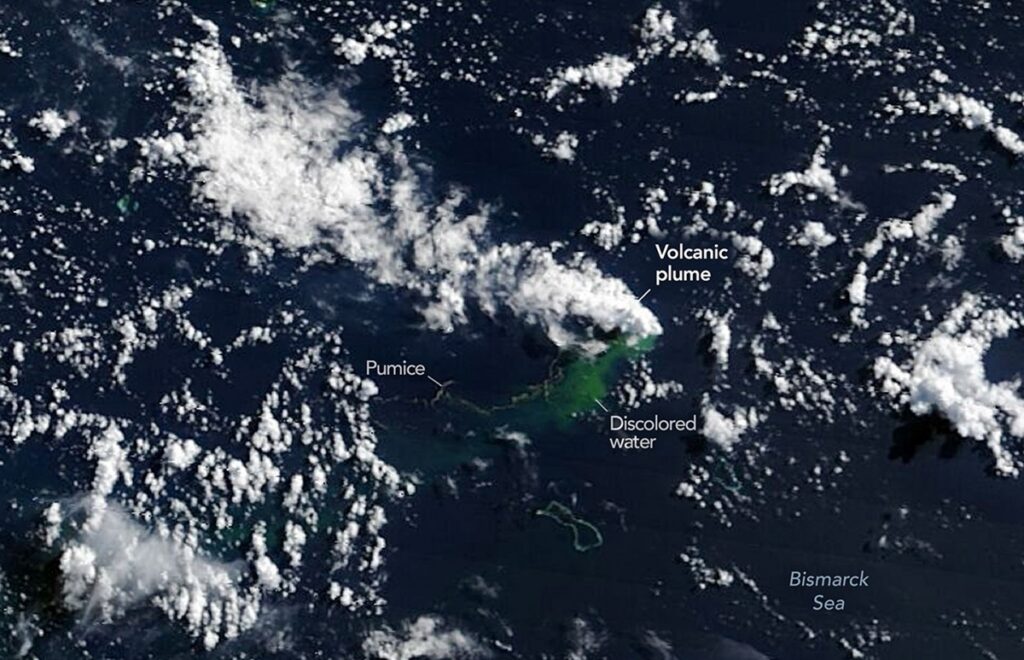
Satellite imagery captured the underwater eruption that could eventually create a new island in the Bismarck Sea. Credit : science.nasa.gov
Imagine waking up to the news that the Earth has created a brand new island. It sounds like something from a science fiction film, but it’s a real possibility unfolding right now beneath the waters north of Papua New Guinea. Since 8 May 2026, an underwater volcano in the Bismarck Sea has been erupting, and scientists say the activity could eventually push enough volcanic material above sea level to create entirely new land.
For now, no island has appeared. But satellites have captured steam rising from the ocean, patches of strangely coloured water and signs that magma is sitting just below the surface. It’s the kind of event that volcanologists rarely get the chance to follow as it happens, and every new satellite image is helping them piece together the story.
What is happening beneath the sea and why are scientists so excited?
Most volcanic eruptions happen out of sight.
When they occur beneath the ocean, especially in remote parts of the world, they can go unnoticed for days or even weeks. This eruption is different because modern satellites spotted it almost immediately.
The first signs appeared on 8 May, when a series of small earthquakes suggested something was happening below the seabed. It wasn’t long before NASA satellites Aqua and Terra recorded large plumes of steam rising from the ocean. Another satellite, PACE, detected unusual areas of discoloured water spreading around the eruption site, while the VIIRS instrument picked up strong thermal anomalies covering about seven square kilometres. Those heat signatures indicate that very hot magma has risen close to the sea surface.
Later, high resolution images from Sentinel 2 and Landsat 9 revealed several points where steam and ash were breaking through the water, confirming that the eruption is taking place in relatively shallow seas.
For researchers, that’s what makes this event so valuable. Instead of trying to reconstruct what happened weeks later, they are able to watch the eruption develop almost as it happens.
Could a new island really form?
When enough lava and volcanic material build up on the seabed, they can eventually break through the ocean surface and create an island. It has happened before in different parts of the world, although it’s far from a common sight.
Scientists say that’s one possible outcome of the current eruption.
At the moment, long streams of floating pumice have already been seen drifting away from the site, carried by surface currents. That tells researchers that large amounts of volcanic material are already reaching the ocean surface.
If the eruption continues for long enough, those deposits could gradually pile up until dry land appears.
The question is what happens next.
New volcanic islands often begin life as loose piles of ash and rock. Waves and strong currents can wear them away surprisingly quickly, sometimes within months or even weeks.
On the other hand, if enough solid lava accumulates, the island could become much more resistant and remain above sea level for years or even longer.
No one can say yet which of those scenarios will play out in the Bismarck Sea.
Scientists are also keeping an eye on another possibility. If seawater reaches rising magma in the right conditions, it can produce powerful steam explosions. Even so, volcanologists believe the overall risk of a major explosive event remains relatively limited because this eruption is linked to a spreading ridge, where volcanic activity is generally less violent than in subduction zones.
One of the least understood volcanic regions on Earth
One reason researchers still have so many unanswered questions is that this part of the Bismarck Sea has never been studied in great detail.
The eruption is taking place along a geological ridge roughly 16 kilometres from another eruption recorded in 1972, but scientists still cannot say with certainty which underwater volcano is responsible.
The seabed here is anything but simple. It contains volcanic structures, geological faults, areas where tectonic plates are slowly pulling apart and nearby subduction zones. Much of it remains poorly mapped, making it difficult to identify the exact source of the eruption or compare it with previous events.
That uncertainty is why satellites have become such an important tool.
Instead of waiting for research vessels to reach the area, scientists can monitor changes from space almost every day. They can measure surface temperatures, track steam plumes, map floating pumice and observe how the eruption evolves without setting foot on a ship.
If an island appears, the story will only be beginning
For most people, the appearance of a new island would be the headline. For scientists, it would mark the start of years of research.
A newly formed island offers a rare chance to watch nature begin again from scratch. Researchers can study how waves reshape the coastline, how rain and wind slowly erode volcanic rock and how the first living organisms arrive.
Seeds carried by the wind, seabirds searching for a place to rest and marine life returning to the surrounding waters all become part of the story.
NASA scientist Jim Garvin has already said that future observations could use data from the NISAR and RADARSAT satellite missions to monitor any new land if it emerges above the sea.
What remains impossible to predict is how long the eruption itself will last.
History offers very different examples. An eruption in the same region in 1972 ended after only four days, while another nearby volcanic episode continued for almost four years.
That uncertainty is part of what has captured the attention of volcanologists around the world.
For now, the world is watching a patch of ocean where the landscape may be changing beneath the waves. Whether it ends with a brand new island or simply another chapter in the region’s long volcanic history, scientists have a rare opportunity to observe one of Earth’s most remarkable natural processes as it unfolds.
Follow Euro Weekly News on Google News
Get breaking news from Spain, travel updates, and expat stories directly on your Google News feed.
Follow on Google NewsSign up for personalised news
Subscribe to our Euro Weekly News alerts to get the latest stories into your inbox!
By signing up, you will create a Euro Weekly News account if you don't already have one. Review our Privacy Policy for more information about our privacy practices.



Farah Mokrani
Farah is a journalist and content writer with over a decade of experience in both digital and print media. Originally from Tunisia and now based in Spain, she has covered current affairs, investigative reports, and long-form features for a range of international publications. At Euro Weekly News, Farah brings a global perspective to her reporting, contributing news and analysis informed by her editorial background and passion for clear, accurate storytelling.
Comments