White circles on tight curves introduced to improve motorcyclist safety in Spain
By Elli Freeman • Published: 06 Aug 2026 • 11:08 • 2 minutes read
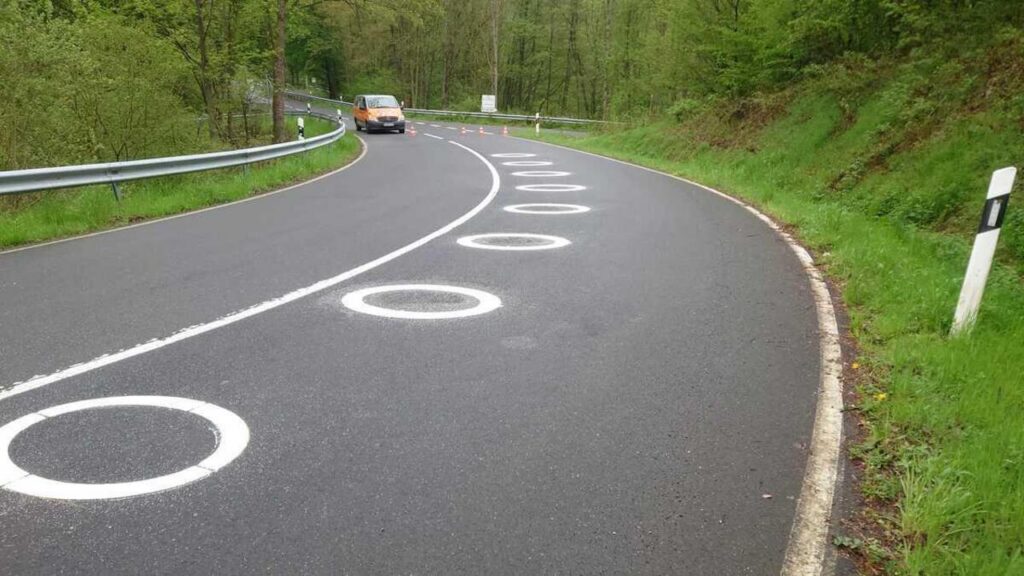
Caption: White circles painted on curves for motorcyclist safety Credit: ISAC - Institute of Highway Engineering
Drivers travelling along some of Spain’s most challenging roads may soon notice white circles painted on the asphalt, as the DGT introduces new road markings designed to improve motorcycle safety. The new white circles, which are being rolled out on dangerous bends, are intended to warn riders of upcoming hazards and encourage a safer riding line through tight curves, helping to reduce the number of serious and fatal motorcycle accidents.
In 2025, 304 motorcyclists died on Spain’s roads, according to the Spanish Association of Automotive Professionals, marking the highest number of rider fatalities in a decade. With motorcyclists remaining one of the country’s most vulnerable groups of road users, reducing accidents and protecting bikers has become one of the DGT’s key road safety priorities.
How the new white circles improve motorcycle safety
The white circles are placed before or along particularly dangerous bends, close to the centre line. Rather than acting as a lane marking, they provide a visual guide that encourages riders to adopt a safer position through the corner.
Upon seeing the circular markings, motorcyclists are advised to keep to the outside of the circles instead of riding close to the centre line. This helps prevent riders from leaning into the path of oncoming traffic, a common risk on left-hand bends where a rider’s upper body can cross the centre line even if the motorcycle itself remains within its lane. The markings also serve as a subtle reminder to reduce speed before entering the corner.
Why the DGT is introducing the markings
The initiative follows years of research into motorcycle accidents on conventional roads, where the vast majority of fatal crashes occur. According to the DGT, between 75 and 80 per cent of motorcyclist fatalities happen on these roads, with almost half involving riders leaving the carriageway while negotiating bends.
The white circles are based on a system first developed in Austria, where road safety experts tested various pavement markings, including bars and elliptical shapes, to influence riders’ positioning through high-risk corners. The markings are designed to improve riders’ line through a bend without introducing additional signs or complicated instructions.
Austria’s results offer encouraging signs
The Austrian trials produced striking results. Researchers monitored 19 high-risk bends in the Tyrol region after introducing the markings and recorded an 80 per cent reduction in motorcycle injury accidents compared with the period before installation. While the figures relate to specific test locations rather than every road, the findings have attracted the attention of road authorities across Europe.
The success of the Austrian scheme has prompted countries to evaluate similar road markings as part of wider motorcycle safety programmes. Some pilot schemes have already been carried out in Catalonia, while the DGT has previously tested other measures such as perpendicular white lines, known as ‘batons’, to help riders judge a safer line and encourage lower speeds when approaching bends.
Although the new circles do not introduce any additional legal obligations, road safety experts hope they will become another simple but effective tool to reduce collisions on some of Spain’s most dangerous stretches of road.
Follow Euro Weekly News on Google News
Get breaking news from Spain, travel updates, and expat stories directly on your Google News feed.
Follow on Google NewsSign up for personalised news
Subscribe to our Euro Weekly News alerts to get the latest stories into your inbox!
By signing up, you will create a Euro Weekly News account if you don't already have one. Review our Privacy Policy for more information about our privacy practices.



Elli Freeman
Originally from the UK, Elli has lived in Spain for more than half of her life. She holds a B.A in English Literature and Creative Writing. Before joining the Euro Weekly News team, Elli was an avid traveller, with a keen interest in exploring new cultures.
Comments