Granada aftershocks keep coming: Where could Spain’s next big quake hit & how strong might it be?
By Adam Woodward • Published: 20 Aug 2026 • 23:13 • 3 minutes read
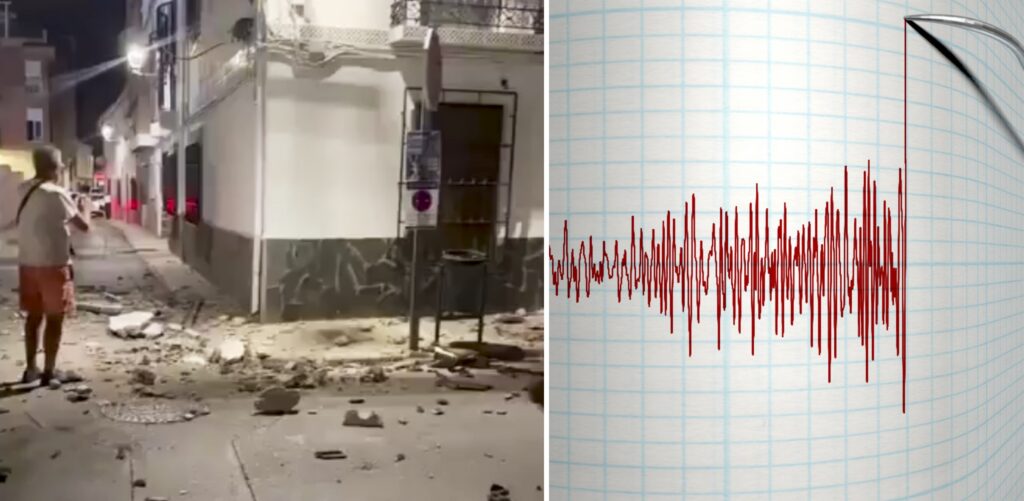
Debris fallen after Granada quake Credit: RI X & Inked Pixels - Shutterstock
Granada province continues to shake with aftershocks after this week’s powerful tremors that left three people hurt and caused damage across the area, including to the Alhambra. Andalucian president Juanma Moreno has told residents this is not over and that everyone should stay ready for more activity in the days and weeks ahead. But when and where will the next big quake be in Spain?
Further smaller jolts have been felt across the province yesterday, keeping locals on edge following the sequence that began last week. Moreno noted faults are still settling and tremors could run on for another week or fortnight, urging people to review safety advice and prepare for the possibility of something larger.
🌍 ¿Por qué #Granada es una de las zonas de España con mayor peligrosidad sísmica?
Los terremotos registrados estos días en Granada vuelven a poner el foco en la actividad sísmica de esta zona de la Península.
🔴 El Mapa de Peligrosidad Sísmica de España del IGN muestra que… pic.twitter.com/3JHteCVGdV
— Instituto Geográfico Nacional-O.A.CNIG (@IGNSpain) August 20, 2026
Why southeast Spain is still the main risk zone
Most of Spain’s seismic activity clusters in the southeast, where the African and Eurasian tectonic plates meet. This collision zone runs roughly from Almeria through to Alicante and takes in large parts of Granada, Malaga and Murcia. Data from the Instituto Geografico Nacional shows nearly 18,000 quakes recorded in the nearby Alboran Sea over the past 25 years alone.
Long active faults such as Palomares and Carboneras in Almeria, plus the Alhama fault in Murcia, have the potential to produce events close to magnitude 7 if they rupture fully. University of Granada researcher Daniel Stich has pointed out these structures are lengthy enough to release considerable energy. Geologist Hector Perea has spoken of a major structure propagating northwards that will generate future quakes, though no one can say when.
Historical records back this up. Of the 30 strongest quakes on the Iberian Peninsula, only eight fell outside the southeast. Past disasters include the 1522 event that killed around 2,500 people in the Almeria-Granada area and the 1804 Almeria quake of magnitude 6.3 that claimed nearly 500 lives. The 2011 Lorca tremor, of magnitude 5.1, though moderate on paper, proved deadly because it struck at a very shallow depth right under the town.
Other areas under watch
Pyrenees regions form the next most active belt because of the ongoing push between the Iberian and Eurasian plates. Galicia sees occasional activity linked to local faults, while the Gulf of Cadiz and areas near Portugal carry the risk of larger offshore events. Canary Islands activity tends to link more to volcanic processes.
What experts say about size and timing
Scientists stress prediction is still pretty impossible. The National Seismic Network says nothing can be ruled out, including another Lorca-style shallow event. Magnitude 7 is still within the capability of the longer faults, yet most activity stays smaller. Building codes introduced from 2003 onwards give modern structures better resistance, but older buildings and shallow hypocentres still raise concern.
Alhambra closure and injured three
Inspections have confirmed no major structural damage at the Alhambra after the recent quakes, allowing most of the complex to reopen to visitors from Wednesday with adapted routes through the Nasrid Palaces and Generalife designed for faster evacuation if more tremors occur. The Alcazaba stays closed for now as a precaution, and only minor issues such as cracks in decorative plasterwork were noted in limited spots. All three people hurt on Tuesday suffered light injuries; one minor was taken to hospital for checks, but the cases are still minor with no reports of serious ongoing concerns.
Residents across the southeast are advised to keep emergency kits ready, know safe spots in their homes, and follow updates from official channels. Activity will continue, but staying informed and prepared reduces the impact when the ground next moves.
Follow Euro Weekly News on Google News
Get breaking news from Spain, travel updates, and expat stories directly on your Google News feed.
Follow on Google NewsSign up for personalised news
Subscribe to our Euro Weekly News alerts to get the latest stories into your inbox!
By signing up, you will create a Euro Weekly News account if you don't already have one. Review our Privacy Policy for more information about our privacy practices.



Adam Woodward
Adam is a writer who has lived in Spain for over 25 years. With a background in English teaching and a passion for music, food, and the arts, he brings a rich personal perspective to his work at Euro Weekly News. As a father of three with deep roots in Spanish life, Adam writes engaging stories that explore culture, lifestyle, and the everyday experiences that shape communities across Spain.
Comments