Almería wildfire stabilised after 22 hours as evacuated residents return home
By Harry Dennis • Published: 25 Aug 2026 • 17:59 • 2 minutes read
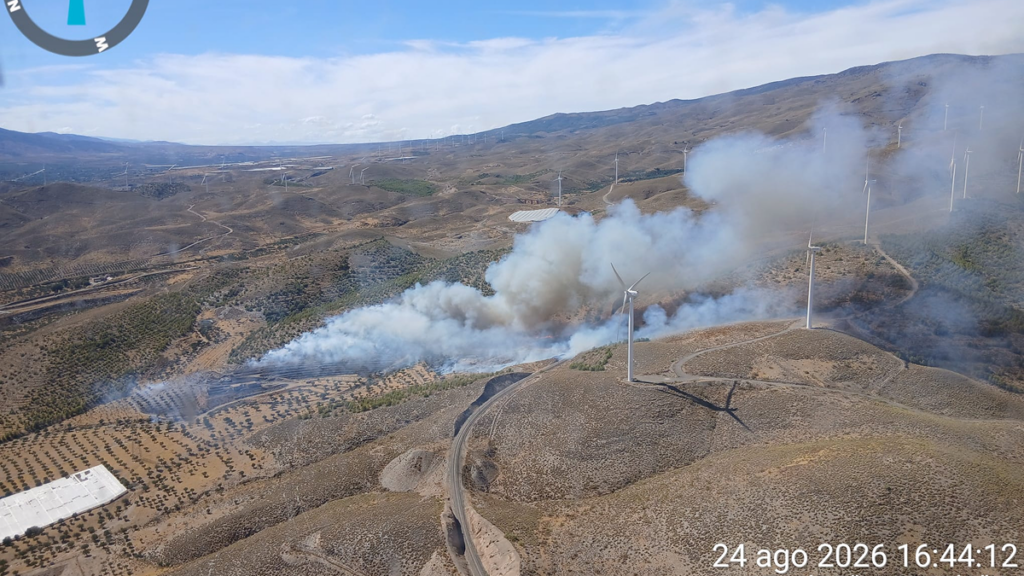
Smoke billows over the hills above Las Tres Villas as Almería's wildfire spread on Monday evening. Credit: Plan INFOCA / X
Families who spent the night away from home in Las Tres Villas were finally able to return on Tuesday afternoon. The wildfire that forced them out and halted trains through Almería has now been declared stabilised, though firefighters say full control is still some way off.
Level 1 emergency downgraded as fire declared stabilised
The Junta de Andalucía declared the Las Tres Villas wildfire stabilised at 2pm on Tuesday, almost 22 hours after it broke out, and downgraded the region’s response from a Level 1 emergency to a lower “pre-emergency” footing. Antonio Sanz Cabello, the regional Presidency and Interior minister who activated the original emergency, said stabilised meant the fire was “evolving favourably” even though it remained short of being fully controlled. Crews were continuing to consolidate the fire’s perimeter and check for hot spots that could reignite.
Fire broke out near a wind farm and spread towards Nacimiento
The blaze took hold at around 4pm on Monday August 24 in the Doña María area of Las Tres Villas, a small municipality of about 547 people in inland Almería, close to a wind farm. Flames quickly gained ground and pushed towards the neighbouring municipality of Nacimiento before firefighters began to gain the upper hand overnight.
Eight confined, nine evacuated, all now back home
Seventeen residents had been affected as a precaution while the fire advanced. Eight people were confined to their homes in the hamlets of Gilma and Los Sanchos and nine more moved away from scattered settlements altogether. With the fire stabilised, all were able to return home or rejoin family on Tuesday afternoon, and the road linking Las Piletas, Gilma and Los Sanchos reopened to traffic.
Rail services on the Almería-Linares-Baeza line, suspended on Monday evening after flames reached the tracks near Abla-Abrucena and Doña María-Ocaña, had already resumed by 9am on Tuesday.
Nearly 100 firefighters and seven helicopters tackled the blaze
At the height of the operation, close to 100 ground and aerial resources were mobilised, including seven helicopters, four water and retardant aircraft, 66 forest firefighters and four reinforcement brigades, working from an advanced command post at Las Tres Villas’ ITV testing centre.
By the time the fire was stabilised on Tuesday afternoon, the operation had scaled back to 84 EMA-INFOCA personnel, five fire engines, a medical unit for forest fires and two cargo aircraft, alongside more than 40 Guardia Civil officers who had helped secure the area throughout.
What ‘stabilised’ means, and what happens next
In Spain’s official wildfire classification, “stabilised” is a distinct stage short of “controlled” and, eventually, “extinguished” – it means firefighters have stopped the fire’s active fronts from advancing, without yet having the blaze fully boxed in. The burnt area is put at more than 300 hectares, though Plan INFOCA said a definitive figure would only follow full extinction.
The fire comes during one of Spain’s worst wildfire summers on record, with more than 260,000 hectares burned nationally so far this year, including the deadly blaze near Los Gallardos, also in Almería province, which caused a total of 14 deaths in July. Crews at Las Tres Villas said their focus now was on preventing any flare-up before the fire can be declared fully under control.
Follow Euro Weekly News on Google News
Get breaking news from Spain, travel updates, and expat stories directly on your Google News feed.
Follow on Google NewsSign up for personalised news
Subscribe to our Euro Weekly News alerts to get the latest stories into your inbox!
By signing up, you will create a Euro Weekly News account if you don't already have one. Review our Privacy Policy for more information about our privacy practices.


Harry Dennis
Born in the UK and raised on the Cádiz coast, Harry brings his background in design, music, and photography to his writing for Euro Weekly News, sharing stories that celebrate culture and lifestyle across Spain and beyond.
Comments