More than 160 migrants reach Murcia in one week as Guardia Civil’s fast patrol boat sits broken
By Harry Dennis • Updated: 26 Aug 2026 • 13:58 • 2 minutes read
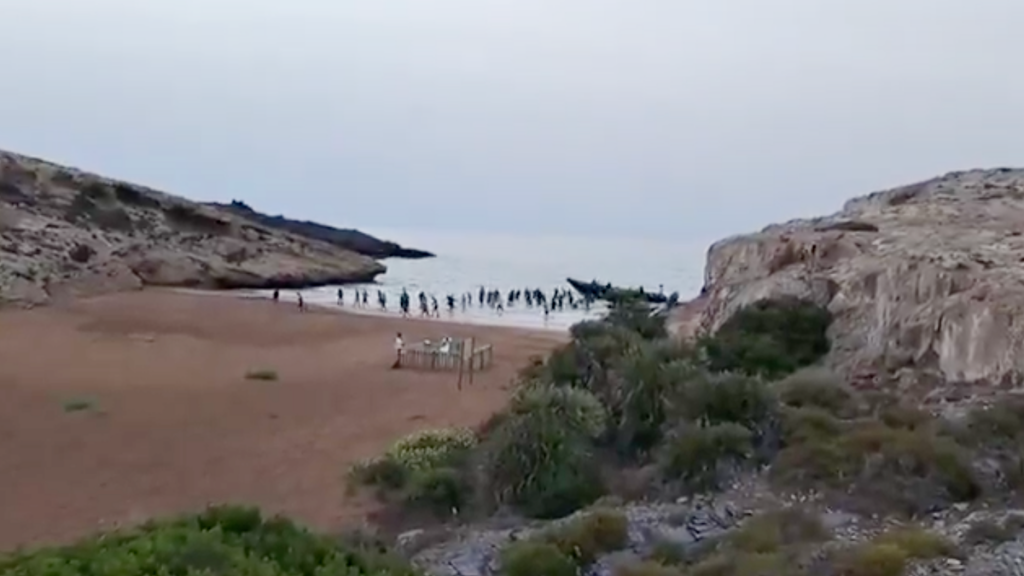
Migrants wade ashore after a speedboat lands on the Murcia coast. Credit: Fernando López Miras / X.
A third boat packed with migrants reached Murcia’s coast on Wednesday August 26, and officers had no way of stopping it. The region’s only rapid patrol boat has sat broken for a week, leaving speedboats free to land in broad daylight while a slower replacement watches from the shore.
The third boat in a week reaches Murcia’s coast unopposed
A speedboat carrying around 50 migrants landed on the Cartagena coast on Wednesday August 26, the third such arrival on the same stretch of coastline in exactly seven days. Officials described the vessel similarly to the two that came before it as a fast, high-powered craft of the kind normally associated with drug trafficking, rather than a traditional wooden patera.
Otra lancha rápida con inmigrantes ha llegado esta mañana a las costas de la #RegióndeMurcia con total impunidad.
Ante la gravedad de la situación, el Consejo de Gobierno se reúne mañana en Cartagena.
La dejación de funciones del Gobierno de España es inadmisible, no puede ser… pic.twitter.com/ZAKvsmjgg7
— Fernando López Miras (@LopezMirasF) August 26, 2026
The first boat landed at Cala del Barco on Wednesday August 20, carrying 62 people, including 15 children, and sent sunbathers scrambling for their cars. A second boat put around 50 people ashore near Cala Reona on Saturday August 22, taking the total past 110. Wednesday’s arrival brings the running total for the entire week to more than 160.
Murcia’s only rapid patrol boat has been broken for a week
Behind all three landings sits the same problem. The Region of Murcia’s sole fast patrol boat capable of chasing down these speedboats has been out of service since around the time the first boat arrived, with no confirmed date for it to return to duty.
Spain’s SIVE coastal radar system keeps detecting the boats as they approach, but without a vessel fast enough to respond, officers have had little choice but to wait until migrants come ashore and search the surrounding hills and coves, rather than intercept them at sea.
Replacement boat sent from Barcelona is ‘too slow’ for the job
A stand-in vessel was sent down from Barcelona to cover the gap, but the Asociación Unificada de la Guardia Civil (AUGC), the officers’ union, said it is simply not built for the job. The union said the boat is suited to patrol and surveillance duties only, lacking the speed to pursue the high-powered narco-style boats now landing on the coast, and has called for a second rapid boat to be sent to the region.
López Miras accuses Madrid of leaving the coast to ‘total impunity’
Region of Murcia president Fernando López Miras wrote to Prime Minister Pedro Sánchez on Monday August 24 demanding urgent reinforcements, including more Guardia Civil personnel and better technology such as radar, sensors and drones. “The mafias are arriving on Murcia’s coast with total impunity,” López Miras said, adding that the region was not dealing with wooden cayucos but organised narco-speedboats reaching the shore “in broad daylight, in the middle of a beach day, among residents.” He called the broken patrol boat “inadmissible” and said the past week’s scenes had generated real fear among locals.
His letter cites 23 children who arrived by boat in the week to Monday alone, on top of 132 in July and more than 500 by sea in the region so far this year.
Cartagena’s mayor warns arrivals have become ‘permanent’
Cartagena mayor Noelia Arroyo has echoed the criticism, describing the landings as “not isolated, but permanent” and arriving “with absolute impunity.” She said there was “clearly fear, clearly a sense of defencelessness” among residents and holidaymakers, and is pushing for boats to be intercepted at sea before they ever reach the beach.
The Interior Ministry has not yet issued a public response to López Miras’s letter or to Wednesday’s landing. With the region’s only rapid patrol boat still out of action, whether a fourth boat is intercepted or simply allowed to land may come down to how quickly it is repaired or replaced.
Follow Euro Weekly News on Google News
Get breaking news from Spain, travel updates, and expat stories directly on your Google News feed.
Follow on Google NewsSign up for personalised news
Subscribe to our Euro Weekly News alerts to get the latest stories into your inbox!
By signing up, you will create a Euro Weekly News account if you don't already have one. Review our Privacy Policy for more information about our privacy practices.



Harry Dennis
Born in the UK and raised on the Cádiz coast, Harry brings his background in design, music, and photography to his writing for Euro Weekly News, sharing stories that celebrate culture and lifestyle across Spain and beyond.
Comments