Bones found in burnt car of British wildfire couple spark Guardia Civil complaint in Almería
By Harry Dennis • Published: 05 Sep 2026 • 11:36 • 2 minutes read
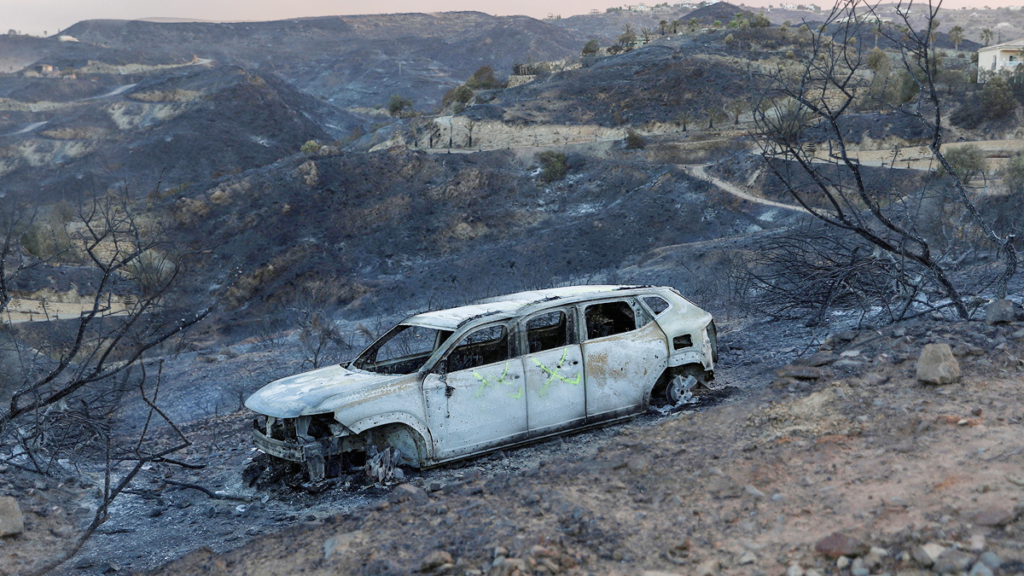
One of the burnt-out vehicles left after the wildfire tore through the Almería landscape. Credit: ataurrahmanstudio / Shutterstock
A bone that looked like part of a human hip was still sitting on the passenger seat, months after Guardia Civil said the burnt-out car held nothing at all. Now Danielle Gillam-Kirton wants to know who, or what, was actually cremated after her parents died in July’s Almería wildfire.
Daughter searches the burnt-out car herself
Danielle Gillam-Kirton had been told there was nothing left to find. Guardia Civil officers said the burnt-out car belonging to her parents, Pete and Fran Gillam, had been inspected meticulously after last July’s wildfire and contained no human remains.
When the assistant headteacher, from Nottinghamshire, searched the vehicle herself at a police compound in Mojácar last month, she found a bone that appeared to be part of a human hip on the front seats, along with further bone fragments, two mobile phones, keys, jewellery and money. “I honestly can’t describe what that felt like,” she told The Guaridan.
Pete and Fran Gillam died in the Bédar wildfire
The couple were among the 14 people who died when the wildfire tore through Los Gallardos and Bédar in July, one of Spain’s worst wildfire disasters in recent years. Fran, a former headteacher, and her husband Pete had built a retirement home in the area, where they were known for organising school fundraising quiz nights and playing padel at a nearby sports club.
Their car was recovered from the El Curato area of Bédar, where the couple are believed to have tried to escape the flames. A cremation had already taken place before the further bones were found.
‘Then who did we cremate?’
Ms Gillam-Kirton has now lodged a formal complaint against the Guardia Civil, though not against any named officers, disputing the force’s account that the car had been thoroughly searched. She has also asked the UK Foreign Office to press Spanish authorities for answers.
“Then who or what did we cremate?” she said, after finding bones her family had been told did not exist. An independent forensic expert consulted by the family said photographs of the remains were consistent with human bone, contradicting Guardia Civil’s initial suggestion that they probably belonged to an animal.
DNA testing still not complete weeks later
The bones were sent for DNA analysis, but the results had still not been made public more than a fortnight later. That delay, along with the discovery of personal belongings still inside the vehicle, forms the basis of the family’s complaint.
A Foreign Office spokesperson said it was supporting the family of a British couple who died in Spain, while stressing that the investigation into the fire and the handling of the remains remains a matter for the Spanish authorities.
Wildfire’s toll still being felt months later
The Gillams were two of the 14 people who died after the wildfire swept through Almería province in July, including eight British nationals alongside Belgian, French, Spanish and American victims.
In the UK, an inquest into the death of another British holidaymaker killed in the same fire, Essex care worker Lisa Fryett, opened at Chelmsford Coroner’s Court last month, with a full hearing still to come.
With the cause of the fire still under investigation and DNA results still awaited, the Gillam family says it has yet to receive a clear account of how their parents died, or whose remains were returned to them for the funeral that followed.
Follow Euro Weekly News on Google News
Get breaking news from Spain, travel updates, and expat stories directly on your Google News feed.
Follow on Google NewsSign up for personalised news
Subscribe to our Euro Weekly News alerts to get the latest stories into your inbox!
By signing up, you will create a Euro Weekly News account if you don't already have one. Review our Privacy Policy for more information about our privacy practices.




Harry Dennis
Born in the UK and raised on the Cádiz coast, Harry brings his background in design, music, and photography to his writing for Euro Weekly News, sharing stories that celebrate culture and lifestyle across Spain and beyond.
Comments